
Water Softener in Lucknow: Price, Size & Local Buying Guide
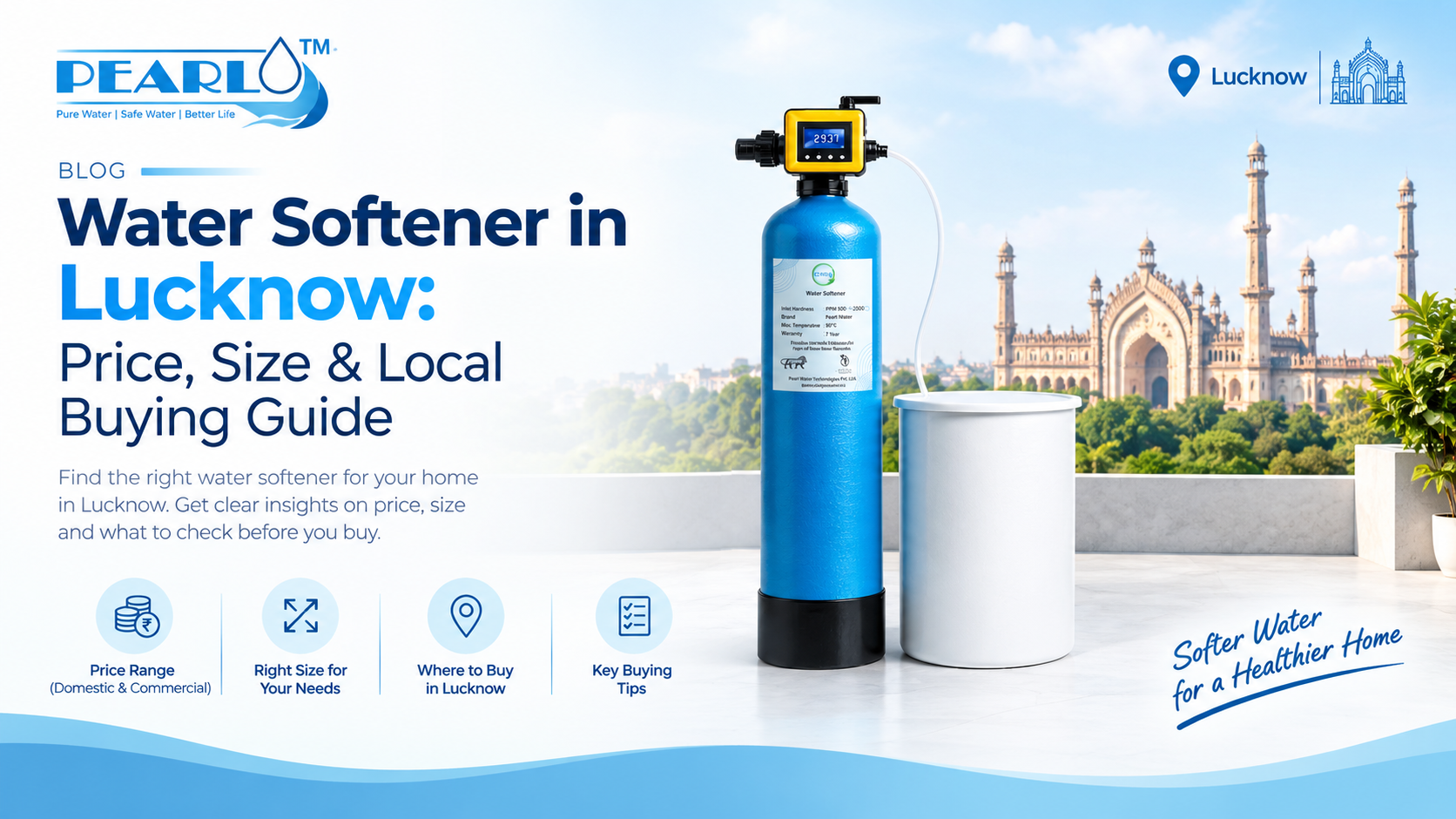
By Pearl Water Technologies, Lucknow branch · Published 28 September 2026 · Updated 18 November 2026
Quick answer: is Lucknow water hard, and do you need a softener?
Often yes, mainly borewell water, though it is less extreme than in some cities. Pearl Water's readings across 12 residential and commercial zones in Lucknow run 97 to 350+ ppm total hardness, from moderately hard to very hard, against a BIS acceptable limit of 200 ppm. If your tap reads above about 180 ppm, a fully automatic water softener is worth fitting. A 1000 LPH unit suits most 2–3 bathroom flats, 2000 LPH or more suits kothis and villas, and hostels and PGs need a unit sized to daily litres. Test your tap first, then size the unit.
Key takeaways
- Hardness varies by locality, borewell depth and whether your tank mixes borewell and Jal Sansthan supply, so there is no single city-wide number.
- A TDS meter does not measure hardness. Test total hardness in ppm as CaCO3.
- A softener protects the geyser, pipes, washing machine and clothes. It does not lower TDS, so keep an RO tap for drinking.
- Lower hardness means less frequent regeneration. At 250 ppm a typical family unit regenerates about every 7 to 11 days.
How hard is Lucknow's water? Hardness levels against BIS limits
Lucknow water ranges from moderately hard to very hard depending on where you live and where your water comes from. BIS IS 10500:2012 sets 200 ppm as the acceptable limit and 600 ppm as the permissible limit where no alternative source exists.
| Total hardness (ppm as CaCO3) | Class | What you usually see | What to do |
|---|---|---|---|
| 0–60 | Soft | Nothing | Nothing |
| 61–120 | Moderately hard | Light spotting on glass | Optional |
| 121–180 | Hard | Scale on taps, thinner lather | Consider a geyser or bathroom unit |
| 181–600 | Very hard | Heavy scale, early geyser failure, stiff laundry | Whole-house softener |
| Above 600 | Very hard, beyond the BIS permissible limit | The same, faster | Softener rated for high inlet hardness, plus a lab test |
Pearl Water's Lucknow readings of 97 to 350+ ppm span the second to fourth rows, which is why testing your own tap matters more than your colony's reputation.
What do independent studies say?
A 2023 study of 40 Lucknow groundwater samples, published in the journal Water, found total hardness of 190 to 495 mg/L, within the BIS permissible limit but spanning the 200 mg/L acceptable limit. It described the water as moderately hard, especially in the central region. The same samples showed TDS of 300 to 1,090 mg/L, above the BIS acceptable limit of 500 mg/L at the high end. The study sampled 40 points, so treat it as a reason to test, not as your own result.
Why does Lucknow groundwater carry hardness and TDS?
Lucknow sits on the Gangetic alluvial plain, so groundwater picks up dissolved minerals from the soil as it moves. As the water table drops, borewells are drilled deeper, and deeper water tends to carry more dissolved salts. That is why two lanes in the same colony can report very different water.
Where Lucknow's household water comes from, and how to test yours
Most Lucknow homes use Jal Sansthan supply, a private borewell, or both. If your overhead tank takes water from both, the tap reading can vary, so test from the tank outlet or the tap you actually use.
Signs your Lucknow home has hard water
- White crust around the tap mouth, showerheads and the geyser element
- Cotton and chikankari kurtas coming out of the wash stiff, dull or scratchy
- Geyser elements burning out within a couple of years
- Cloudy white patches on steel sinks, glass shower panels and dark tiles
- Hair that feels rough even after conditioner
Which number should you test: TDS or total hardness?
Test total hardness in ppm as CaCO3. A TDS meter counts all dissolved salts, so two waters with the same TDS can have very different hardness. Use a total hardness strip or titration kit, or bring a sample bottle to our Lucknow branch for a test.
A water softener does not reduce TDS. It swaps calcium and magnesium for sodium, so TDS stays about the same and can edge up slightly. That matters in Lucknow, where independent samples have shown TDS well above 500 mg/L.
For step-by-step testing, read how to check water hardness at home and how to tell if your area has hard water. For TDS targets, see the recommended TDS level for RO water.
What size water softener do you need? The three-number method
Size a softener from three numbers: daily litres, inlet hardness and resin volume. The LPH on the label is a flow rate, not a daily capacity.
- Daily litres. Multiply people by about 135 L, the CPHEEO urban supply norm. A family of 4 is roughly 540 L a day.
- Daily hardness load. Litres × ppm ÷ 1000 gives grams of hardness per day. 540 L at 250 ppm is 135 g a day.
- Resin volume. As a rule of thumb, each litre of cation resin removes about 40–60 g of hardness between regenerations at typical salt doses. A unit with 25 L of resin holds roughly 1.0–1.5 kg, so at 135 g a day it regenerates about every 7 to 11 days.
Then check peak flow. 1000 LPH is about 16.7 litres a minute, and a typical shower uses roughly 8–12 litres a minute.
| Home type | Typical daily use | Starting point | Step up if |
|---|---|---|---|
| Flat, 2–3 bathrooms, 3–5 people | 405–675 L | 1000 LPH fully automatic | Hardness is at the top of the 97–350+ ppm range |
| Kothi or villa, 4+ bathrooms | 700 L and above | 2000 LPH or higher | There is a garden, rooftop tank loop or staff quarters |
| Hostel, PG, guest house, small hotel | Sized on total daily litres and peak flow | Customised unit | Hot water runs all day |
| Only the geyser scales up | Hot water only | 250 LPH geyser softener | Hardness is above its rated inlet level of about 400 ppm |
Unlike in much harder cities, a geyser-only unit can work for many Lucknow readings, because most fall below its rated inlet hardness. Above 400 ppm, step up to a 1000 LPH unit. For a deeper comparison, read our guide to 1000 vs 2000 vs 3000 LPH softener capacity.
Which water softener suits your kind of home in Lucknow?
We have not measured every colony, so this table goes by house type, not by claims about each area's water.
| Where you live | Home type | What we usually suggest |
|---|---|---|
| Gomti Nagar, Gomti Nagar Extension, Vibhuti Khand | Apartments, duplexes, towers | 1000 LPH automatic on the flat inlet. Check the drain point and get society approval first. |
| Aliganj, Indira Nagar, Mahanagar, Rajajipuram | Independent houses with roof tanks | 1000 to 2000 LPH on the line from the tank, so the geyser and washing machine are covered. |
| Jankipuram, Kanpur Road, Alambagh, Chinhat | Independent houses, growing colonies | Match the size to your borewell water reading. Add sediment filtration if the water is muddy. |
| Sushant Golf City, Shaheed Path, Raebareli Road, Faizabad Road | Villas, townships, larger plots | 2000 LPH or above for many bathrooms, or a central unit for a cluster. |
| Hazratganj, Chowk, older city areas | Older buildings, older pipes | A small or geyser-only softener. Inspect the plumbing before fitting a big unit. |
Softeners we recommend for Lucknow homes
- 1000 LPH fully automatic, inlet hardness up to 1500 ppm: 2–3 bathroom flats on hard borewell water
- 1000 LPH Pearl Lite series: the tighter-budget option for normal home use
- 2000 LPH fully automatic, up to 1500 ppm: kothis and villas
- 250 LPH geyser softener, inlet hardness up to 400 ppm: when only the geyser is suffering and hardness is moderate
Full range on the water softeners page.
What about PGs, hostels, hotels and hospitals in Lucknow?
Lucknow has many student hostels, PGs, guest houses, small hotels and clinics. These places use water and hot water all day, and scale eats into boilers, geysers and laundry machines fast. Sizing depends on total daily litres and peak flow, not bathroom count, so it is usually a customised unit. Explore our commercial water softeners and industrial RO range, or read our society water softener guide. Call us with your daily usage and we will size it: +91-8588022991.
Do you need a softener and an RO in Lucknow?
Usually both when borewell TDS is high. A softener protects pipes, the geyser, clothes and the RO membrane from scale. An RO purifier on the kitchen line handles drinking water. See softener vs RO plant and softener vs purifier for home, or browse RO water purifiers and book RO service.
Is softened water safe to drink?
Softening adds sodium, about 0.46 mg for every 1 mg/L of hardness removed. Removing 300 ppm adds roughly 140 mg/L of sodium. Many people notice a salty taste above about 200 mg/L, so at Lucknow's typical readings the effect is milder than in harder-water cities, but we still suggest drinking from an RO tap. If you follow a sodium-restricted diet, ask your doctor first.
What to ask before you buy a water softener in Lucknow
- What inlet hardness is the unit rated for?
- How many litres of resin does it hold, and how many days between regenerations at my usage?
- Is regeneration time-based or flow-metered?
- How much salt does one regeneration use, and where do I buy refills?
- Where does the backwash drain go, and how much space do the resin and salt tanks need?
- Who services the unit in my colony, and how fast do they respond?
Before installing, check four basics: an inlet point after the tank pump and before the geyser, floor space for two tanks, a nearby drain and a power socket with stable voltage. Apartment residents also need society or builder permission. Thinking of doing it yourself? Read can you install a softener without a plumber first. If a unit has stopped softening, see the troubleshooting guide. Scale on the geyser has its own fixes: how to prevent geyser scaling.
What decides the price of a water softener in Lucknow?
Capacity, level of automation, resin volume, control valve and installation scope. Pearl Water's home range starts from about Rs. 8,464 and rises with capacity and automation; current prices are on the water softeners page. See the water softener price guide for a full breakdown.
Softener salt and resin in Lucknow
Salt tablets come in 25 kg, 50 kg and 100 kg packs, and resin in 25 litre and 50 litre bags. Everything is on the softener spares page. For yearly salt cost, see the salt price guide.
Talk to Pearl Water Technologies in Lucknow
Pearl Water Technologies Pvt. Ltd., Lucknow branch
Address: Plot No. 21, Kh. No. 11/18, Jankipuram Garden, Near Coca Cola Agency, Lucknow, Uttar Pradesh 226021
Phone / WhatsApp: +91-8588022991
Email: pwtlucknow@gmail.com
Areas covered: Mahanagar, Rajajipuram, LDA Colony, Ashiyana, Jankipuram, Chinhat and nearby Lucknow zones.
Delivery: Doorstep delivery across Lucknow takes 3 to 5 business days. You can also use our contact page or find a service partner.
For a faster recommendation, share your colony, water source and any TDS or hardness reading.
Water softener in Lucknow: FAQs
Is Lucknow water hard?
Often, especially borewell water. Pearl Water's readings across 12 Lucknow zones run 97 to 350+ ppm total hardness, from moderately hard to very hard. It varies by locality and borewell depth, so test your own tap.
Do I need a water softener in Lucknow if I get Jal Sansthan supply?
Possibly. If your tank also takes borewell water, or your tap shows scale, test total hardness. Above about 180 ppm, a softener is worth considering.
Which softener is best for a flat in Gomti Nagar or Indira Nagar?
A 1000 LPH fully automatic unit on the main inlet suits most 2–3 bathroom flats. Check the drain point and society permission before you book.
What is the price of a water softener in Lucknow?
Pearl Water's home range starts from about Rs. 8,464 and rises with capacity, automation and installation scope. Delivery across Lucknow takes 3 to 5 business days. See the water softeners page for current prices.
Does a water softener reduce TDS, and do I still need an RO?
No, a softener does not lower TDS. It swaps calcium and magnesium for sodium, so TDS stays about the same. If TDS is high, keep an RO at the kitchen tap for drinking water.
Is softened water safe to drink?
It is not harmful for most people, but it carries added sodium, roughly 0.46 mg per 1 mg/L of hardness removed. We suggest drinking from an RO tap. If you follow a sodium-restricted diet, ask your doctor first.
What size softener does a kothi, PG or hostel need?
A kothi with 4 or more bathrooms usually needs 2000 LPH or higher. Hostels, PGs and small hotels are sized on total daily litres and peak flow, so they usually need a customised unit.
How often does a softener need regeneration or salt?
It depends on daily use and hardness. A family of 4 using about 540 L a day at 250 ppm, on a unit with 25 L of resin, regenerates roughly every 7 to 11 days. Top up the salt tank as the level drops.
Does hard water damage clothes and geysers in Lucknow?
Yes. Scale builds up on geyser elements and shortens their life, and mineral residue can leave cotton and chikankari fabrics stiff and dull. A softener on the main inlet reduces both.
Where can I buy a water softener or softener salt in Lucknow?
From our Jankipuram branch, or online at pearlwater.in. Salt tablets in 25, 50 and 100 kg packs are on the spares page.
Comments (0)