


23-Jul-2026
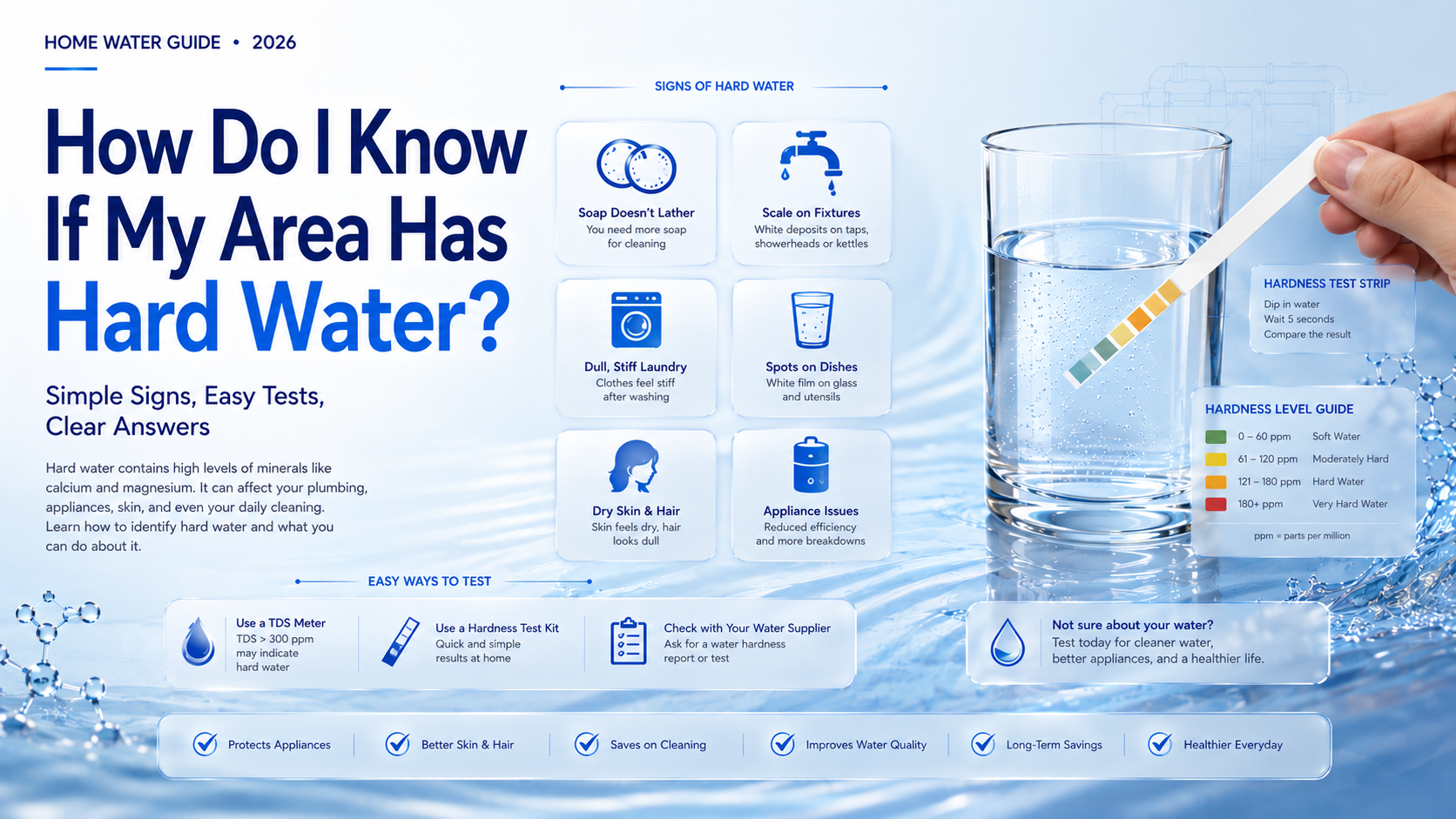
Quick answer: You likely have hard water if you notice white/chalky scale on taps and kettles, soap that won't lather properly, stiff clothes after washing, or dry, itchy skin after a shower. For certainty, run a quick soap-lather test at home, check your locality's water source (borewell water is almost always harder than treated municipal supply), or look up your state on the hard-water map further down this page. A water hardness of above 120 mg/L (as CaCO3) is generally classed as "hard" under Indian drinking water standards (BIS IS 10500).
If any of that sounds familiar, keep reading — this guide walks through every visible sign, a 2-minute test you can do right now, which parts of India are most affected, and how a water softener fixes it for good.
Hard water is water carrying a high concentration of dissolved calcium (Ca2+) and magnesium (Mg2+) minerals. It's not dirty or unsafe in the way contaminated water is — it's simply mineral-rich, usually because it has passed through limestone, chalk, or gypsum-rich soil before reaching your tap. This is exactly why borewell and groundwater sources tend to be harder than piped municipal/river-sourced water in most Indian cities.
Water hardness is measured in mg/L as CaCO3 (calcium carbonate equivalent), and is generally classified as:
Hardness Level |
mg/L as CaCO3 |
What It Feels Like |
Soft |
0–60 |
Water lathers easily, no scale buildup |
Moderately Hard |
61–120 |
Occasional spotting, mild scale over months |
Hard |
121–180 |
Visible scale, poor lather, dry skin/hair |
Very Hard |
180+ |
Heavy scale, frequent appliance issues |
(Classification based on general water-quality standards; India's acceptable limit under BIS IS 10500 is 200 mg/L, with 600 mg/L as the permissible limit in the absence of an alternate source.)
For a full breakdown of what separates hard water from soft water, see our detailed guide: What is the Difference Between Hard and Soft Water?
You don't need a lab test to get a strong first indication. Look around your own home for these:
If you're seeing three or more of these regularly, your area almost certainly has hard water. For the science behind why hard water damages appliances specifically, see How to Prevent Scaling on Your Geyser Due to Hard Water.
Visible signs are a good starting clue, but here are three simple ways to confirm it in under five minutes:
We've written a complete, equipment-free walkthrough of these methods (plus what the results actually mean) here: How to Check Water Hardness at Home in India (Without Any Equipment)
If you want a lab-accurate number, most municipal water boards and private water-testing labs in major cities offer paid hardness testing — useful if you're deciding between a semi-automatic and fully-automatic water softener based on your exact hardness level.
Groundwater hardness in India varies by geology and water source, and the Central Ground Water Board (CGWB), alongside state groundwater departments, has long tracked this as part of national groundwater quality monitoring. Broadly, regions drawing heavily on borewell/groundwater — rather than river or treated municipal supply — tend to report the hardest water. Based on commonly cited groundwater quality patterns, states and regions that frequently report high hardness include:
This is a general pattern, not a precise city-by-city reading — hardness can vary block-to-block even within the same city depending on whether your building draws from a borewell, a municipal line, or a mix of both. If you're on borewell water anywhere in India, it's worth assuming moderate-to-hard water until proven otherwise. For the specific problems borewell users run into, read: Water Softener Not Working? Fix Borewell Water Hardness in India
Once you've confirmed hard water — through visible signs, a home test, or a lab report — a water softener is the standard, proven fix. It works through ion exchange, swapping out the calcium and magnesium ions in your water for sodium ions, so your taps, appliances, skin, and hair stop bearing the cost of scale buildup.
Depending on your situation:
Once installed, keeping your system running well is simple — mainly topping up water softener salt on schedule and replacing the resin bed every 10–12 years.
Q: Can I have hard water even if my building uses municipal supply, not a borewell? Yes. Municipal water is generally softer than groundwater, but it isn't guaranteed to be soft — it depends on the original water source your municipal board draws from. Testing is still the only sure way to know.
Q: Does hard water affect drinking water safety? No — hard water is not unsafe to drink; it's simply mineral-rich. The concerns with hard water are practical (scale, poor lathering, appliance wear) rather than health-related for most people.
Q: How is hard water different from high-TDS water? TDS (Total Dissolved Solids) measures all dissolved substances in water, while hardness specifically measures calcium and magnesium content. Water can have low TDS and still be hard, or high TDS and still be relatively soft — they're related but not the same test.
Q: What's the fastest way to check without buying anything? The soap-lather test above takes under two minutes and needs nothing but a bottle, water, and liquid soap — it's the quickest first check before you invest in a testing kit or a water softener.
This guide is based on publicly available groundwater quality patterns referenced by the Central Ground Water Board (CGWB) and India's drinking water standard IS 10500, along with practical field observations from installing and servicing water softeners across Indian households. For a hardness reading specific to your address, a local water-testing lab or a quick soap-lather test at home remains the most reliable starting point.
Written and reviewed by the Pearl Water Technologies content team, based on our experience manufacturing and installing water softeners, FRP vessels, and water treatment spares across India.
Leave A Comment