


13-Jul-2026
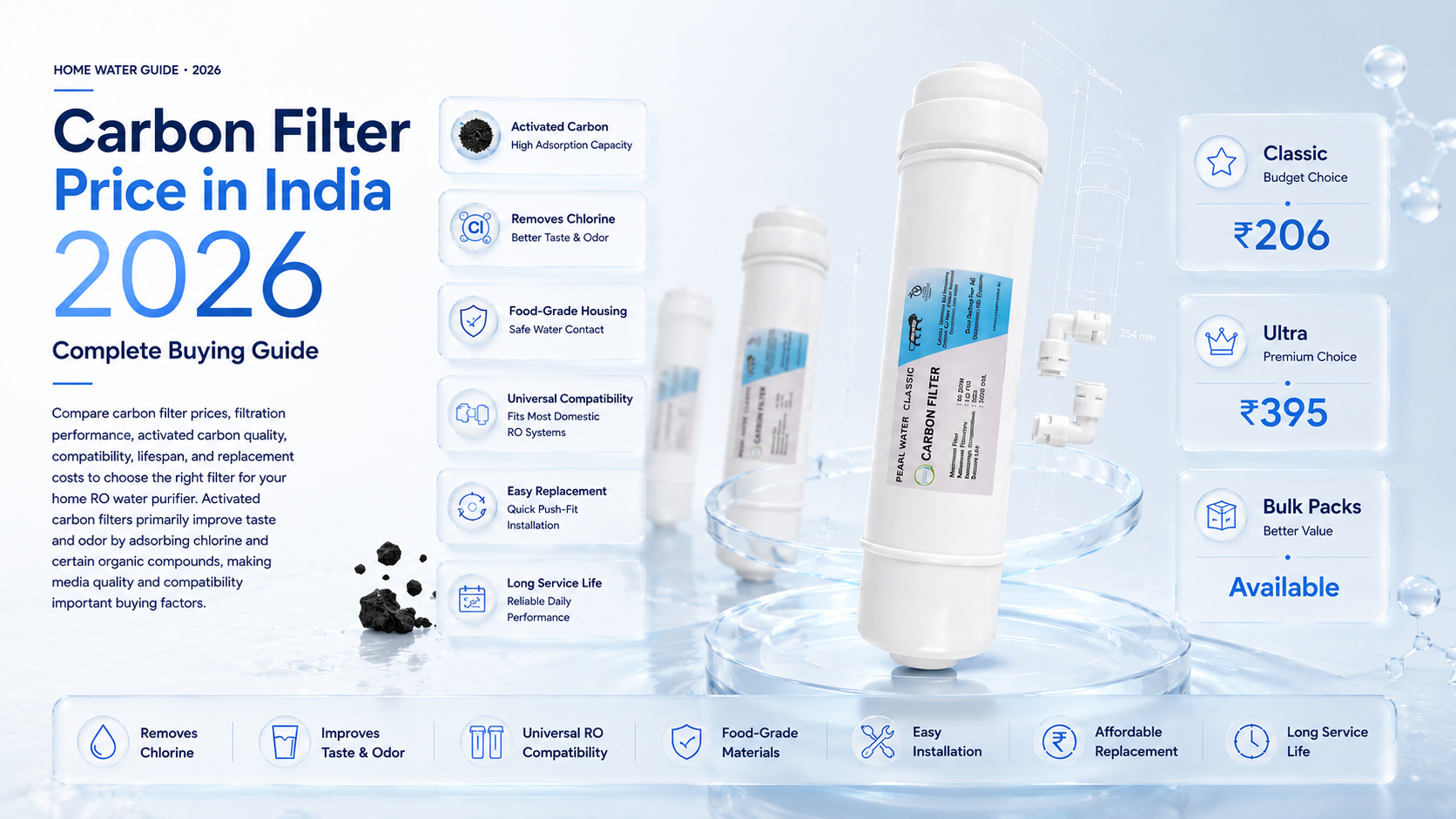
Carbon filter prices in India range from Rs.179 for a single CTO/Carbon Block filter to Rs.939 for a pack of 5 premium Ultra carbon filters, depending on type, brand, and pack size. A standard 10-inch pre-carbon filter for a domestic RO purifier typically costs Rs.180–Rs.250 per piece, with bulk packs offering 10–15% savings per unit.
If you own an RO water purifier, chances are you've searched "carbon filter price" while trying to figure out why your water suddenly tastes off, smells like chlorine, or why your last RO service quote felt too high. This guide answers that question directly — with real, current prices from our carbon filter for RO water purifier online store — and explains everything else you need to know before you buy.
A carbon filter is a water filtration cartridge that uses activated carbon — a highly porous form of processed carbon, usually made from coal, coconut shell, or fruit shell — to remove chlorine, bad odour, pesticides, and organic chemical impurities from water through a process called adsorption.
Unlike a sediment filter (which physically traps dirt and rust) or an RO membrane (which removes dissolved salts and heavy metals), a carbon filter's job is chemical: it pulls contaminants out of the water and traps them inside its porous structure, the way a sponge soaks up liquid. This is why carbon filters are sometimes called the "taste and odour" stage of an RO system — they're the reason purified water tastes clean instead of like a swimming pool.
Every domestic RO purifier in India — whether it's Kent, Aquaguard, Livpure, Pureit, or Havells — uses at least one carbon filter stage, and most use two (pre-carbon and post-carbon). Together with the sediment and cartridge stages, these filters make up a complete RO filter kit.
Here is the current price breakdown for standard 10-inch domestic carbon filters, based on live Pearl Water Technologies pricing:
Filter Type |
Pack Size |
Price |
Price Per Piece |
|---|---|---|---|
CTO / Carbon Block (10-inch) |
1 piece |
Rs.179 |
Rs.179 |
Carbon Filter Classic |
1 piece |
Rs.206 |
Rs.206 |
Carbon Filter Classic |
Pack of 2 |
Rs.299 |
Rs.149.5 |
Carbon Filter Classic |
Pack of 3 |
Rs.449 |
Rs.149.6 |
Carbon Filter Classic |
Pack of 5 |
Rs.674 |
Rs.134.8 |
Carbon Filter Ultra |
1 piece |
Rs.215 |
Rs.215 |
Carbon Filter Ultra |
Pack of 2 |
Rs.395 |
Rs.197.5 |
Carbon Filter Ultra |
Pack of 3 |
Rs.539 |
Rs.179.6 |
Carbon Filter Ultra |
Pack of 5 |
Rs.845 |
Rs.169 |
Key takeaway: Buying in packs of 3 or 5 typically saves 15–20% per filter compared to buying single pieces — worth it since carbon filters need replacing every 6–9 months anyway.
Prices are exclusive of applicable taxes and subject to change. Check live prices on the Pearl Water Carbon Filter page →
Classic vs Ultra vs CTO: Which Carbon Filter Should You Buy?
Prefer a combo instead of buying separately? Pearl Water also offers a pre-carbon filter with sediment filter combo that bundles both stages at a better price.
This is one of the most searched questions among first-time RO buyers, so here's the direct answer:
Feature |
GAC (Granular Activated Carbon) |
Carbon Block (CTO) |
|---|---|---|
Structure |
Loose carbon granules |
Compressed solid carbon |
Flow rate |
Higher |
Slightly lower (denser) |
Contaminant contact time |
Lower |
Higher |
Best suited for |
High-flow systems, pre-filtration |
Fine filtration, chlorine/VOC removal |
Channelling risk |
Higher (water can find gaps) |
Lower (solid block) |
In simple terms: GAC filters are typically used as the first carbon stage because they handle higher flow rates well. Carbon block filters are often used at the pre-membrane or post-RO stage because their solid structure gives water more contact time with the carbon, resulting in more thorough chemical removal.
A common misconception is that one carbon filter is enough. In reality, most RO systems use carbon at two separate stages, and each does a different job:
Pre-carbon filter (before the RO membrane):
Post-carbon filter (after the RO membrane):
Skipping the pre-carbon stage doesn't just affect taste — it shortens the life of your expensive RO membrane. This is why a good RO filter kit always bundles at least one carbon filter with the membrane, sediment filter, and cartridge filter together.
Water Source |
Recommended Replacement |
|---|---|
Municipal / corporation supply |
Every 6 months |
Borewell / tanker / high-TDS water |
Every 3–4 months |
Classic Carbon Filter (rated life) |
~6,000 litres |
Ultra Carbon Filter (rated life) |
~8,000 litres |
Delaying a carbon filter change doesn't just affect taste. An exhausted carbon filter lets chlorine pass straight through to the RO membrane, which can degrade the membrane and shorten its 2-year lifespan to under 6 months — turning a Rs.200 filter delay into a Rs.1,000+ membrane replacement. Not confident doing it yourself? Pearl Water's RO service team can handle the full filter change for you.
Does a carbon filter reduce TDS? No, not meaningfully. TDS (Total Dissolved Solids) reduction is the job of the RO membrane, not the carbon filter. A carbon filter's role is to remove chlorine, bad taste, odour, and organic chemical impurities. You may see a very minor TDS change as water passes through, but it is not the carbon filter's primary function — don't rely on it to lower high TDS water.
What is the price of a carbon filter in India in 2026? Carbon filter prices range from Rs.179 for a single CTO/Carbon Block filter to Rs.215 for a single Ultra filter, with multi-packs bringing the per-piece cost down to as low as Rs.135–Rs.170 depending on the pack size. See live prices and buy carbon filters online at Pearl Water.
Can I use any carbon filter with my Kent, Aquaguard, or Livpure purifier? Yes. Standard 10-inch carbon filters with universal 1/4-inch quick-fit connectors are compatible with all major domestic RO purifier brands in India, including Kent, Aquaguard, Livpure, Pureit, Havells, and AO Smith.
What is the difference between Carbon Filter Classic and Ultra? Classic is rated for approximately 6,000 litres (around 6 months) and suits municipal water supply. Ultra is rated for approximately 8,000 litres (around 8–9 months) and is built for tougher input water like borewell or tanker supply.
How do I know if my carbon filter is exhausted? The clearest sign is the return of a chlorine smell or taste in your purified water — this means the carbon has stopped adsorbing chlorine and it's passing straight through, which can also start damaging your RO membrane.
Is a carbon filter and a sediment filter the same thing? No. A sediment filter physically traps particles like dirt, rust, and sand using a mesh-like structure. A carbon filter chemically adsorbs dissolved impurities like chlorine, pesticides, and odour-causing compounds. Most RO systems use both, in sequence — sediment first, then carbon.
Why Choose Pearl Water Carbon Filters
Pearl Water Technologies has been manufacturing water treatment products in India since 2010, with ISO 9001:2015 certification and every batch tested for adsorption performance before dispatch. Our carbon filters are made from a blend of coal, coconut shell, and fruit shell activated carbon, and are compatible with all standard 10-inch domestic RO housings — meaning they work as a direct replacement across Kent, Aquaguard, Livpure, Pureit, and other major brands.
Shop Carbon Filter for RO Water Purifier Online →
Looking for the rest of your RO filter stages? Explore our full range:
Related Reads
Have questions about which carbon filter is right for your water source? Contact Pearl Water Technologies or call our toll-free number for expert guidance.
Leave A Comment