


17-Aug-2026
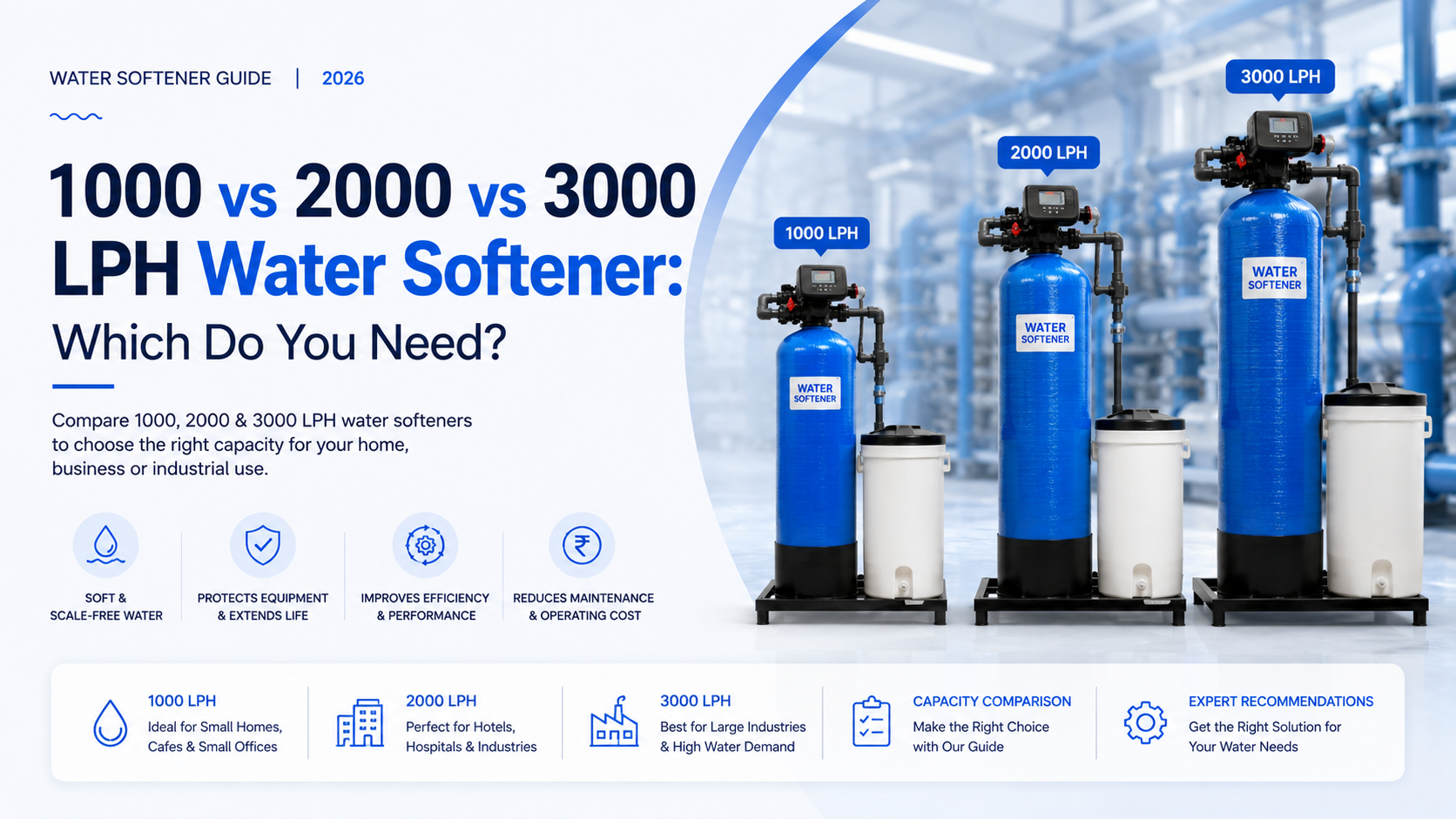
Quick answer: A 1000 LPH water softener suits a single bathroom or a small 1-2BHK flat. A 2000 LPH system is the right fit for most independent 3-4BHK homes with 2-3 bathrooms and daily appliance use. A 3000 LPH (or higher) system is built for larger homes, villas, or light commercial/industrial use where multiple bathrooms, a washing machine, a geyser, and an RO plant are all drawing softened water at once. Getting this sizing right — matched to your household's actual daily water usage and hardness level — matters more than picking the biggest or cheapest option available.
If you're comparing water softener systems and unsure which capacity fits your home, this guide breaks down exactly how to decide — plus everything else worth knowing before you buy, including types, pricing, brands, and installation.
A water softener is a home water softener system designed to remove the calcium and magnesium responsible for "hard water" — the mineral buildup that causes limescale, poor soap lather, and dry skin and hair after a shower.
The core mechanism is called ion exchange. Water passes through a resin bed inside the unit, where hardness-causing calcium and magnesium ions are swapped out for sodium ions before the water reaches your taps. Over time, the resin's capacity gets used up, so the system periodically runs a regeneration cycle — flushing itself with a salt brine solution to recharge the resin bed so it can keep working.
That's really the whole mechanism behind how a water softener works: no complex electronics beyond a control valve that manages timing, and two ongoing maintenance needs — periodic salt refills and, eventually (usually after 10-12 years), a resin bed replacement. For the full explainer on the process, see what is water softener resin and how it works.
Before capacity, it's worth understanding the different types of water softener machine on the market, since "capacity" only matters once you've picked the right category:
For most Indian households dealing with genuinely hard water, a salt-based, ion-exchange system remains the most reliable choice — which is also why the rest of this guide focuses on sizing that type correctly.
Within salt-based systems, you'll also choose between:
This is the other key decision alongside capacity:
LPH stands for Litres Per Hour — the volume of softened water the system can produce continuously. This is the single most important spec once you've picked salt-based, ion-exchange as your technology of choice. Here's how the three most common capacities compare:
Capacity |
Best Suited For |
Typical Household |
Bathrooms |
Water Softener for Washing Machine? |
Water Softener for Geyser? |
1000 LPH |
Single bathroom / small flat |
1-2BHK apartment, rental flat |
1 bathroom |
Light use only |
Yes, single geyser |
2000 LPH |
Standard independent home |
3-4BHK house/flat |
2-3 bathrooms |
Yes, regular use |
Yes, multiple geysers |
3000 LPH+ |
Large home, villa, light commercial |
Villa, large family home, small commercial premises |
3+ bathrooms |
Yes, heavy daily use |
Yes, multiple geysers + RO plant |
A useful way to think about it: 1000 LPH covers a water softener for apartment living or a single-bathroom setup comfortably. 2000 LPH is the realistic middle ground that fits most independent Indian homes without over- or under-sizing. 3000 LPH and above starts moving into commercial water softener and industrial water softener territory — used in guesthouses, small hotels, clinics, or light industrial premises where continuous, higher-volume softened water is needed, sometimes paired with a water softener for RO plant feeding a larger purification setup.
Undersizing leads to inconsistent softening and more frequent regeneration than expected; oversizing means paying more upfront and for ongoing salt consumption you don't actually need. Matching capacity to your real daily usage — not just guessing based on home size alone — is what actually determines whether a water softener performs well for years.
This comparison trips up a lot of first-time buyers, so it's worth being precise:
For the foundational difference between hard and soft water itself, see: What is the Difference Between Hard and Soft Water?
Water softener price in India scales fairly directly with LPH capacity, since a higher-capacity unit needs a larger resin bed, a bigger FRP vessel, and often a more robust control valve. As a general pattern:
Beyond the unit price, water softener cost in India also includes installation, ongoing salt refills, and an eventual resin bed replacement after roughly a decade — all of which scale somewhat with capacity too, since a larger system uses more salt per regeneration cycle. For a full, current cost breakdown across capacities, see: Water Softener Price in India 2026: Complete Cost Guide. You can browse and compare water softener online across all three capacities to see current pricing side by side.
Several established brands sell water softeners in India, including Kent water softener, Aquaguard water softener, Livpure water softener, Eureka Forbes water softener, and Pureit water softener ranges, alongside manufacturers like Pearl Water Technologies. There's no single universal "best" brand — the right choice depends on your specific hardness level, household size, and what you're prioritizing. That said, a few criteria matter more than brand name alone when judging the best water softener brand in India for your situation:
For the fullest look at how to evaluate the best water softener for home in India across brands, this guide is a useful companion: Best Water Softener in India: Home & Society Expert Guide.
If you're searching "water softener near me," it usually means you want more than just a product — reliable local installation and after-sales support matter as much as the unit itself. This matters especially across India's major cities and states where hard water is a common concern:
Wherever you're located, the same sizing principles apply — match capacity to household size, water source, and hardness level rather than choosing based on whichever supplier is physically closest. You can review the full water softener system range and specifications online first, so you know what fair pricing and sizing look like before finalizing a local installer.
Once you've picked the right capacity, installation connects the unit into your main water line (for whole-house systems) or a single bathroom's supply line (for point-of-use systems), along with a bypass valve and a drain connection for the regeneration cycle. For a full walkthrough of what's involved — and whether it's realistic to do yourself — see: Can I Install a Water Softener Myself Without a Plumber?
Ongoing water softener maintenance is minimal regardless of capacity: periodic salt top-ups (larger systems use more salt per cycle) and a resin bed replacement roughly every 10-12 years. For a complete maintenance walkthrough, see: Effortless Water Softener Care: Installation & Maintenance Tips.
The core water softener benefits — less limescale, better soap lather, softer laundry, and gentler effects on skin and hair — only show up consistently when the system is correctly sized for your actual usage. An undersized unit struggles to keep up with demand, while a well-matched one delivers consistent results:
Q: Is softened water safe to drink? Yes — softened water is not unsafe to drink. A water softener doesn't purify water for contaminants; it simply reduces calcium and magnesium content. The mild increase in sodium content is generally not a concern for most people, though those on strict low-sodium diets may want to keep a separate untreated tap for drinking.
Q: What is the difference between a 1000 LPH and 2000 LPH water softener in practice? A 1000 LPH system comfortably handles one bathroom's continuous demand; a 2000 LPH system handles 2-3 bathrooms plus regular washing machine and geyser use without straining the resin bed between regeneration cycles.
Q: Can I install a water softener for just one bathroom instead of the whole house? Yes — a compact, point-of-use water softener for single bathroom use is a common, more affordable choice for renters or smaller flats where whole-house coverage isn't necessary or practical.
Q: How does a water softener work, in simple terms? It uses ion exchange: water flows through a resin bed that swaps out hardness-causing calcium and magnesium for sodium, then periodically regenerates itself using salt to keep working.
Q: Do I need a bigger water softener if I have a washing machine and a geyser? Generally yes — daily washing machine and geyser use adds meaningfully to your household's total water demand, which is why most homes with both typically need at least a 2000 LPH system rather than a 1000 LPH one.
This guide reflects standard sizing principles for residential and light-commercial ion-exchange water softeners, based on practical field experience matching system capacity to household water usage across different home sizes and water sources in India. Exact capacity needs can vary based on your specific hardness level and daily usage pattern — if in doubt, a quick water hardness test and a conversation with your supplier before buying is the most reliable way to confirm the right fit.
Written and reviewed by the Pearl Water Technologies content team, based on our experience manufacturing and installing water softener systems, FRP vessels, and water treatment spares across India.
Leave A Comment