Added to wishlist.

What Is a Pool Filter and Which Type Do I Need?

12-Aug-2026

What Is a Pool Filter and Which Type Do I Need?

What Is a Pool Filter and Which Type Do I Need?

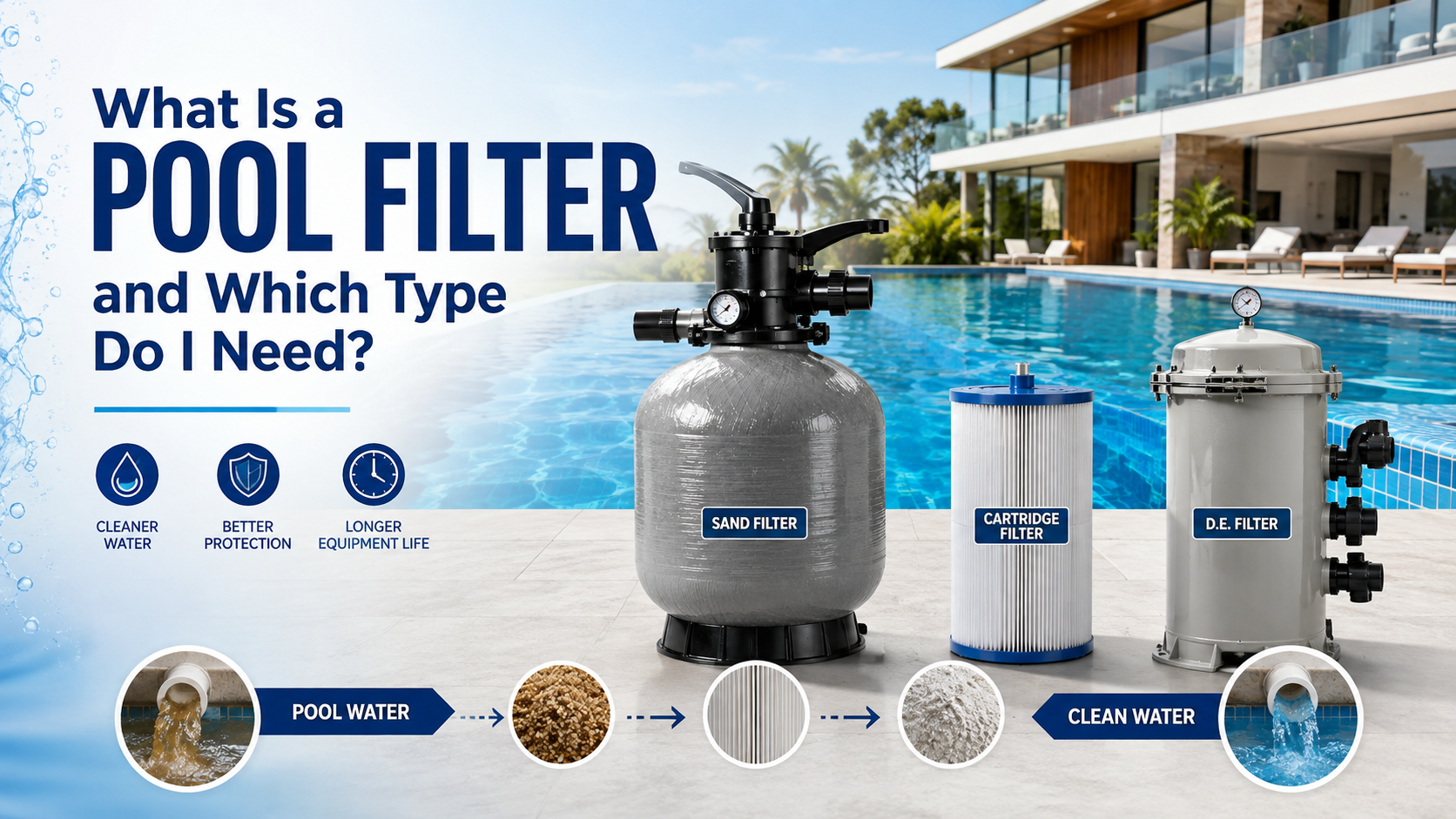
Quick answer: A pool filter is the equipment that removes dirt, debris, algae, and fine particles from your swimming pool water by circulating it through a filtration medium — sand, a pleated cartridge, or diatomaceous earth (DE) — before returning clean water to the pool. For most residential pools in India, an FRP sand filter is the best balance of cost, low maintenance, and long-term durability. Cartridge filters suit smaller pools where water conservation matters more than upfront cost, while DE filters deliver the finest filtration but need more hands-on care.

The rest of this guide breaks down exactly how each type works, what it costs to run, and how to decide which one fits your pool.


What Is a Pool Filter, Exactly?

A pool filter is the component of your pool's circulation system responsible for physically trapping contaminants suspended in the water. As your pump draws water from the pool's skimmers and main drain, it pushes that water through the filter, where a filtration medium captures dirt, dust, pollen, sunscreen residue, algae spores, and other fine particles before the water is returned to the pool through the return jets.

Without a working filter, even a perfectly chemically-balanced pool would turn cloudy and unsanitary within days — filtration and chemical sanitation (like chlorine) work together, not as substitutes for each other. If you're also trying to understand how filtration interacts with water chemistry, our guide on pool pH vs chlorine covers that relationship in detail.


How Does a Pool Filter Work?

Every pool filter follows the same basic principle, regardless of type:

  1. The pump draws water from the pool.

  2. Water is pushed into the filter tank under pressure.

  3. Water passes through the filtration medium (sand, cartridge, or DE powder).

  4. Trapped particles stay behind in the medium; clean water exits.

  5. Filtered water returns to the pool through the return line.

What differs between filter types is what the water passes through, how fine the filtration is, and how you clean the trapped debris back out — which is exactly what determines which type is right for your pool.


The 3 Main Types of Pool Filters

1. Sand Filters (Most Common)

A sand filter uses a bed of specially graded silica sand inside a pressure-rated tank — typically built from FRP (Fiberglass Reinforced Plastic) for corrosion resistance. Water is forced down through the sand bed, where particles as small as 20–40 microns get trapped between the grains.

How it's cleaned: Backwashing — reversing water flow through a multiport valve to flush trapped debris out through a waste line. Takes 2–3 minutes and requires no manual handling of dirty media.

Best for: Most residential pools, especially in India where low-maintenance operation and durability against heat/humidity matter. This is the type used across Pearl Water's FRP swimming pool sand filter range.

2. Cartridge Filters

A cartridge filter uses a pleated polyester cartridge instead of loose media. Water flows through the folded fabric, which traps particles as small as 10–15 microns — finer than a standard sand filter.

How it's cleaned: The cartridge is physically removed and hosed down (or soaked in cleaning solution) every few weeks, and fully replaced every 1–2 years.

Best for: Smaller pools, above-ground pools, and situations where minimizing water usage matters, since cartridge filters don't require the water-wasting backwash cycle sand filters do.

3. DE (Diatomaceous Earth) Filters

A DE filter coats internal grid elements with diatomaceous earth powder — a naturally occurring, ultra-fine mineral. This produces the finest filtration of the three types, capturing particles as small as 2–5 microns.

How it's cleaned: Backwashed like a sand filter, but DE powder must be manually recharged into the tank after every backwash cycle.

Best for: Pools where water clarity is the top priority and the owner (or a pool service) is comfortable with more frequent, hands-on maintenance — common in high-end residential or specialty applications, less common in standard Indian residential/commercial pools.


Sand vs Cartridge vs DE: Comparison Table

Factor

Sand Filter

Cartridge Filter

DE Filter

Filtration fineness

20–40 microns

10–15 microns

2–5 microns

Cleaning method

Backwash (2–3 min)

Remove & hose down

Backwash + DE recharge

Cleaning frequency

Every 1–2 weeks (by pressure)

Every 2–4 weeks

Every 4–6 weeks

Water usage for cleaning

Moderate (backwash water)

Minimal

Moderate

Upfront cost

Low–moderate

Moderate

Highest

Ongoing running cost

Low (sand lasts 3–5 yrs)

Moderate (cartridge replacement)

Moderate–high (DE powder, grids)

Tank material (typical)

FRP fiberglass

Plastic/composite

FRP fiberglass

Best for

Most residential & commercial pools

Small/above-ground pools

Ultra-clear water priority


Which Pool Filter Type Do You Actually Need?

Here's a practical decision framework rather than a generic recommendation:

Choose a sand filter if:

  • You want the lowest day-to-day maintenance effort (this is the right call for most homeowners)

  • Your pool is medium-to-large (residential, farmhouse, hotel, or resort scale)

  • You want a filter with a long service life and low running cost

  • You're in a hot, humid climate where tank corrosion resistance matters (FRP construction handles this well)

Choose a cartridge filter if:

  • Your pool is small (above-ground, plunge pool, or compact residential)

  • You want to minimize water wasted during cleaning

  • You don't mind removing and cleaning the cartridge by hand periodically

Choose a DE filter if:

  • Water clarity is your absolute top priority (competition pools, high-end residential)

  • You're comfortable with — or have a service company for — more involved maintenance

  • Budget for both upfront cost and ongoing DE powder isn't a major constraint

For most pool owners in India comparing all three, sand filtration remains the default recommendation because it delivers the best combination of low maintenance, durability, and cost-effectiveness over the filter's lifetime — which is why it's the most widely installed filter type for both residential and commercial pools nationwide.


How to Size Your Pool Filter

Once you've chosen a filter type, sizing correctly matters just as much as the type itself. As a general rule:

  1. Calculate your pool's total volume in litres.

  2. Divide by the filter's rated flow rate (in litres/hour) to estimate the hours needed for one full water turnover.

  3. Aim for a daily filtration run time of 6–8 hours for residential pools.

Undersized filters run constantly without ever fully keeping up; oversized filters simply add unnecessary cost. Pearl Water's FRP sand filter range spans multiple sizes to match different pool volumes — from the compact 400mm 6 CBM model for small pools up to the 650mm 16 CBM for larger residential and light-commercial pools. See the full range to compare capacities against your pool's volume.


Understanding the Valve on Top of Your Filter

Most sand and DE filters use a top-mounted multiport valve to control filtration mode — Filter, Backwash, Rinse, Waste, Recirculate, and Closed. Understanding these settings isn't optional trivia; using the wrong mode at the wrong time (like forgetting to switch back to "Filter" after backwashing) sends unfiltered water straight into your pool. Our detailed breakdown of what a top mount pool filter with a multiport valve does covers every setting and when to use it.


Ongoing Maintenance: What to Expect After You Buy

Whichever filter type you choose, plan for these recurring tasks:

  • Sand filters: backwash every 1–2 weeks (triggered by pressure gauge reading, not a fixed calendar), replace sand every 3–5 years

  • Cartridge filters: hose down every 2–4 weeks, replace cartridge every 1–2 years

  • DE filters: backwash and recharge DE powder every 4–6 weeks

For a complete week-by-week and season-by-season maintenance routine covering filtration alongside water chemistry, see our step-by-step swimming pool maintenance guide. And if your current filter is aging and you're weighing repair versus replacement, our guide on signs your swimming pool filter needs replacement will help you decide.


Frequently Asked Questions

What is a pool filter used for?

A pool filter removes dirt, debris, algae, and other suspended particles from swimming pool water by circulating it through a filtration medium, keeping the water clear and hygienic between chemical treatments.

Which type of pool filter is best?

For most residential and commercial pools, a sand filter (especially an FRP-bodied one) offers the best balance of low maintenance, durability, and cost. Cartridge filters suit smaller pools prioritizing water conservation, while DE filters suit pools where the finest possible filtration is the top priority.

How do I know what size pool filter I need?

Match the filter's rated flow rate (litres or cubic meters per hour) to your pool's total volume so a full water turnover is achievable within roughly 6–8 hours of daily filtration run time.

How long does a pool filter last?

An FRP sand filter tank can last many years with proper maintenance; the sand media itself typically needs replacing every 3–5 years. Cartridge filters need cartridge replacement every 1–2 years, and DE filter grids typically last several years with proper care.

Can I switch from one filter type to another?

Yes, though it usually requires replacing the filter tank itself (not just the media), since sand, cartridge, and DE filters use different tank and internal designs. Most pool owners switch during a filter replacement cycle rather than mid-life.

Do I need a pool filter if I use chlorine?

Yes. Chlorine sanitizes the water chemically, but it doesn't remove physical debris, dirt, or fine particles — that's the filter's job. The two systems work together, not as substitutes for one another.


Why Trust This Guide

This guide is published by Pearl Water Technologies, a manufacturer of FRP swimming pool filtration systems supplying residential, hotel, resort, and institutional pools across India. The filtration principles, sizing methodology, and maintenance schedules described above reflect standard practice used in our own product engineering and the guidance we provide to installers and customers directly. For product-specific specifications, always refer to the datasheet of the exact filter model you're considering on our pool filter product range.


Ready to Choose Your Filter?

If you already know you want a low-maintenance FRP sand filter, browse Pearl Water's full range — sized from small residential pools up to large commercial facilities — on our pool filter page. Still comparing options? Our FRP pool filter buying guide walks through what to check before you buy, beyond just filter type.

Share:

Leave A Comment

Thank You for subscribing our newsletter.