29-Oct-2026
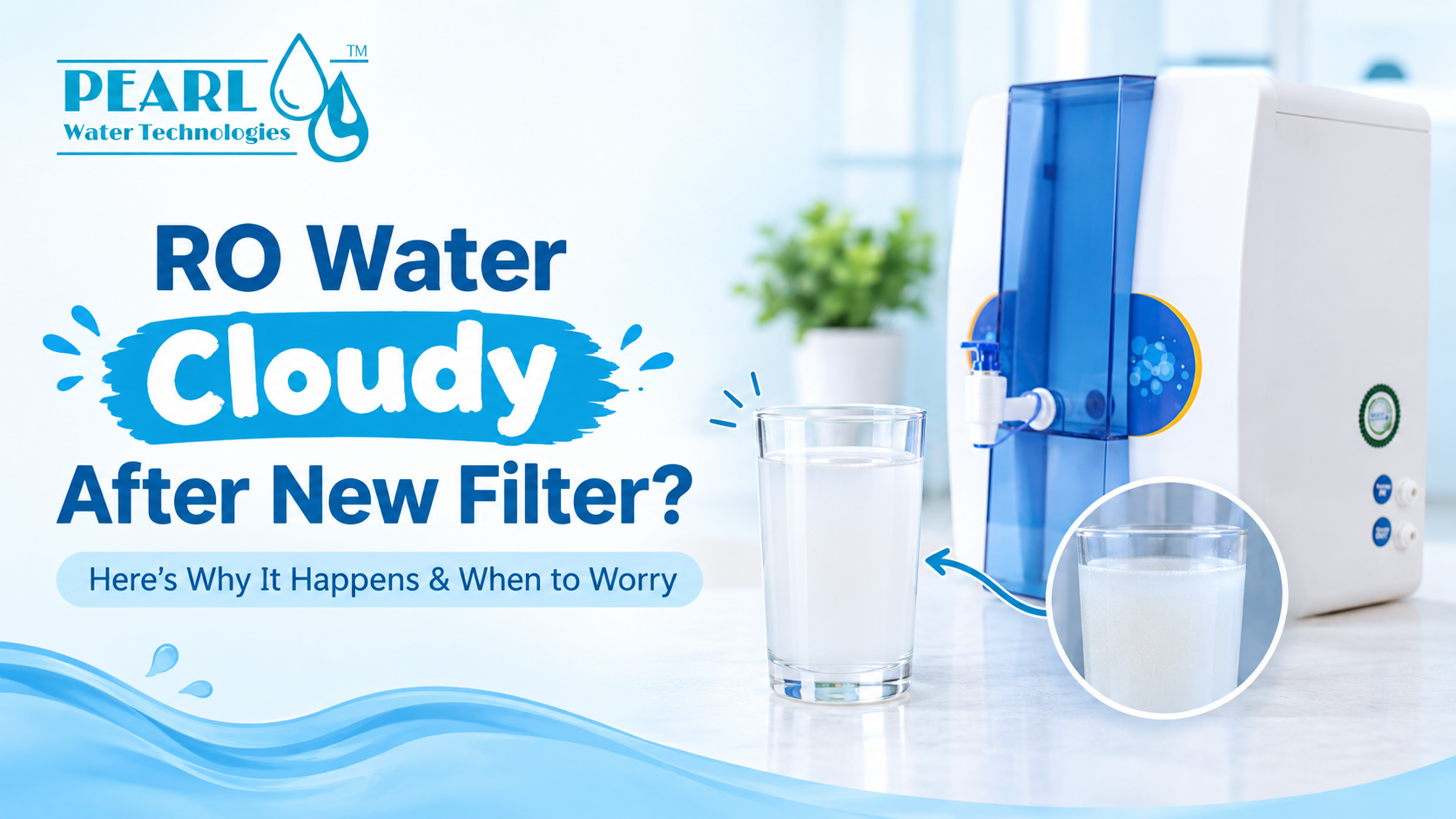
Why Is My RO Water Cloudy After Changing the Filter?
RO water turns cloudy or milky after a new filter because of trapped air. New cartridges and membranes hold air pockets, and when that air is pushed through under pressure it creates thousands of tiny bubbles. The water looks white for a moment, then clears from the bottom of the glass upward. It is harmless and usually stops within 24 hours.
If the water stays cloudy or leaves a white or grey residue, the cause is something else. This guide covers both cases.
Fill a clear glass with RO water and place it on a table. Watch for one to two minutes.
What you see |
What it means |
|---|---|
Cloudiness clears from the bottom up |
Air bubbles. Harmless. |
Cloudiness stays uniform and does not clear |
Suspended particles or high dissolved solids. Needs checking. |
White or grey powder settles at the bottom |
Scale or carbon or sediment fines. Needs flushing. |
Black specks float or settle |
Carbon fines. See our guide on black particles in RO water after a new carbon filter. |
This is the most common cause. A dry sediment cartridge, carbon block or RO membrane holds air in its pores. Once water flows, that air is released as microbubbles. This is why the water looks “milky” like a soda or an aerated tap stream.
When you open the system for a filter change, air enters the tubing and the pressure tank. The first few litres push that air out, so the water looks cloudy until the lines are purged.
New membranes are shipped with a preservative solution. If the membrane is not flushed properly, you may see cloudy water, a slight taste change or higher TDS in the first tanks.
If a cartridge housing is not sealed correctly, the system can draw in air on the inlet side. In that case the cloudiness does not clear after a day, and you may also hear hissing or see small leaks.
Weak pressure makes the system release air unevenly. The storage tank also needs the right pre-charge (air pressure) when empty. A tank that has lost its pre-charge produces sputtering, air-filled output.
If the water settles white at the bottom of the glass, scale or dissolved minerals may be the cause, not air. This is common in areas with hard borewell supply. A sediment filter and, where needed, a water softener keep the membrane protected.
Using genuine, compatible parts also reduces these problems. Browse the complete RO filter kit for matching cartridges, and see the individual parts below:
Call a technician if:
These point to a damaged membrane, a bad seal, a pressure fault or a water-quality issue that needs testing. If your input water is the problem, learn more about RO water purifiers or water softeners for hard water.
For more maintenance guides, see the Pearl Water blog.
Action completed successfully.

Leave A Comment