


18-Sep-2026
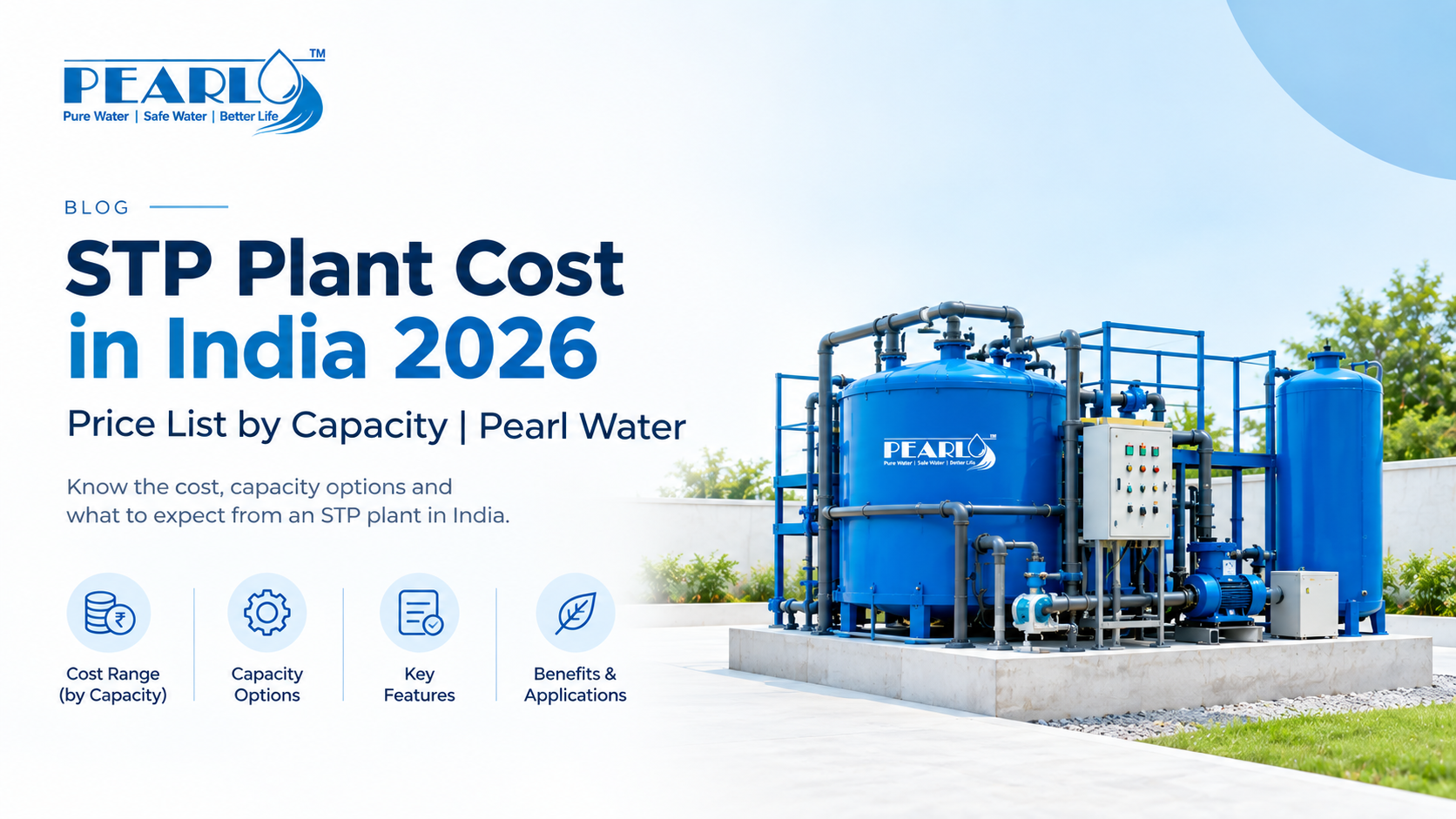
If you've been asking suppliers "STP plant kitne ka padega," you've probably gotten five different answers from five different vendors — and none of them explained why. That's because sewage treatment plant pricing isn't a single number. It depends on capacity, the treatment technology you pick, how much automation you want, and where the plant will be installed. This guide breaks all of that down using actual market pricing, not rough estimates.
For a straight answer before the detail: a semi-automatic STP plant in the 1 KLD to 10 KLD range typically costs anywhere from Rs. 75,000 to Rs. 12 lakh, depending on the technology used. Larger plants (50 KLD and above, common for townships, hotels, and industrial campuses) scale up from there, usually falling between Rs. 10 lakh and Rs. 40 lakh for equipment alone, before civil work.
That's the headline number. Now here's what actually moves that price up or down.
1. Capacity (KLD — Kilolitres per Day)
This is the single biggest cost driver. A 1 KLD plant for a small guesthouse and a 100 KLD plant for a residential township aren't the same category of purchase — capacity decides tank size, blower rating, pump specifications, and civil structure, all of which scale cost.
2. Treatment Technology
This is where most buyers get confused, because the three common technologies — MBBR, SBR, and MBR — have very different price points for similar capacity. You can browse live examples of each on our STP plant range:
3. Automation Level
Semi-automatic systems need manual monitoring for certain cycles and cost less upfront. Fully automatic systems run with minimal supervision, cost more initially, but save on manpower long-term.
4. Civil Work
Equipment pricing (what most quotes show you) doesn't include the underground tank construction, piping, and electrical work — this typically adds 30-50% on top of equipment cost, depending on soil condition and site access.
5. Site Location
Freight, local labour rates, and site accessibility (basement installation vs. open ground) all affect final delivered-and-commissioned cost.
Capacity |
Technology |
Approx. Equipment Cost |
1 KLD |
SBR |
Rs. 1.2 lakh |
10 KLD |
MBBR |
Rs. 78,000 – Rs. 1.5 lakh |
10 KLD |
MBR |
Rs. 9.5 lakh – Rs. 10 lakh |
25 KLD |
MBBR/SBR |
Rs. 3 lakh – Rs. 5 lakh |
50 KLD |
MBBR/SBR |
Rs. 6 lakh – Rs. 10 lakh |
100 KLD |
SBR/MBBR |
Rs.10 lakh – Rs. 18 lakh |
These are equipment-only figures — civil construction, installation, and commissioning are quoted separately based on site survey. Anyone quoting you a single flat number without asking about your site is skipping steps that will show up as extra cost later. For exact specifications and full capacity range, check our complete STP plant catalog.
We get this question constantly, so it's worth explaining properly. MBBR uses biofilm carriers to grow bacteria that digest organic waste — simple, mechanically robust, low maintenance. MBR adds a membrane filtration stage on top of biological treatment, physically straining out particles down to microscopic levels. That membrane module alone can account for 40-50% of an MBR system's cost, and it needs periodic replacement (typically every 5-7 years), which affects long-term operating cost too — not just the upfront number.
If your treated water just needs to meet discharge norms, MBBR or SBR is usually the practical choice. If you're planning to reuse treated water for flushing or landscaping inside a premium project, MBR earns its higher price. To understand exactly how the treatment stages work, see our earlier post: What is a Sewage Treatment Plant and How Does It Work.
Equipment is only part of the spend. Two things buyers routinely underestimate:
This isn't a sales pitch — it's a genuine risk buyers should factor in. Under CPCB and State Pollution Control Board norms, most residential and commercial establishments above a certain sewage generation threshold are legally required to have an STP. Non-compliance can attract penalties running into lakhs, along with the operational risk of project approvals or occupancy certificates getting held up. Factoring in STP cost at the design stage — not after a compliance notice — is almost always cheaper. If your facility also generates industrial wastewater alongside sewage, it's worth checking our ETP plant range as well, since many industries need both systems running together.
Q: What is the cheapest STP technology available?
MBBR is generally the most budget-friendly for small to mid capacities (1-25 KLD), balancing low upfront cost with manageable running costs.
Q: Does STP plant cost include civil work?
No. Most quoted prices cover equipment only. Civil work (tank, piping, electrical) is a separate cost, usually 30-50% on top, and depends heavily on site conditions.
Q: How much does STP maintenance cost per year?
Expect AMC costs of roughly 8-12% of the plant's capital cost annually for routine upkeep.
Q: Is a 1 KLD STP plant enough for a small guesthouse or farmhouse?
For very low daily sewage generation (roughly matching a handful of rooms or a small household), yes — a 1 KLD unit is a common starting point, though actual sizing should be based on occupancy and water usage, not capacity alone.
Q: Can I get a custom capacity STP built, or only standard sizes?
Standard capacities (1, 5, 10, 25, 50, 100 KLD) cover most needs, but custom capacities are routinely engineered for specific site requirements.
Pearl Water Technologies is an ISO 9001:2015 certified manufacturer of STP, ETP, and Industrial RO systems, with installations including MBBR-based STP systems for corporate campuses such as Candor TechSpace, Noida. For a capacity assessment and site-specific quote, contact our Lucknow branch at +91-8588022991.
Leave A Comment