


27-Oct-2022
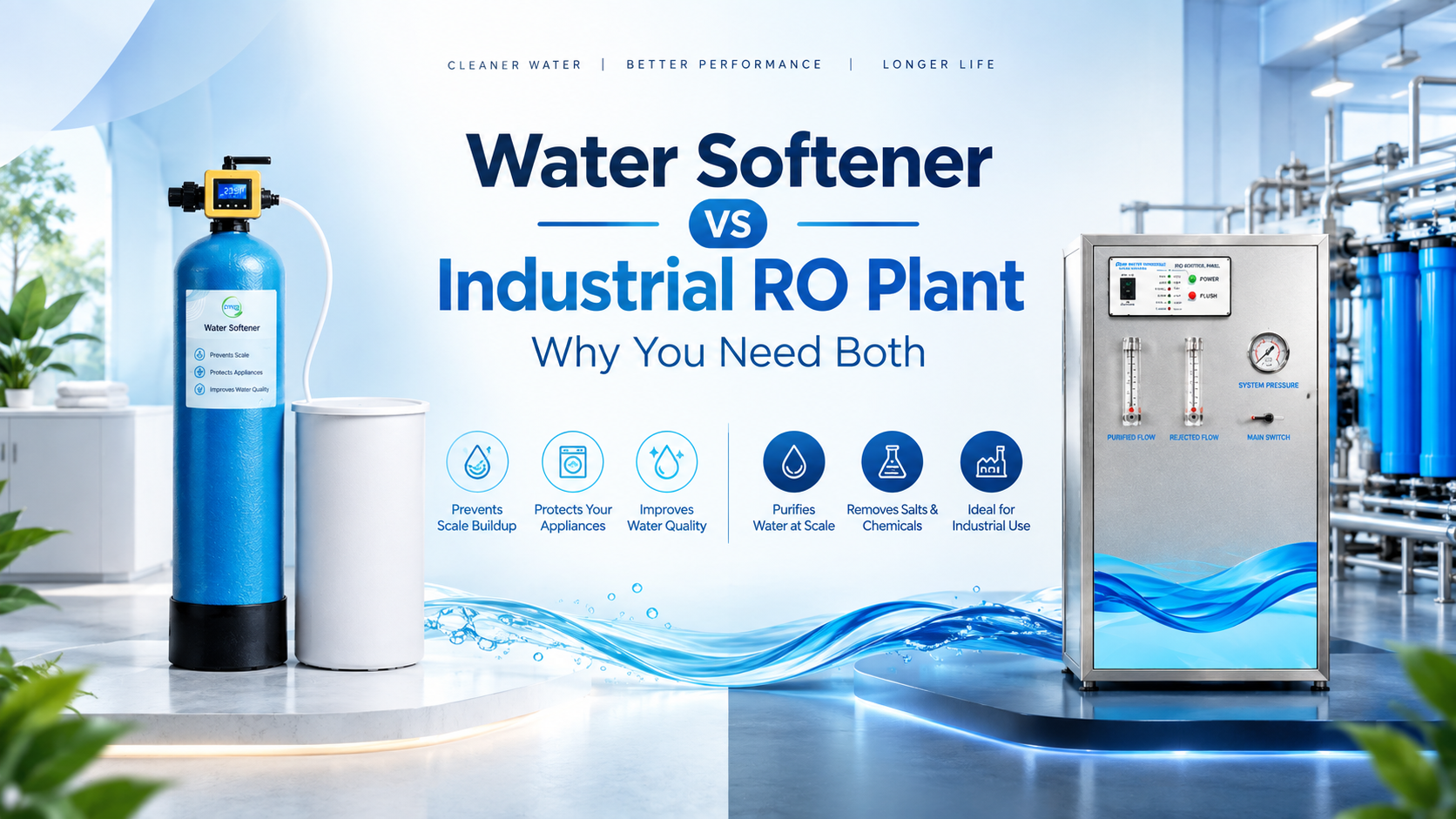
If you're setting up or running an RO plant for manufacturing, pharma, food and beverage, textiles, or any process water application, you've probably come across the term "pretreatment" more than once. Nine times out of ten, when people ask about that, what they're really asking is: do I need a water softener before my RO plant, or can the RO handle everything on its own?
Short answer — for anything beyond mild water hardness, yes, you need the softener too. They're not competing systems. An industrial water softener and an RO plant do two different jobs, and skipping the softener is one of the most common (and expensive) mistakes we see in new installations.
Here's the full picture.
An industrial water softener removes calcium and magnesium — the minerals responsible for hardness — from incoming water, using the same ion-exchange principle as a domestic softener but built at a scale suited to continuous industrial flow rates. Water passes through a resin bed, hardness minerals get swapped for sodium, and the resin periodically regenerates itself using salt brine. On its own, a softener doesn't remove dissolved solids, organic contaminants, or biological content — its entire job is hardness removal.
An RO (Reverse Osmosis) plant forces water through a semi-permeable membrane under high pressure, rejecting dissolved salts, TDS, heavy metals, and a wide range of contaminants to produce high-purity process or product water. This is the system that gets your water to the purity level most industrial processes actually require — but it's also the part of the system that's most sensitive to what's feeding into it.
Because hard water is genuinely damaging to RO membranes at scale. Calcium and magnesium in untreated feed water precipitate onto the membrane surface as scale, and once that starts, membrane efficiency drops, pressure requirements climb, and cleaning cycles need to happen more often. On an industrial scale, that's not a minor inconvenience — replacement membranes are a significant recurring cost, and unplanned downtime for cleaning or replacement directly affects production. A water softener installed as pretreatment removes the hardness before it ever reaches the membrane, which is the single biggest thing you can do to protect your RO system's lifespan.
You can technically run it, and for genuinely low-hardness feed water, some operations get away without dedicated pretreatment. But for moderate to hard water — which covers a large share of groundwater and borewell sources across India — skipping the softener typically means faster membrane fouling, more frequent cleaning-in-place (CIP) cycles, higher energy consumption from increased feed pressure, and membranes needing replacement well before their rated lifespan. The upfront saving from skipping pretreatment tends to get eaten up fast by these ongoing costs.
|
|
Industrial Water Softener |
Industrial RO Plant |
Job |
Removes hardness (calcium, magnesium) |
Removes dissolved solids, contaminants, TDS |
Technology |
Ion exchange resin bed |
Semi-permeable membrane under pressure |
Role in the system |
Pretreatment, protects downstream equipment |
Primary purification stage |
Runs alone? |
Yes, for hardness-only applications |
Technically yes, but at risk if feed water is hard |
What it protects |
Boilers, pipework, heat exchangers |
Product/process water purity |
Failure mode if skipped |
N/A (it's the protective step) |
Membrane scaling, reduced efficiency, early replacement |
Any operation where water quality directly affects the product or the equipment tends to need both. This commonly includes boiler feed water systems (where scale in boiler tubes is a serious efficiency and safety issue), pharmaceutical manufacturing (where water purity standards are strict and equipment protection matters just as much), food and beverage production, textile processing and dyeing (where hard water affects dye uptake and fabric finish), and general manufacturing facilities running RO for process water. In pretty much all of these, the softener isn't optional extra equipment — it's what keeps the RO plant performing at spec over its expected lifetime.
For hardness specifically, yes — when people refer to "RO pretreatment" in the context of hard water, they usually mean a water softener installed ahead of the RO system. Full pretreatment setups can include other stages too (sediment filtration, dechlorination, antiscalant dosing), but for hardness, the softener is the standard, proven solution rather than relying on chemical antiscalants alone.
Mainly scale and duty cycle. Industrial softeners are built for continuous, high-volume flow rather than a household's intermittent daily usage pattern, often using dual-tank configurations so one tank can regenerate while the other keeps supplying softened water without interruption. The underlying ion-exchange technology is the same — what changes is the vessel size, resin volume, and how the system is engineered to handle sustained demand without downtime. If you're comparing capacity needs, our 1000 LPH vs 2000 LPH vs 3000 LPH capacity guide covers residential and light-commercial sizing; for larger industrial requirements, it's worth discussing your specific flow rate and hardness level directly.
Not entirely, and it depends on your specific water chemistry — a softener handles calcium and magnesium hardness directly, which is often the biggest scaling risk, but some operations still use antiscalant dosing alongside softening for additional protection against other scale-forming compounds (like silica) that ion exchange doesn't address. This is worth evaluating based on your actual feed water analysis rather than assuming one approach covers everything.
The underlying principle is identical — protect the RO membrane from hardness-related scaling — but the scale and context are completely different. A home RO purifier sits under a kitchen sink treating drinking water for a household; an industrial RO plant might be processing thousands of litres per hour for a production line. If you're looking at the household side of this question instead, we've covered that separately: Water Softener vs Water Purifier: Which Does Your Home Need?
If you're speccing a new RO plant or troubleshooting scaling issues on an existing one, the sizing and configuration of the softener pretreatment stage should be based on your actual feed water hardness and required flow rate — not a generic assumption. Undersizing pretreatment defeats the purpose; oversizing adds unnecessary cost. For a look at our broader water softening range as a starting reference point, see: water softener systems. For FRP vessel specifications relevant to industrial-scale softening setups, see: FRP Vessels.
This is based on how we actually spec pretreatment for RO installations across manufacturing, pharma, food and beverage, and textile clients — the right setup always comes down to your specific feed water analysis and flow requirements, not a one-size-fits-all recommendation.
Written by the Pearl Water Technologies team, from our experience supplying water softening and FRP vessel systems for industrial and commercial water treatment across India.
Leave A Comment