03-Nov-2026
By the Pearl Water Technologies Water Treatment Team | Product specs and price checked on 3 Nov 2026
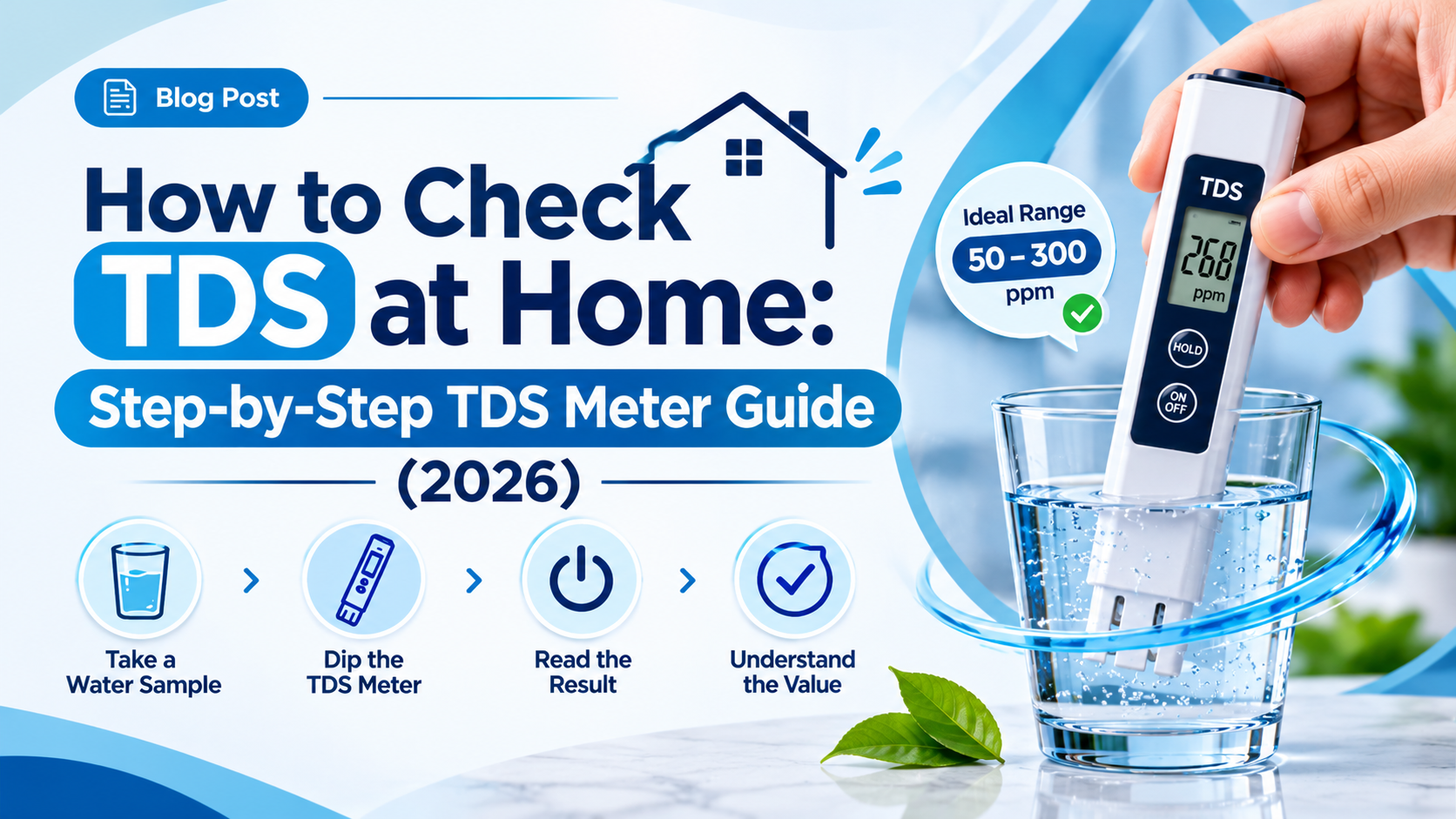
Quick answer: To check TDS at home, fill a clean glass with your water, switch on a digital TDS meter, dip it in up to the marked line, stir lightly to clear air bubbles, wait 10 to 15 seconds, then press hold and read the ppm value. It takes under two minutes. For an RO purifier, test the raw water going in and the purified water coming out, and compare the two.
Key takeaways
Not much. A digital TDS meter, a clean glass or steel tumbler, and a pen and paper (or your phone's notes) to log readings.
The meter does the clever part. TDS (total dissolved solids) is the amount of dissolved minerals and salts in your water, shown in ppm (parts per million, which is practically the same as mg per litre). A TDS meter doesn't count those particles one by one. It measures how well the water conducts electricity, because dissolved salts make water more conductive, and then converts that to a ppm figure using a built-in factor. That's why it's quick, cheap and good for tracking changes, and also why it can't tell you what is dissolved.
If you want one, the Pearl Water TDS Meter is listed at Rs. 359 before GST (Rs. 424 including GST). It reads 0 to 9,990 ppm, has a built-in thermometer, a hold button and a large LCD, and comes pre-calibrated with a carry pouch. More on what to look for further down.
1. Collect a clean sample. Run the tap for 20 to 30 seconds first, so you're testing fresh water from the line and not what's been sitting in the pipe. Fill a clean, dry glass. Rinse it once with the same water before the final fill, because leftover soap or juice will skew the number.
2. Switch on the meter. Take off the protective cap and press the power button.
3. Dip it in, but only up to the line. Immerse the meter up to its maximum immersion level and no further. Don't let it touch the sides or bottom of the glass. Dipping past the line is the quickest way to damage a meter.
4. Stir lightly and wait. Give it a gentle swirl to dislodge tiny air bubbles clinging to the electrode, then hold still for 10 to 15 seconds. The number will wobble for a moment and then settle.
5. Press hold, then read. Hit the hold button to lock the value, lift the meter out and note it down. This is the reason hold exists: you can read it comfortably without the number changing as you pull the meter from the water.
6. Switch off and dry. Turn it off, wipe the electrode dry and put the cap back. Don't leave it in a hot car or in direct sun.
That's the whole routine. Write the reading down with the date and the source (tap, borewell, tank or purifier). A single number tells you little. A log of five or six tells you a lot.
This is the most useful thing a TDS meter does for anyone who owns an RO. Do it in two readings, back to back:
Then work out the rejection rate:
Rejection % = (Input TDS minus Output TDS) divided by Input TDS, times 100
A worked example: raw water reads 800 ppm and purified water reads 40 ppm. That's 760 removed out of 800, which is 95%. A healthy RO membrane typically rejects somewhere around 90 to 98%. If the same purifier later reads 120 ppm on the same 800 ppm input, that's 85%, and it's telling you something has changed.
Two honest caveats. First, many purifiers have a TDS controller that deliberately blends a little raw water back in for taste, so the output won't be near zero and your calculated rejection will look lower than the membrane's real rating. That's by design. Second, a single reading can mislead, so compare against your own earlier readings, not just a textbook number.
What to do with your result:
Two reference points help. India's drinking water standard, BIS IS 10500:2012, sets an acceptable limit of 500 ppm and allows up to 2,000 ppm only where there is no better source. WHO's older taste guidance rates water under 300 ppm as excellent, 300 to 600 as good, 600 to 900 as fair, 900 to 1,200 as poor and above 1,200 as unacceptable to taste.
Reading (ppm) |
What it usually means |
Sensible next step |
Under 50 |
Very low. Typical of RO output without a TDS controller |
Fine to drink. Some people find it tastes flat |
50 to 150 |
Typical healthy RO output with a controller |
Nothing to do. Keep logging |
150 to 300 |
Soft-to-moderate tap water |
If this is your tap water, see do I need RO if TDS is below 200? |
300 to 500 |
Within the BIS acceptable limit |
A standard RO purifier is enough if you want to lower it |
500 to 1,000 |
Above the acceptable limit, common with borewells |
Use RO. A membrane with headroom helps |
1,000 to 2,000 |
High |
Use an RO built for high TDS. See our buying guide and price guide |
Above 2,000 |
Very high |
Call us before buying. A domestic unit may not be enough |
For the full safe-range picture, read our Ideal TDS Level for Drinking Water guide. And if your water has started tasting different, a quick reading is the fastest first clue, as we explain in why your water might taste different suddenly.
Not accurately. You can't taste or see a TDS number. Cloudy water isn't necessarily high in TDS, and crystal-clear water can be very high. The reference method in labs is to evaporate a measured volume of water and weigh the dry residue, which needs a precise scale and isn't practical at home. Some RO purifiers display a TDS reading, but that's a built-in meter doing the same job.
So your realistic options are a digital meter for everyday checks, or a lab test if you need a certified result (for example, for a business, a school or a legal requirement).
If a number surprises you, check these before you blame the water or the purifier:
What you see |
Likely cause |
Fix |
Number keeps jumping |
Air bubbles on the electrode, or you're moving the meter |
Stir gently once, then hold still for 10 to 15 seconds |
Different number every time |
Dirty glass, or sample taken before the tap ran clear |
Rinse the glass, let the tap run 20 to 30 seconds, test again |
Reads higher than expected |
Residue on the electrode or in the glass |
Rinse the electrode in clean water, dry it, retest |
Reading changes with warm vs cold water |
Temperature affects conductivity (very roughly 2% per degree C) |
Test at about room temperature |
Display faint, erratic or blank |
Low battery |
Replace the battery |
Two meters disagree slightly |
Normal meter-to-meter variation |
Track trends on one meter instead of comparing exact numbers |
This model is listed as pre-calibrated, so you shouldn't need to adjust it. If readings still look off, test the same water on a second meter or send a sample to a lab.
This is the part most guides skip, and it matters. A TDS meter measures total dissolved solids and nothing else. It cannot detect:
The reverse is also true: a high reading doesn't automatically mean the water is dangerous, and a low reading doesn't mean it's safe. It's an excellent screening and tracking tool, not a safety certificate. If you have a real health concern, read is your water making you sick? and consider a lab test. On a related note, if you've been wondering about water and hair, we cover that in can high TDS water cause hair fall?.
Once a month is a good baseline for a household. Test extra:
If you own an RO, build the monthly reading into your maintenance routine alongside the tips in how to maintain your RO water purifier.
You don't need anything fancy, but a few features make a real difference in daily use:
Here is how the Pearl Water meter lines up, using its product page:
Spec |
Pearl Water TDS Meter |
Type |
Digital |
TDS range |
0 to 9,990 ppm |
Temperature range |
0.1 to 80.0 degrees C |
Accuracy |
Plus or minus 2% |
Battery life |
About 3 months |
Extras |
Hold function, auto-off after 10 minutes, built-in thermometer, carry pouch with clip |
Price |
Rs. 359 excl. GST (MRP Rs. 399), Rs. 424 incl. GST (MRP Rs. 471) |
Warranty / returns |
1 year warranty, 10-day replacement |
Multi-unit offer |
Buy 2 for 3% off, 3 for 4% off, 4 or more for 5% off |
If you're testing for a family, a shop and a house at once, the multi-unit discount adds up, and it pairs naturally with a new RO purifier, a replacement RO filter kit or a domestic RO membrane.
How can I check the TDS of water at home? Use a digital TDS meter. Fill a clean glass, switch the meter on, dip it in up to the marked line, stir lightly to clear air bubbles, wait 10 to 15 seconds, press hold and note the ppm value.
Can I check TDS without a TDS meter? Not accurately. Taste and appearance can't tell you the TDS. The lab reference method (evaporate and weigh the residue) isn't practical at home, so use a digital meter, or a lab test if you need a certified result.
How do I check if my RO purifier is working properly? Test the TDS of the raw input water and the purified output water, then calculate rejection: input minus output, divided by input, times 100. A healthy membrane typically rejects around 90 to 98%. A rejection rate that keeps falling suggests the membrane or filters need attention.
What is a normal TDS reading for drinking water? Under India's BIS IS 10500:2012, 500 ppm is the acceptable limit, and up to 2,000 ppm is permissible only where no better source exists. WHO's older taste guidance rates under 300 ppm as excellent and 300 to 600 ppm as good. RO output with a TDS controller commonly sits around 50 to 150 ppm.
Is a TDS meter accurate? For household tracking, yes. The Pearl Water meter lists plus or minus 2% accuracy. It's best for spotting changes over time rather than for certified results, and two different meters can differ slightly.
How often should I check my water's TDS? Monthly as a baseline, and also after season changes, switching sources, changing filters or when taste changes.
Does a TDS meter show if water is safe to drink? Not on its own. It measures dissolved solids only. It doesn't detect bacteria, pesticides, heavy metals or hardness, so treat it as a screening and tracking tool.
Why does my RO water show a higher TDS than it used to? Usually an ageing membrane, overdue filters or a drifted TDS controller. See TDS not reducing after changing the membrane and book an RO service if it keeps climbing.
Ready to test your own water? Get the Pearl Water TDS Meter, call us on 9582215137, or message us on WhatsApp with your reading and we'll tell you what it means and what, if anything, you need.
Action completed successfully.

Leave A Comment