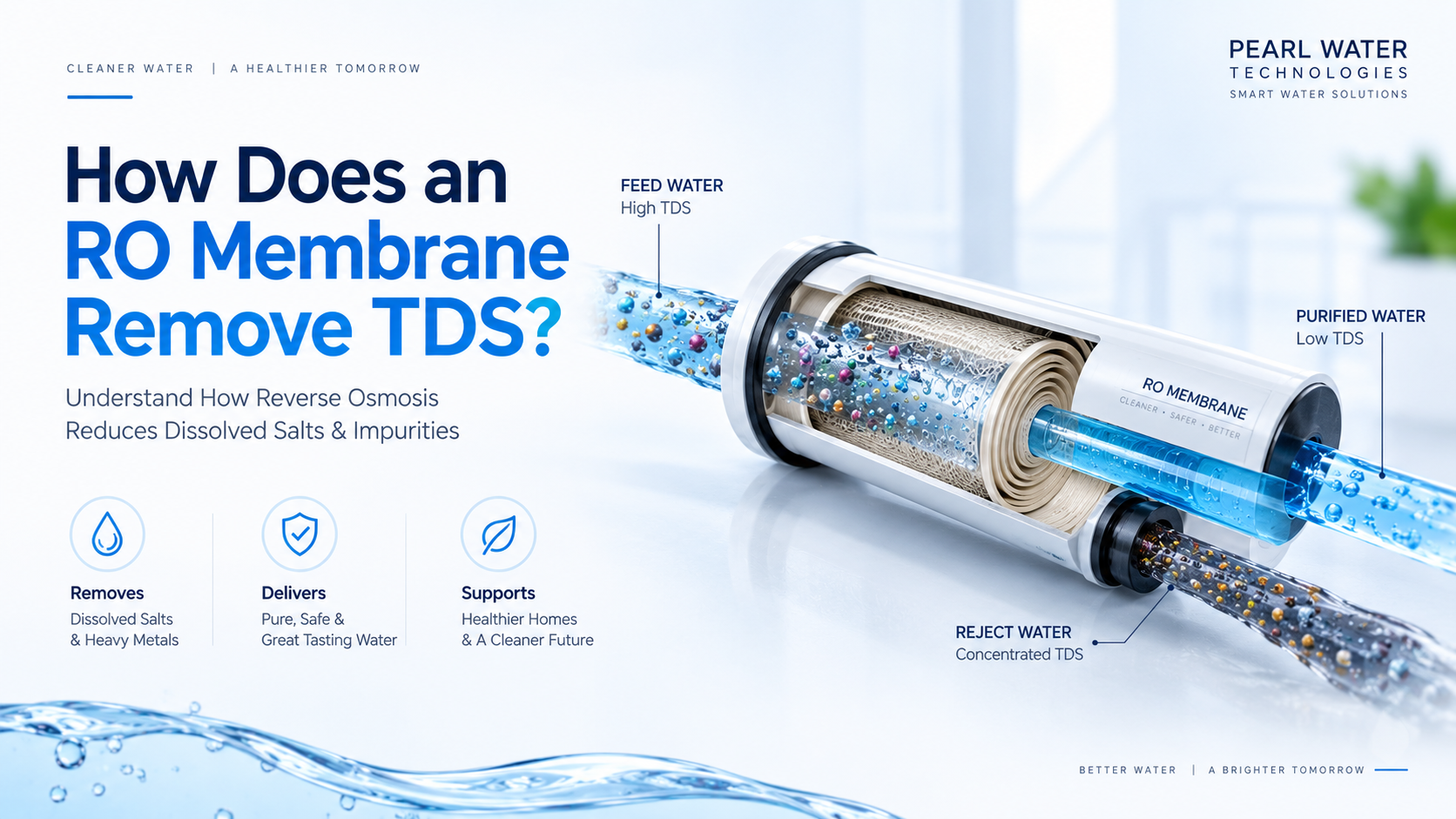
An RO membrane removes TDS by forcing water under pressure through a non-porous, semi-permeable polyamide layer that only lets water molecules pass through via a solution-diffusion process — dissolved salt ions are chemically excluded by their size and charge, not filtered out like sediment. This typically rejects 90–99% of dissolved salts, depending on membrane condition, pressure, and feed water quality.
If you only need the headline, that's it. Below is the actual mechanism, what changes real-world rejection rates, and how to verify your own system is still doing its job.
TDS (Total Dissolved Solids) is the combined concentration of all dissolved substances in water — minerals, salts, and metal ions like calcium, magnesium, sodium, chloride, fluoride, and, in contaminated sources, heavy metals like lead or arsenic. TDS is measured in PPM (parts per million).
High TDS doesn't just affect taste — it's often the reason water tastes "hard," salty, or metallic, and it's the specific problem an RO membrane is designed to solve. Neither a sediment filter nor a carbon filter reduces TDS — they remove particles and chlorine/odour respectively. Only the membrane stage touches dissolved solids.
Natural osmosis moves water from a less-concentrated solution to a more-concentrated one, across a semi-permeable membrane, trying to equalize concentration.
Reverse osmosis applies external pressure to force that flow to run backward — pushing water out of the concentrated (contaminated) side, leaving dissolved salts behind.
That's the setup. What actually happens at the membrane surface, molecule by molecule, is where TDS removal actually occurs — and that's a more specific mechanism than "filtering."
The Real Mechanism: How TDS Actually Gets Rejected
Here's the part most explanations skip: an RO membrane doesn't work like a strainer. A sediment filter is a strainer — it has physical holes, and anything bigger than the hole gets blocked. An RO membrane's active layer, by contrast, has no pores large enough to be called holes in any meaningful sense (roughly 0.0001–0.0005 micron — smaller than most dissolved ions, but that's not the full story either).
Instead, RO membranes work on what's called the solution-diffusion model:
Water molecules dissolve into the dense polyamide layer on the membrane's surface (the same way a gas dissolves into a liquid, chemically, not mechanically).
Under pressure, those dissolved water molecules diffuse through the polymer layer, driven by the concentration and pressure gradient.
On the other side, water molecules come back out of solution, re-forming as liquid permeate.
Dissolved salt ions are far less soluble in the membrane's polymer material and diffuse through it dramatically slower — in practice, close to not at all under normal operating conditions.
This is why membrane material (see our guide on RO membrane material and structure) matters so much: TDS rejection isn't primarily about pore size at all — it's about how selectively the polymer dissolves water versus dissolved ions. A Thin Film Composite polyamide layer is specifically engineered to maximize that selectivity.
A second, reinforcing effect — charge exclusion: most dissolved salts split into charged ions in water (sodium becomes Na?, chloride becomes Cl?). The polyamide membrane surface carries its own slight electrical charge, which repels similarly-charged ions approaching the surface — an additional barrier layered on top of the solution-diffusion mechanism, particularly effective against multivalent ions like calcium and magnesium.
Step-by-Step: What Happens to a Dissolved Salt Ion
Feed water, pressurized by a booster pump, reaches the membrane surface after passing through sediment and carbon pre-filtration.
Water molecules at the membrane surface dissolve into the polyamide layer; the dissolved salt ion largely does not.
Applied pressure drives dissolved water molecules through the polymer via diffusion.
The salt ion, unable to effectively enter or diffuse through the polymer layer, is swept along the membrane surface by the remaining flow instead — becoming part of the reject/concentrate stream.
Water molecules exit the far side of the membrane as permeate — the purified water headed to your storage tank.
The reject stream, now carrying a higher concentration of the rejected salts, is flushed out as waste water.
This is also why RO systems always produce two output streams, not one — the rejected TDS has to go somewhere, and that's the reject/waste line, not the membrane itself.
TDS Rejection Rate vs Recovery Rate — Not the Same Thing
These two numbers get mixed up constantly, and they measure completely different things:
Rejection rate — the percentage of dissolved salts the membrane blocks. A 95% rejection rate means output TDS is roughly 5% of input TDS. This is the number that answers "how well does it remove TDS."
Recovery rate — the percentage of total feed water that becomes usable purified water, versus how much becomes reject/waste. Domestic systems typically run 25–30% recovery. This answers "how much water is wasted," not "how clean is the output."
A membrane can have excellent rejection and poor recovery (very clean water, lots of waste) or the reverse — they're independent specs, and both matter for different reasons.
What Actually Affects How Much TDS Gets Removed
Rejection rate isn't fixed once you buy a membrane — real-world TDS removal depends on:
Membrane condition — scaling, fouling, or physical damage reduces the polyamide layer's selectivity over time. This is why membrane fouling is a real performance issue, not just a flow-rate issue.
Operating pressure — too little pressure and the water/salt diffusion selectivity ratio shifts unfavorably; RO systems are engineered around a specific pressure range for a reason.
Feed water temperature — higher temperature generally increases flow but can slightly reduce rejection, since membrane permeability changes with temperature.
Feed water TDS level itself — very high input TDS pushes closer to a membrane's rated working limit (commonly up to 1000–2000 PPM for domestic membranes), reducing effective rejection at the margin.
Pre-filtration quality — a worn sediment filter or carbon filter lets abrasive particles or chlorine reach the membrane, physically damaging the selective layer and permanently reducing its rejection capability.
Membrane age — even with perfect maintenance, the polyamide layer's selectivity gradually declines over its service life, typically 12–24 months for domestic membranes.
How to Verify Your RO Membrane Is Actually Removing TDS
The only reliable way to know your actual rejection rate isn't to guess — it's to measure it directly with a TDS meter:
For example: input 500 PPM, output 40 PPM → (1 − 40/500) × 100 = 92% rejection. A healthy domestic RO membrane should sit at 90% or higher; a sustained drop below that is a clear, measurable sign of membrane wear — more reliable than judging by taste alone.
When TDS Removal Starts Failing
Rising output TDS is usually the earliest, most measurable sign your membrane needs attention — often appearing before flow rate drops or taste changes become obvious. For the full troubleshooting breakdown and replacement guidance, see:
Q: Does an RO membrane filter out TDS like a sieve?
No. TDS removal happens through a solution-diffusion process — water molecules dissolve into and diffuse through the membrane's polymer layer, while dissolved salt ions largely can't, plus a charge-repulsion effect at the membrane surface. It's a chemical selectivity mechanism, not physical straining like a sediment filter.
Q: What percentage of TDS does an RO membrane remove?
Typically 90–99%, depending on membrane technology, condition, operating pressure, and feed water TDS level. Domestic Thin Film Composite membranes commonly rate 90–95%.
Q: Why does my RO water still show some TDS on a meter?
No RO membrane achieves 100% rejection — a small percentage of dissolved salts always pass through, which is normal and expected. As long as rejection stays above roughly 90%, the system is performing correctly.
Q: What's the difference between rejection rate and recovery rate?
Rejection rate measures how much TDS the membrane blocks (water quality). Recovery rate measures how much of the feed water becomes usable purified output versus waste (water efficiency). They're independent specs.
Q: Can I improve my RO membrane's TDS removal without replacing it?
Only marginally — checking and replacing worn pre-filters (sediment and carbon) protects the membrane from further damage, and confirming correct operating pressure helps. But a membrane whose polyamide layer has already degraded from age or fouling needs replacement to restore rejection rate; cleaning alone won't reverse structural wear.
Q: How do I test if my RO membrane is still removing TDS properly?
Use a TDS meter to compare input and output water TDS, then calculate rejection rate: (1 − output ÷ input) × 100. Rejection consistently below 90% signals it's time to inspect or replace the membrane.
About This Guide
Written and reviewed by the Pearl Water technical team, based on our direct experience manufacturing and testing domestic and industrial RO membranes, including the 80 GPD RO Membrane Classic. For the broader system overview, see our companion guide: What Is an RO Membrane and How Does It Work?


Leave A Comment