


29-Jul-2026
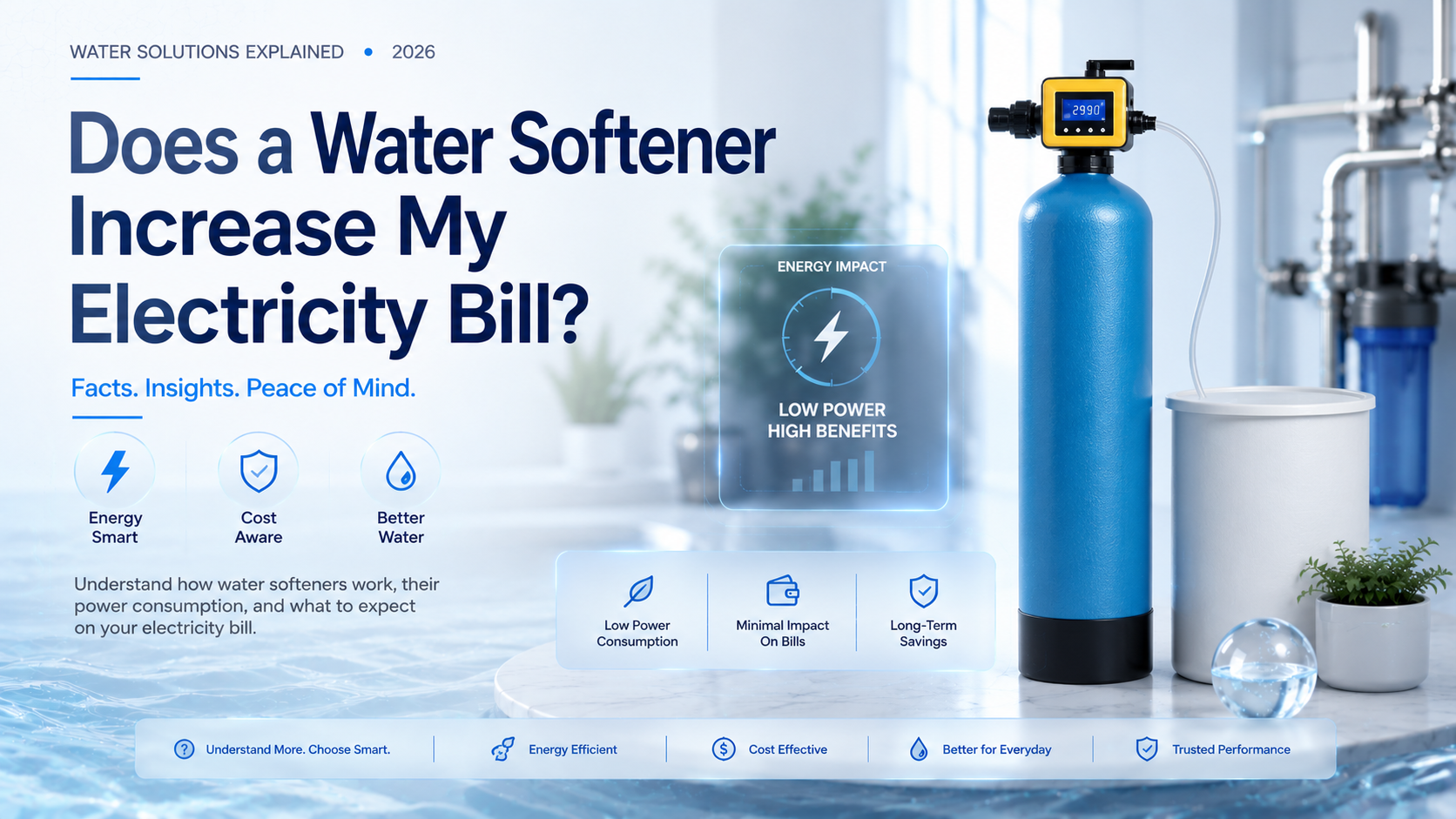
Quick answer: No, not meaningfully. A water softener's control valve — the only electrical part in the system — draws roughly as much power as a Wi-Fi router, and it only runs briefly during a regeneration cycle every few days, not continuously. Semi-automatic softeners need no continuous electricity at all. In fact, most homes see their overall energy costs go down after installing one, because hard water is what actually drives up electricity bills over time by making your geyser and heating appliances work harder against limescale.
If you're comparing water softeners and this is your main hesitation before buying, here's the full picture — how much power the unit itself actually uses, why hard water is the real cost driver, and the math behind why softening your water is usually a net saving, not a net expense.
A water softener is a largely mechanical device — water passes through a resin bed, minerals get exchanged, and periodically the system flushes and recharges itself with brine. The only component that needs electricity at all is the control valve/head, which manages timing and, on fully-automatic units, triggers the regeneration cycle automatically.
That control valve typically draws a very small amount of power — comparable to a small Wi-Fi router or a phone charger left plugged in — and it isn't running at full draw all day. It's mostly idle, waking up briefly to check the schedule or execute a regeneration cycle that usually takes somewhere between 20–90 minutes, once every few days depending on your water usage and hardness level.
There's no heating element, no compressor, no continuous pump running in a typical residential softener — which is exactly why its direct electricity footprint is so small compared to appliances people actually worry about, like geysers, air conditioners, or washing machines.
Yes — but perhaps not the way people expect. The difference isn't "high power vs low power," it's "some power vs effectively none."
Type |
Needs Continuous Power? |
What Uses Electricity |
Typical Impact on Bill |
Fully Automatic |
Yes, but minimal |
Control valve + timer, runs regeneration automatically on schedule |
Negligible — comparable to a small always-on gadget |
Semi-Automatic |
No |
Nothing — regeneration is triggered manually via a valve |
Zero direct electricity cost |
If minimizing electricity use is your absolute top priority and you don't mind manually triggering regeneration every few days, a semi-automatic system uses no power at all. If convenience matters more to you, a fully-automatic system's power draw is small enough that it won't show up as a noticeable change on your monthly bill. For a full breakdown of how these two types compare beyond just electricity — cost, maintenance, and convenience — see our detailed guide on choosing between them when you're browsing water softener systems for your home.
Here's the part most people miss when they ask this question: it's usually not the softener that increases electricity costs — it's the hard water it's replacing.
When water carrying dissolved calcium and magnesium is heated repeatedly — inside a geyser, for instance — those minerals precipitate out as limescale on the heating element. This scale layer acts as an insulator between the heating element and the water it's supposed to be heating. The element has to run longer, and work harder, to transfer the same amount of heat through that scale buildup, which translates directly into higher electricity consumption for something as routine as heating water for a shower.
This effect compounds over time as scale thickens, which is exactly why a geyser in a hard-water home often becomes noticeably less efficient (and needs more frequent servicing or element replacement) well before it would in a soft-water home. We've covered this specific mechanism in more depth here: How to Prevent Scaling on Your Geyser Due to Hard Water.
So the realistic comparison isn't "electricity bill with no softener vs. electricity bill with a softener installed." It's "electricity bill with an increasingly scaled-up geyser vs. electricity bill with a geyser that stays close to its rated efficiency" — and the second scenario is the one a water softener helps you stay in.
Exact numbers vary by household — geyser capacity, water usage, local hardness level, and electricity tariff all play a role, so treat this as an illustration of the direction of the effect rather than a fixed number for your home:
Over a year, the tiny, occasional draw of a softener's control valve is very unlikely to outweigh the efficiency you preserve in your geyser, RO purifier pump (if applicable), and other water-heating appliances by preventing scale in the first place. This is why many households report their electricity usage staying flat or even easing slightly after switching to softened water, rather than increasing.
If you want the fuller cost picture — not just electricity, but installation, salt, and resin over time — this guide walks through it: Water Softener Price in India 2026: Complete Cost Guide.
Even though the direct impact is already small, a few habits keep it that way:
Q: Does a fully automatic water softener need to be plugged in all the time? Yes, a fully automatic system needs continuous (low) power to keep its control valve's timer and settings active, even though actual regeneration only runs briefly every few days.
Q: Will installing a water softener show up as a noticeable change on my electricity bill? For most households, no — the softener's own power draw is too small to separate from your home's normal background electricity usage. If anything, many households see a slight improvement over time as geysers and heaters run more efficiently on softened water.
Q: Does a semi-automatic water softener use any electricity at all? No. Semi-automatic softeners are fully manual — you trigger the regeneration cycle yourself via a valve, with no electrical components involved.
Q: Is a water softener's electricity use higher than an RO water purifier's? Generally no. RO purifiers run a pump more continuously during filtration, while a softener's control valve is mostly idle and only active briefly during scheduled regeneration — making a softener's typical power draw lower in comparison.
This guide reflects general engineering principles of ion-exchange water softeners and limescale's well-documented effect on heating-element efficiency, along with practical field observations from installing and servicing water softeners across Indian households. Exact electricity impact varies by geyser capacity, water usage, and local hardness levels — for a number specific to your home, comparing two to three months of electricity bills before and after installation remains the most reliable way to measure it.
Written and reviewed by the Pearl Water Technologies content team, based on our experience manufacturing and installing water softeners, FRP vessels, and water treatment spares across India.
Leave A Comment