03-Nov-2026
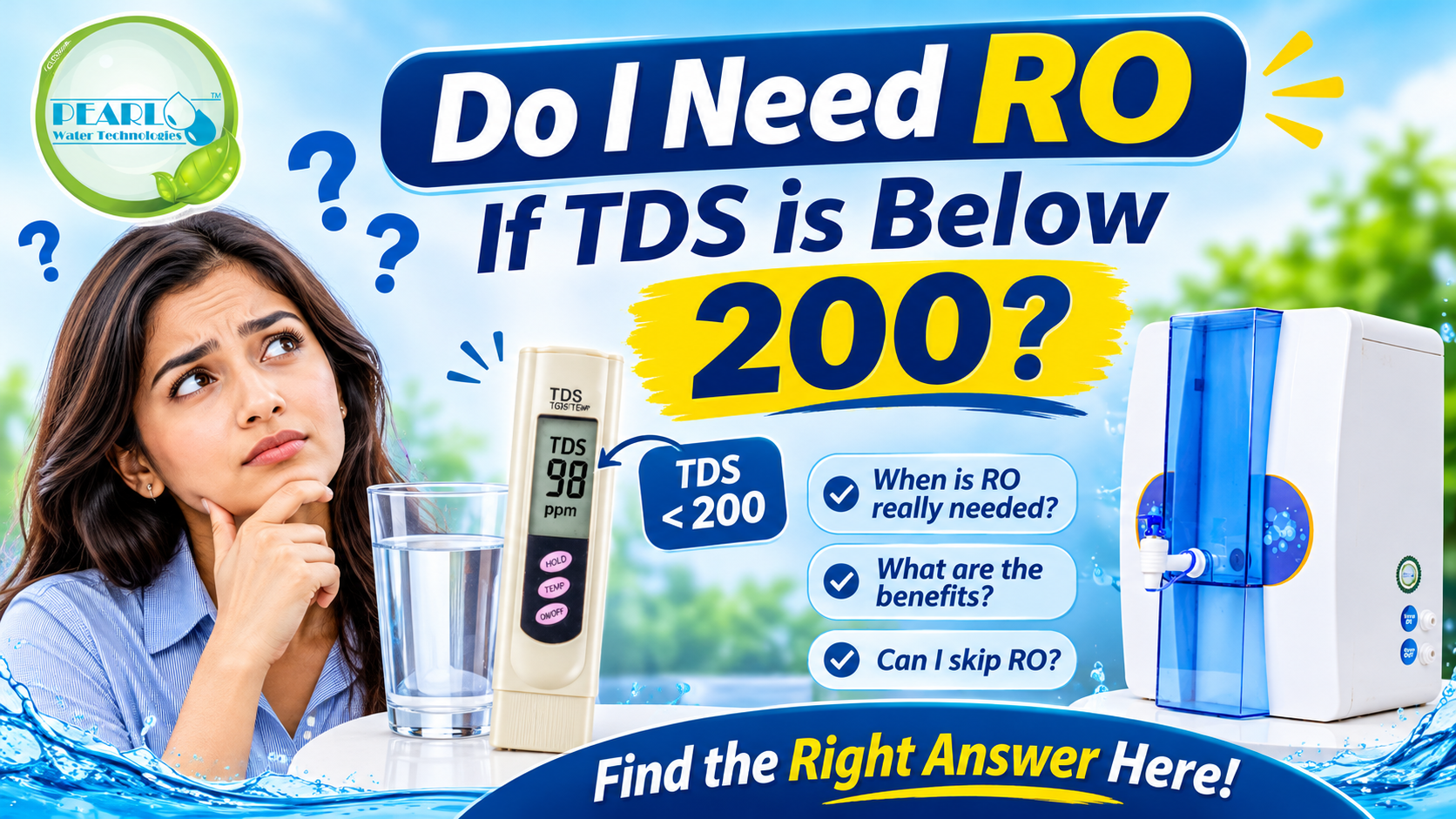
What does a TDS reading below 200 actually tell you?
TDS (total dissolved solids) is the total amount of dissolved minerals and salts in water, shown in mg/L or ppm. A handheld TDS meter reads it by measuring electrical conductivity.
A low number is a good sign, but it’s an incomplete one. A TDS meter cannot tell you whether the water contains:
That’s why we tell customers to treat TDS as a screening number, not a safety certificate.
BIS standard IS 10500:2012 sets 500 mg/L as the acceptable limit for TDS in drinking water, and 2,000 mg/L as the permissible limit where no better source exists. WHO describes water under 300 mg/L as excellent for taste and over 1,200 mg/L as unacceptable.
TDS (ppm) |
What it generally means |
|---|---|
Below 300 |
Excellent taste rating (WHO) |
Up to 500 |
Within BIS acceptable limit |
500 to 2,000 |
Permissible only if no alternative source exists (BIS) |
Above 1,200 |
Taste rated unacceptable (WHO) |
At 200 ppm, you are well inside every one of these bands.
For most households, no. An RO membrane is built to reduce dissolved salts. If there aren’t many salts to remove, you pay for a system that wastes water and strips useful minerals without solving a problem you have.
This is also the direction of Indian policy discussion. In 2019 the National Green Tribunal told the environment ministry to prohibit RO where TDS is under 500 mg/L, and to require recovery of more than 60% of water where RO is allowed. The reasoning from its expert committee was that RO is not useful at such levels and removes important minerals while wasting water. The Supreme Court later stayed a December 2021 NGT order on this issue. In the sources we checked, no final ban has been confirmed, so please check the current position before relying on it.
Low TDS doesn’t rule out contamination. Consider RO, or a specific treatment, if a lab report shows any of these:
In our installations, the “surprise” cases are often borewell water that reads low on a TDS meter but fails a lab test on one specific parameter. This is why we ask for a lab report before recommending anything.
A NABL-accredited lab report is the most reliable basis for this decision.
For clean, low-TDS water, a layered setup is usually enough:
Keep the filters changed on time. If you already have a system, our guides on when to change RO filters and how long they last cover replacement timing.
You have a few sensible options:
Customers who call us about “flat-tasting” RO water often turn out to have low-TDS source water. That is worth checking before you replace anything. If you’re troubleshooting a different RO issue, our RO troubleshooting posts may help, and you can also see our RO filter kits and RO water purifiers.
1. Is TDS below 200 safe to drink?
It’s within BIS and WHO TDS guidance, but TDS alone doesn’t prove safety. Bacteria, nitrate, fluoride, arsenic and heavy metals need separate tests.
2. Is RO bad for low-TDS water?
It’s usually unnecessary. RO removes dissolved salts, so on low-TDS water it can leave very low-mineral water and waste a lot of reject water.
3. What is the ideal TDS for drinking water?
WHO rates water below 300 mg/L as excellent for taste. BIS allows up to 500 mg/L as acceptable. There is no single “perfect” number.
4. What if my TDS is below 200 but the water tastes or smells bad?
Taste and smell often come from chlorine, iron, hardness or organic matter, not TDS. A carbon filter, sediment filter or softener may fix it better than RO.
5. Can a TDS meter tell me if water is safe?
No. It measures conductivity only. Use it as a quick screen, then confirm with a lab test.
Action completed successfully.

Leave A Comment