


06-Oct-2026
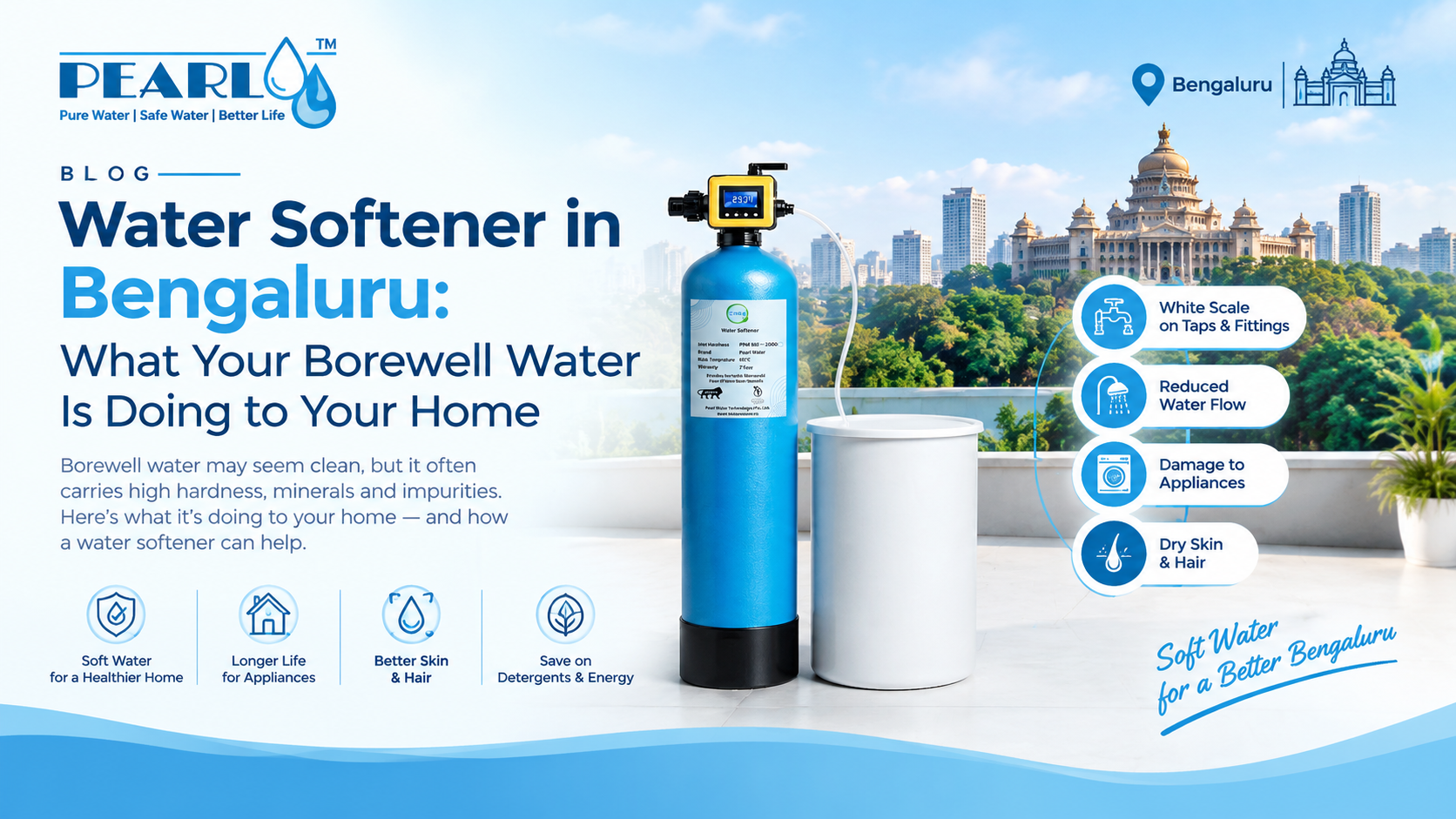
By Pearl Water Technologies, Bengaluru branch · Published 6 October 2026 · Updated 6 October 2026
If your Bengaluru home runs on borewell water, or a mix of BWSSB (Cauvery) supply and borewell water in a shared sump, there is a good chance it is hard. Independent surveys and government groundwater studies of the city have repeatedly flagged high hardness and TDS, more often in borewell samples than in BWSSB supply. A 2-3 bathroom apartment usually needs a 1000 LPH fully automatic water softener; an independent house or villa typically needs 2000 LPH or more. Test your tap first, then size the unit.
Question |
Short answer |
Who needs one? |
Homes on borewell water, or BWSSB supply mixed with borewell in a sump |
Typical apartment (2-3 bathrooms) |
1000 LPH fully automatic |
Independent house / villa |
2000 LPH or higher |
Only the geyser scales up |
250 LPH geyser softener |
Price |
Home range starts from about Rs. 8,464 (check the water softener page for current prices) |
Local service |
Pearl Water Technologies, Bengaluru |
Two sources, mixed unevenly across the city. BWSSB pipes in Cauvery river water to large parts of the core city. Everywhere else, and often alongside BWSSB connections too, apartments, villas and independent houses rely on borewells drilled 400 to 1,500 feet down. As the city has grown outward into layouts like Whitefield, Sarjapur Road, Electronic City and Yelahanka, borewell dependence has grown with it, because BWSSB pipelines have not always kept pace with new construction.
Most apartment complexes blend whatever BWSSB water they get with their own borewell output in a common underground sump, then pump it up to overhead tanks. So even a building with a BWSSB connection can still deliver hard water at the tap if the sump mix leans heavily on the borewell. This is the detail that makes a single "Bengaluru hardness number" misleading, and why your own building's sump matters more than the locality's reputation.
For a large share of borewell-dependent homes, yes. A city-wide household survey commissioned a few years ago tested over a thousand homes and found a noticeable share of samples with hardness above acceptable levels, with the problem concentrated in borewell water rather than BWSSB supply. Separately, a Department of Mines and Geology study that analysed thousands of groundwater samples across Bengaluru found total hardness, TDS, nitrate and iron exceeding permissible limits in a meaningful portion of the city, particularly from deeper borewells. Academic studies of specific pockets, including industrial belts like Peenya, have reported total hardness and TDS well beyond acceptable levels in local groundwater.
These are area-wide figures from different years and different sampling methods, so none of them tell you what is coming out of your own tap today. Treat them as a reason to test, not as your personal result. Our own field readings from Bengaluru homes: 450–900 ppm total hardness, measured across selected layouts including NRI Layout, HSR Layout, Whitefield and Sarjapur Road.
Not sure yet? Read how to check water hardness at home, or how to tell if your whole area has hard water. You can also bring a sample from your sump or overhead tank to our Bengaluru team for a reading.
We have not measured every layout individually, so this goes by home type and water source rather than claiming a fixed number for each area.
Where you live |
Water source |
What we usually suggest |
Whitefield, Sarjapur Road, Electronic City, Marathahalli |
Mostly borewell, newer high-rise apartments |
1000 LPH automatic at the apartment inlet, or a central unit at the society's sump if the committee wants one plant for all towers. |
BTM Layout, Jayanagar, JP Nagar, Banashankari |
BWSSB with borewell backup |
Test first, since BWSSB-heavy buildings may need only a smaller unit; borewell-heavy ones need full capacity. |
Yelahanka, Hennur, Hebbal, Thanisandra |
Mixed, many newer borewells |
1000 to 2000 LPH depending on bathrooms and daily usage. |
Independent houses, villas (Varthur, Sarjapur outskirts, Devanahalli) |
Own borewell, often deep |
2000 LPH or above, sized to the household's daily litres. |
Peenya, industrial belts |
Borewell, sometimes affected by industrial discharge |
Get water tested for heavy metals and industrial contaminants in addition to hardness before choosing a plan. |
Still deciding on capacity? Our guide to 1000 vs 2000 vs 3000 LPH softeners breaks it down by bathroom count and usage.
Full range and prices on the water softeners page. For what drives the cost, see the water softener price guide.
Bengaluru has a large share of its housing in large gated communities and multi-tower societies, many running their own borewells and sumps for hundreds of flats. Softening at the central sump, rather than flat by flat, is often the more practical and economical route for an RWA or builder association to take, since it protects every flat's plumbing and every common-area appliance in one go. Sizing depends on total daily consumption across the society, not bathroom count per flat. Read our full society water softener guide, and call our Bengaluru team with your society's daily usage for a proposal.
Usually both, if your borewell TDS runs high, which is common across much of the city. A softener protects pipes, the geyser, your washing machine and your RO membrane from scale. An RO purifier at the kitchen brings TDS down for drinking water. They solve different problems, so one does not replace the other. Full comparison in softener vs RO plant and softener vs purifier for home. Already have an RO that needs attention? Book RO service, or browse our RO water purifiers. Unsure what TDS reading is acceptable? See recommended TDS level for RO water.
Thinking of fitting it yourself? Read can you install a softener without a plumber first. If an existing unit has stopped softening properly, start with our softener troubleshooting guide. Scale building up specifically on the geyser has its own fix: how to prevent geyser scaling.
Salt tablets are available in 25 kg, 50 kg and 100 kg packs. Resin comes in 25 litre and 50 litre bags. Full range on the softener spares page. For a sense of ongoing salt cost, see the salt price guide.
Looking for a water softener, RO system, or water-treatment solution in Bengaluru? Get in touch with the Pearl Water Bengaluru team for product guidance, water-treatment solutions, installation support, and service assistance.
Address: 7&8, V P Multi Zone, Shop No. 05/01, 5th Main Road, NRI Layout, Kalkere, Bengaluru – 560016
WhatsApp / Phone: 080-31685682
Email: pwtsouth@gmail.com
Office Hours: 10:00 AM – 5:00 PM
Areas We Cover: Bengaluru and surrounding areas, subject to service availability.
Site Visits & Installation: Site visits and installation support are available based on the product and location. Contact the Bengaluru team to confirm availability and schedule.
Delivery: Pearl Water delivers water-treatment products in Bengaluru. Delivery availability and timelines may vary by product and location; confirm the details with the team before ordering.
You can also reach us through our contact page or find a suitable Pearl Water service partner.
For faster assistance, share your Bengaluru location, water source, and available TDS or hardness reading with the team so they can recommend a suitable water-treatment solution.
Mostly the borewell water. Studies have repeatedly found hardness and TDS above acceptable limits in a meaningful share of Bengaluru groundwater samples, more so than in BWSSB supply. Test your own tap.
A 1000 LPH fully automatic unit on the main inlet suits most 2-3 bathroom flats. Villas typically need 2000 LPH or more.
Possibly yes, since many buildings blend BWSSB supply with borewell water in a shared sump. Test the tap before deciding.
Our home range starts from about Rs. 8,464 and rises with capacity and automation. Installation and delivery charges for Bengaluru.
Through our Bengaluru team, or online at pearlwater.in.
Leave A Comment