


24-Apr-2026
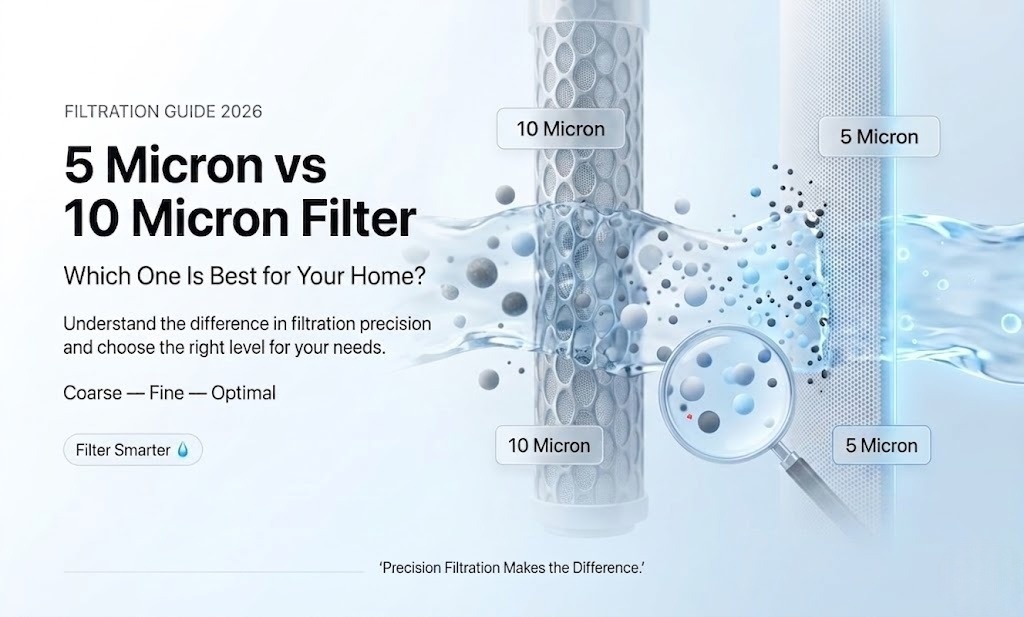
If you live in India, dealing with muddy municipal water or hard borewell water is a common household struggle. You rely on your RO water purifier to keep your family safe, but have you ever paid attention to the pre-filter installed outside the machine?
Most homeowners face a common dilemma when buying a ro kit: Should you choose a 5 micron filter or a 10 micron filter?
Choosing the wrong ro water purifier filter can lead to clogged membranes, slow water flow, and frequent machine breakdowns. In this comprehensive 2026 guide, we will break down the differences, explain which one suits Indian water conditions best, and help you choose the perfect filter kit for your home.
To understand which filter is better, we first need to understand what a "micron" actually is. A micron (short for micrometer) is a unit of measurement equal to one-millionth of a meter, or 1/1000th of a millimeter.
To put this into perspective:
When we talk about the cartridge filter micron size, we are referring to the size of the pores in the filter material. A filter’s micron rating tells you what size of particles it can successfully block.
Understanding your required cartridge filter size is the most crucial step before investing in a water purifier kit.
A 5 micron water filter is designed to catch very fine particles. Because the pores are so small, it offers an incredibly thorough level of mechanical filtration before the water even enters your main RO system.
In the Indian context, a 5 micron filter is highly recommended if your primary water source is a borewell or underground tank. Borewell water often contains very fine, dissolved sand and silt that isn't always visible to the naked eye but will absolutely destroy an RO membrane over time.
Always check the cartridge filter specification when buying. A true 5 micron spun filter will feel denser and heavier than higher micron variants.
A 10 micron filter has slightly larger pores. It is designed to act as a robust first line of defense, catching larger debris without clogging up too quickly.
If you receive municipal supply (like Delhi Jal Board, BMC, or BWSSB) that is occasionally muddy but relatively free of microscopic silt, a cartridge filter 10 micron is ideal. It handles the heavy lifting of large dirt particles easily.
To make your decision easier, here is a quick comparison to help you evaluate which ro filter set component is right for you.
Feature |
5 Micron Filter |
10 Micron Filter |
Pore Size |
Very tight (Blocks microscopic dirt) |
Moderate (Blocks visible dirt) |
Best For Water Type |
Borewell / Tanker water (High fine sediment) |
Municipal water (Large dirt/rust) |
Water Flow Rate |
Slower (Can restrict flow if clogged) |
Faster (Better pressure maintenance) |
Lifespan |
2 to 3 months (Depending on dirt level) |
3 to 4 months |
Impact on RO Membrane |
Maximum protection |
Good protection |
Micron Cartridge Filter Price |
100 - 250 |
80 - 200 |
Choosing the right ro water purifier kit depends entirely on the water entering your home.
If your TDS (Total Dissolved Solids) is above 500 ppm and the water comes directly from the ground, choose a 5 micron filter. Borewell water carries fine silt that can act like liquid sandpaper inside your RO pump. A 5-micron pre-filter acts as a strict security guard, ensuring nothing abrasive gets inside.
If you get municipal water, the TDS is usually lower (under 300 ppm), but the water can suddenly turn muddy due to pipe repairs or monsoon rains. In this case, choose a 10 micron filter. If you use a 5-micron filter here, the heavy mud will choke it within weeks, stopping the water flow completely. A 10-micron filter handles high-volume mud much better.
Many modern Indian homes use a double pre-filter housing. If your water is terribly dirty, you can use a 10-micron filter in the first housing to catch big mud, and a 5-micron filter in the second housing to catch fine dirt. This is the ultimate water filter kit setup.
Using the wrong pre-filter doesn't just affect water quality; it affects your wallet. Your RO system is a costly investment, and the pre-filter is its cheapest, yet most vital, protector.
The RO membrane is the heart of your purifier. Its pores are an incredibly tiny 0.0001 microns. If you use a cheap, unbranded filter, or no pre-filter at all, sharp sand particles will reach the membrane and tear its delicate layers. Once the membrane is torn, it will allow heavy metals and high TDS water directly into your drinking glass. Replacing an RO membrane is expensive. Regular replacement of your ro service kit prevents this.
If your filter is fully clogged (say, you used a 5-micron in highly muddy water and forgot to change it), the RO booster pump will try to pull water through a blocked wall. This creates immense back-pressure, causing the pump motor to overheat and eventually burn out.
To prevent this, it is crucial to buy a high-quality water purifier service kit and ensure you set ro maintenance reminders every 3 months. Upgrading your entire ro filter set timely is much cheaper than replacing a dead booster pump.
Homeowners are often confused about the ro kit price because local mechanics charge wildly different amounts for servicing. Let's break down the realistic filter kit price in India for 2026 so you aren't overcharged.
Expert Tip: Buying your filter kit online from a trusted manufacturer and hiring a local technician for fitting (or doing a DIY replacement) can save you up to 40% on maintenance costs!
When shopping for a water purifier filter kit, micron rating isn't the only size that matters. You also need to look at the physical dimensions of the filter.
The Cartridge Filter 10 inch is the universal standard for 99% of domestic RO water purifiers in India (like Kent, Aquaguard, Pureit, and custom assembled ROs). It fits perfectly into standard pre-filter bowl housings installed next to your machine.
The 20 inch filter cartridge is used for commercial RO plants, whole-house water filtration systems, or large offices. These are not meant for standard under-sink or wall-mounted home RO systems.
Always ensure your cartridge filter specification explicitly states "10-inch standard" before checking out your cart.
As water treatment experts with over 10+ years of experience in solving India's hard water problems, we have tested thousands of filters across different states—from the hard borewells of Bangalore to the muddy municipal lines of Delhi.
Our clear recommendation: For most Indian homes, the 5 micron filter is the superior choice.
Here is why:
Invest in a branded, high-density ro service kit, and your water purifier will serve you flawlessly for years.
Which is better 5 micron or 10 micron filter?
A 5-micron filter is better for borewell water as it removes fine sand and silt, protecting the RO membrane. A 10-micron filter is better for muddy municipal water as it prevents rapid clogging while removing larger debris.
What is the price of RO filter kit in India?
In 2026, a basic ro kit price (pre-filter, carbon, sediment) ranges from 450 to 800. A complete kit including the RO membrane costs between 1,500 to 3,500.
How often should I change RO filter kit?
The outside pre-filter (spun filter) should be changed every 3 to 4 months. The internal ro filter set (carbon, sediment, membrane) should be replaced once a year for optimal water purity.
What is cartridge filter micron size?
Cartridge filter micron size refers to the pore size of the filter material. 1 micron equals one-millionth of a meter. A 5-micron filter blocks smaller particles than a 10-micron filter.
What is RO filter set price?
The ro filter set price for internal inline filters (Sediment + Carbon) usually ranges from 300 to 600. Prices vary based on the brand, carbon quality, and whether it uses food-grade plastic.
Can I use a Cartridge Filter 10 inch in any RO brand?
Yes, a standard 10-inch spun filter cartridge is universally compatible with almost all domestic RO water purifier pre-filter housings in India.
Understanding the difference between a 5 micron and a 10 micron filter is the key to maintaining a healthy and efficient water purifier. While a 10 micron filter is great for heavy municipal mud, a 5 micron water filter remains the ultimate protector for your RO membrane against India's notorious borewell silt.
Don't wait for your RO system to break down before you take action. Regular maintenance with a high-quality ro service kit is the smartest way to ensure your family drinks safe, sweet-tasting water all year round.
Ready to protect your RO purifier? Upgrade to premium, ISO-certified filtration today!
Upgrade your RO system today — clean water starts with the right filter.
Leave A Comment