23-Oct-2026
By Pearl Water Technologies | October 2026
Short answer: Polyphosphate crystals are food-grade phosphate granules that sit in a small inline cartridge on the pipe feeding your geyser. They dissolve slowly and stop hardness minerals from clumping into scale. They do not remove calcium or magnesium, so they are a scale inhibitor and not a true water softener. In moderately hard water they work well. In very hard borewell water they only go so far, and their effect fades as the water gets hotter.
If your geyser takes longer to heat than it did two years ago, or the heating rod comes out of the tank wrapped in a white crust, you already know the problem. Hard water is doing it. The trouble starts when you go looking for a fix. Search for a water softener for bathroom and you will find big salt-based tanks, magnetic clamps, little cartridges full of crystals, and every one of them claims to be the answer.
This guide is about one of those options, polyphosphate crystals. What they are, whether they are safe to use on the water you bathe in, where they genuinely help, and where you should not expect much from them.
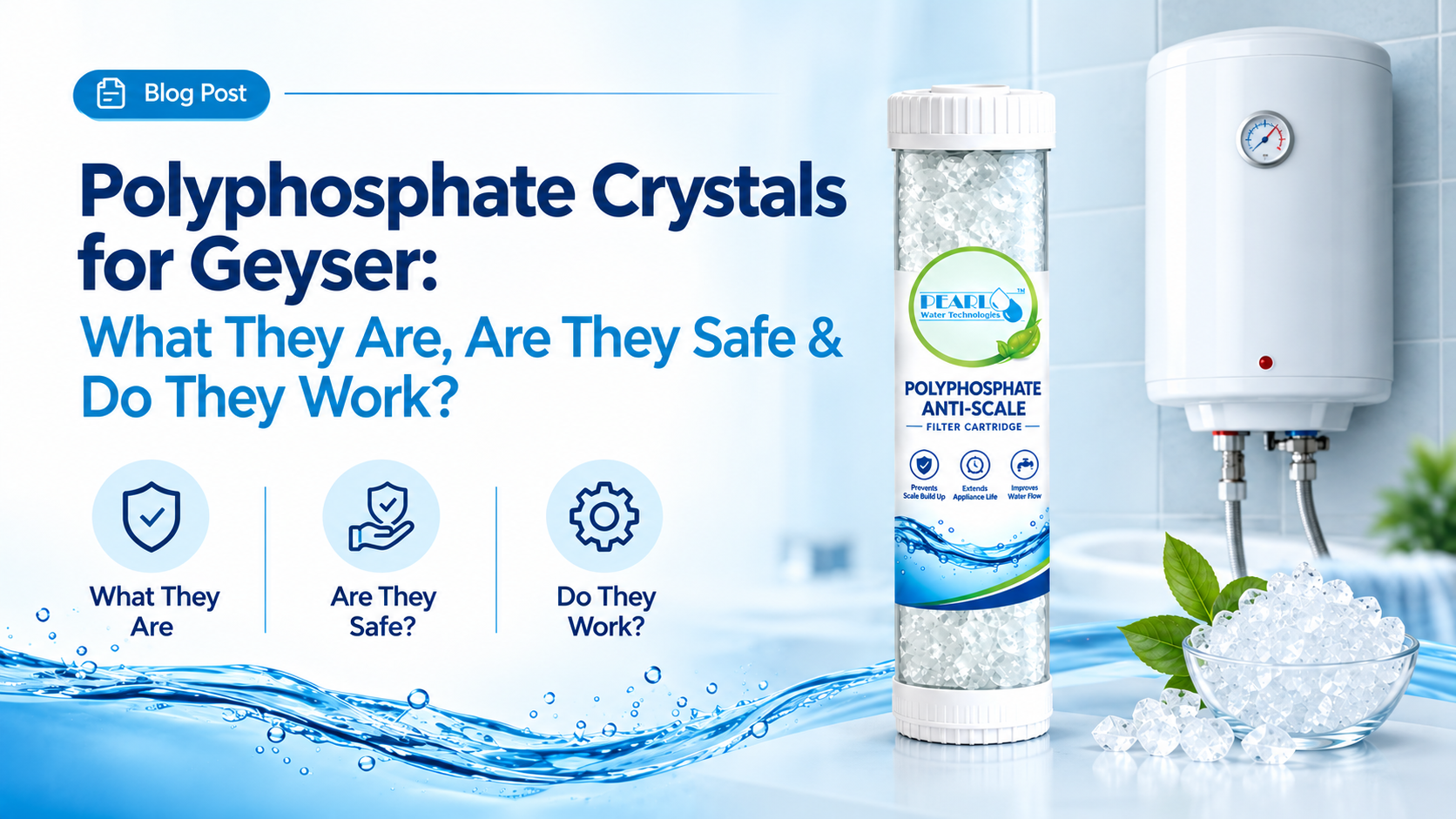
Polyphosphate crystals are small, glassy granules made from sodium polyphosphate, often sodium hexametaphosphate. They dissolve very slowly in flowing water, releasing a tiny amount of phosphate into it. You will see them sold as polyphosphate crystals, anti-scale beads, phosphate balls or simply scale inhibitor crystals for geyser use. Same thing, different labels.
They are not new. Phosphates of this family have been used for decades to protect boilers, coffee machines, washing machines and water heaters. The inline cartridge versions that fit a home plumbing line are just the household-sized form of that idea.
Hard water carries dissolved calcium and magnesium. Heat the water and calcium carbonate starts to come out of solution as tiny crystals. Those crystals grab onto the hottest, roughest surface nearby, and in a geyser that is the heating element. Layer by layer, you get scale.
Polyphosphate interferes at the very first step. Its molecules attach to those tiny crystal seeds and stop them from growing and sticking. The minerals stay small, stay suspended, and leave with the water when you open the tap.
So the hardness is still in your water. It just stops turning into a deposit inside your geyser.
This is where most people get misled, so it is worth being plain about it. A polyphosphate scale inhibitor and an ion-exchange softener do different jobs.
|
|
Polyphosphate scale inhibitor |
Ion-exchange water softener |
What it does |
Keeps hardness minerals from forming scale |
Removes calcium and magnesium from the water |
Water hardness after treatment |
Unchanged |
Close to zero |
Soap lather, skin and hair feel |
No noticeable change |
Clearly softer feel, better lather |
Needs salt, drain or power |
No |
Yes (salt and a drain; automatic models need power) |
Upkeep |
Replace crystals or cartridge on schedule |
Refill salt, service resin periodically |
Best for |
Protecting a geyser or washing machine on moderately hard water |
Whole bathroom or home, high hardness, skin and hair concerns |
If you want the longer comparison, our guide on salt vs salt-free water softeners covers it in detail. And if you are not sure how hard your water actually is, start with how to check water hardness at home or see how to know if your area has hard water.
For a bathing line, yes, as long as you buy the right grade. A few things are worth knowing.
One more safety point. Do not tip loose crystals straight into the geyser tank. You cannot control the dose, and heat breaks the phosphate down quickly. The inlet cartridge is the right way to use them.
Honest answer: yes, within limits. Here is where they hold up and where they don't.
They work reasonably well when:
They struggle when:
Polyphosphate also does not remove scale that is already built up. If your geyser is already coated, descale it first, then install the cartridge to stop it coming back. Our guide on how to prevent scaling in your geyser covers descaling and the other prevention options.
A simple way to check it is working: look at the heating element at the next service. If it is clean or has only a light film after several months, the cartridge is doing its job.
The principle is not limited to homes, by the way. RO plants use the same kind of chemistry, which we explain in what is antiscalant and how it works.
Pick based on what is actually bothering you.
Only the geyser is the worry (short lifespan, slow heating, higher electricity use), and water hardness is moderate. An inline scale inhibitor is a sensible, low-effort choice, especially in a rented flat where you cannot plumb in a large system. Pearl Water's Anti-Scale Guard is an inline scale guard made for this setup: geyser, washing machine and bathroom lines.
You also see hair fall, dry skin, spotty glass and stained tiles. Those come from the hardness itself, and an inhibitor won't touch them. You need a real water softener for bathroom use. Our best water softener for bathroom in India guide goes through types and prices, and can high TDS water cause hair fall explains the hair side. For stained tiles and taps, see 3 ways to get rid of hard water stains in your bathroom.
Your water is very hard (borewell, high TDS). Go with an ion-exchange softener sized to your usage. The 1000 vs 2000 vs 3000 LPH capacity guide helps you size it, and the water softener price guide shows what to budget. You can also browse the full water softener range and water softener spares.
Living in a major city? We have local buying guides for Gurugram, Lucknow and Bengaluru.
What are polyphosphate crystals used for? They are used to stop scale forming on heating elements and inside pipes. In homes they are mostly fitted on the inlet line of geysers and washing machines.
Do polyphosphate crystals soften water? No. They don't remove calcium or magnesium, so the water stays just as hard. They stop that hardness from depositing as scale.
Are polyphosphate crystals safe for bathing? Food-grade polyphosphate at the low dose used in these cartridges is considered safe for a bathing line. Check that the product is food-grade or certified for drinking-water contact before you buy.
How long do polyphosphate crystals last? Usually a few months, depending on water flow and the product. Follow the cartridge label and replace it earlier if you have a large household.
Can I put polyphosphate crystals directly in my geyser? It is not recommended. The dose cannot be controlled and heat breaks the phosphate down. Use an inline cartridge on the cold inlet instead.
Do they remove scale that is already in the geyser? Not reliably. They are meant to prevent new scale. Descale the geyser first and then fit the inhibitor.
What is the best scale inhibitor for a geyser in hard water? For moderate hardness, an inline polyphosphate scale guard is a practical choice. For high hardness, a salt-based water softener combined with regular descaling gives better protection.
Is a scale inhibitor the same as antiscalant? The idea is the same, but antiscalant usually means the chemical dosed into RO plants. Household inline scale inhibitors work on a similar principle at a much smaller scale.
Polyphosphate crystals are a cheap and low-effort way to protect a geyser when your water is moderately hard. They are not a softener, they lose strength in very hot water, and they only work while the cartridge is fresh. If your problem goes beyond geyser scale into skin, hair, soap and stains, treat the hardness itself.
Not sure which route suits your water? Message the team on WhatsApp at +91 85880 22991 with your area and a photo of your geyser element, and we will point you to the right option from our water softener range.
Action completed successfully.

Leave A Comment