Added to wishlist.

What Is the Average Lifespan of an RO Membrane? Complete Replacement Guide

29-Aug-2026

What Is the Average Lifespan of an RO Membrane? Complete Replacement Guide

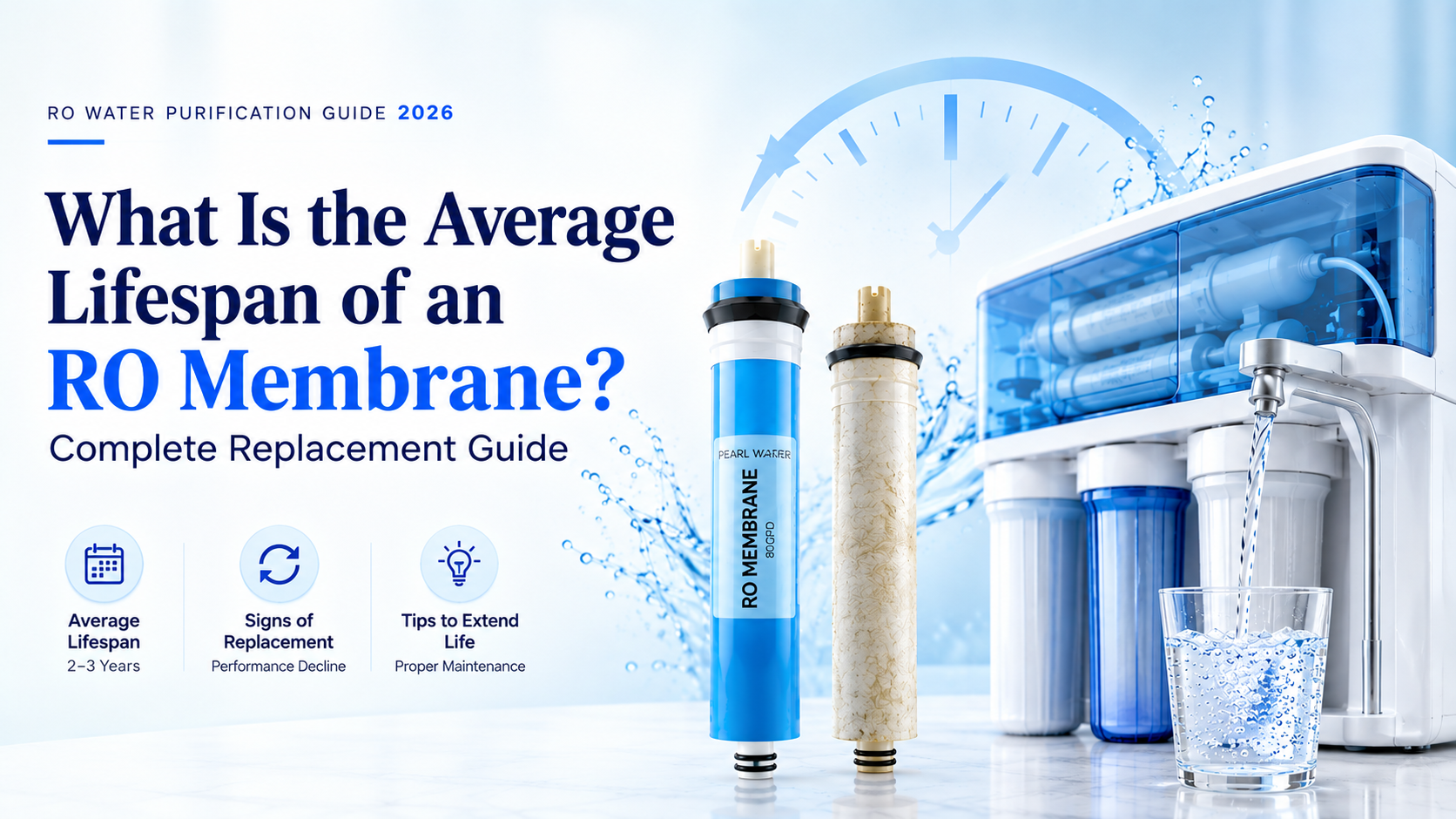
The average lifespan of an RO membrane is about 2–3 years in a properly maintained reverse osmosis system, although the actual service life can vary significantly depending on feed-water quality, TDS, chlorine exposure, water usage, operating pressure, pretreatment, and maintenance.

For many domestic RO water purifiers, manufacturers commonly recommend membrane replacement around 18–24 months, while some membranes can continue performing effectively for longer when operating conditions and pretreatment are well controlled. Pentair, for example, states that an average RO membrane can last approximately two to three years, while individual domestic systems may specify replacement around 18–24 months.

For commercial and industrial RO systems, membrane life can be different. Proper pretreatment, monitoring, cleaning, and operating conditions can significantly extend membrane service life. DuPont notes that industrial RO membranes can have much longer operating lives under appropriate conditions, with some systems achieving several years of service before replacement.

Quick answer: If you have a domestic RO purifier, a practical planning range is 18–36 months, but the membrane should be replaced based on performance—not simply its age.


How Long Does an RO Membrane Last?

There is no single replacement date that applies to every RO membrane.

A membrane installed in a home receiving relatively clean, low-fouling feed water may last longer than one operating continuously with high TDS, hardness, sediment, iron, silica, or inadequate pretreatment.

A useful general guide is:

RO Application

Typical Membrane Replacement Range

Domestic RO purifier

18–36 months

High-TDS domestic application

Around 12–24 months may be more realistic

Commercial RO

Often several years with proper pretreatment and cleaning

Industrial RO

Highly dependent on design, feed water and maintenance

Poorly maintained system

May require replacement much sooner

These are planning ranges, not guarantees. Membrane performance should be monitored using parameters such as permeate flow and salt/TDS rejection rather than relying only on a calendar-based replacement schedule. Manufacturer documentation also emphasizes that membrane life varies with feed-water quality and operating conditions.


What Is an RO Membrane?

An RO membrane, or reverse osmosis membrane, is the main separation component inside a reverse osmosis water purification system.

It uses a semi-permeable membrane to allow water molecules to pass through while rejecting a large proportion of dissolved salts and other contaminants.

In a typical RO system:

Feed Water → Sediment Filter → Carbon Filter → RO Membrane → Post-Treatment → Purified Water

The RO membrane is therefore one of the most important components affecting the system's purification performance.

If the membrane becomes fouled, scaled, chemically damaged, or physically compromised, the system may produce less purified water and may show declining contaminant or TDS rejection.

For users looking for replacement components, Pearl Water's [RO Filter Kits] can be used as a starting point for selecting compatible membrane and filter combinations.


7 Factors That Affect RO Membrane Lifespan

1. Feed-Water TDS

One of the most important factors affecting an RO membrane is the quality of the incoming water.

Higher TDS means the membrane has to separate a greater concentration of dissolved substances. However, TDS alone does not determine membrane life. Hardness, silica, iron, organics, chlorine, suspended solids and other contaminants can also contribute to fouling or scaling.

If the feed water contains high levels of dissolved salts, the RO system must be designed and operated appropriately.

This is particularly important in areas where groundwater has relatively high TDS.


2. Hardness and Scaling

Hard water contains calcium and magnesium ions that can contribute to mineral scale formation.

When scale builds up on the membrane surface, water flow can decrease and operating pressure may increase.

If scaling becomes severe, normal cleaning may not completely restore membrane performance.

For challenging feed water, appropriate pretreatment and antiscalant strategies may be required depending on the RO system design.


3. Sediment and Suspended Particles

Sand, dirt, rust and other suspended particles can foul the membrane if they are not adequately removed before the water reaches the RO element.

This is why a good sediment prefilter is important.

Regular replacement of the prefilters helps protect the membrane from unnecessary loading.

Pearl Water's [Complete Pre Filter Kit] is designed for pre-filtration before the RO membrane and includes sediment and carbon filtration components.


4. Chlorine Exposure

Many common thin-film composite RO membranes are sensitive to chlorine.

If chlorine reaches the membrane because the carbon prefilter is exhausted or improperly maintained, it can damage the membrane material and reduce its useful life.

This makes carbon filtration an important part of RO pretreatment.

Do not assume that a membrane is protected simply because a carbon filter is installed. The carbon filter must also be replaced at the appropriate interval.


5. Water Pressure and Operating Conditions

RO membranes require sufficient pressure to overcome osmotic pressure and produce permeate.

If pressure is too low, production can decline. If operating conditions are outside the membrane manufacturer's recommended range, performance and service life can also be affected.

Temperature, pH, salt concentration, recovery and concentration polarization are among the factors that can influence RO membrane performance.


6. Frequency of Use

Usage also affects membrane performance.

A household that produces much more purified water every day may place a greater operating load on the membrane than a household with very low consumption.

However, low usage does not automatically mean a membrane will last forever. Long periods of inactivity can also require appropriate system flushing and storage procedures.

Follow the membrane and RO system manufacturer's instructions when the system will remain unused for an extended period.


7. Maintenance and Pretreatment

Proper maintenance is one of the most effective ways to extend RO membrane life.

A well-maintained RO system should have:

  • Regular sediment filter replacement

  • Regular carbon filter replacement

  • Correct operating pressure

  • Appropriate pretreatment

  • Periodic water-quality checks

  • Membrane performance monitoring

  • Proper cleaning when required

  • Correct flow and recovery settings

DuPont emphasizes the importance of pretreatment and cleaning for maintaining RO system performance and extending membrane service life.


8 Signs Your RO Membrane Needs Replacement

Instead of replacing a membrane simply because it has reached a certain age, look for changes in system performance.

1. RO Water TDS Starts Increasing

A noticeable increase in purified-water TDS can indicate declining membrane rejection.

However, check the feed-water TDS and the accuracy of the TDS meter before concluding that the membrane has failed.

2. Purified Water Production Decreases

If the RO system suddenly produces substantially less water than normal, the membrane may be fouled or another component may be restricting flow.

Low production can also result from:

  • Low feed pressure

  • Clogged prefilters

  • Low water temperature

  • Flow restrictor problems

  • Pump problems

  • Membrane fouling or scaling

Therefore, don't replace the membrane without checking the complete system.

3. Water Quality Changes

Changes in taste, odor or overall water quality can be a warning that the filtration system requires maintenance.

However, these symptoms can also originate from post-filters or other components, so the entire system should be checked.

4. The Membrane Is Fouled or Scaled

Visible evidence of fouling, scaling or severe deposits can indicate that the membrane requires cleaning or replacement.

5. The Membrane Cannot Recover Its Performance

If appropriate cleaning does not restore membrane flow or rejection to an acceptable level, replacement may be necessary.


How Often Should You Replace an RO Membrane?

For a typical domestic RO purifier, 18–24 months is a reasonable maintenance checkpoint, while a membrane operating under favorable conditions may last closer to 2–3 years.

Do not treat these numbers as an automatic replacement rule.

A better approach is:

Age + Water Quality + TDS Rejection + Permeate Flow + Maintenance History = Replacement Decision

For example, if an RO membrane is 24 months old but still provides acceptable flow and salt rejection, immediate replacement may not be necessary.

Conversely, a membrane that is only 12–18 months old may need replacement if it has been exposed to severe fouling, scaling, chlorine damage or poor pretreatment.

Pentair specifically notes that membrane functional life varies with feed-water quality and recommends periodic testing of product water to verify membrane performance.


How to Extend the Life of an RO Membrane

If you want your RO membrane to last longer, focus on protecting it rather than simply delaying replacement.

1. Replace Sediment and Carbon Filters on Time

The prefilters are the first line of defense.

A clogged sediment filter can reduce water flow, while an exhausted carbon filter may fail to adequately protect a chlorine-sensitive membrane.

2. Monitor Feed-Water and Product-Water TDS

Measure:

  • Feed-water TDS

  • RO product-water TDS

  • TDS rejection trend

A sudden change can help identify a developing problem.

3. Maintain Correct Pressure

Ensure the RO system operates within the manufacturer's specified pressure range.

4. Control Scaling

If the feed water is hard or has a high scaling potential, appropriate pretreatment can help reduce membrane fouling and scaling.

5. Avoid Unnecessary Chemical Exposure

Use only chemicals and cleaning procedures compatible with the specific membrane.

6. Don't Ignore Reduced Water Production

Reduced output is not always a membrane problem, but it should be investigated promptly.

7. Use the Correct Replacement Membrane

A replacement membrane should match the RO system's required specifications, including dimensions, capacity, rejection characteristics and operating conditions.

For domestic applications, Pearl Water offers membrane-containing [RO replacement kits] in different configurations.


RO Membrane vs RO Filter: What's the Difference?

This is a common source of confusion.

An RO filter kit may contain several filtration stages, while the RO membrane is one specific component within the system.

For example, a complete domestic RO replacement kit may contain:

  • Sediment filter

  • Carbon/pre-filter

  • RO membrane

  • Post-carbon filter

  • Alkaline filter

  • Connectors and other accessories

The membrane is responsible for the primary RO separation, while the other filters provide pretreatment and post-treatment.

Pearl Water's [RO Membrane & Alkaline Filter Kit] is one example of a replacement kit combining a membrane with other filtration stages.


Can You Clean an RO Membrane Instead of Replacing It?

Sometimes, yes—but it depends on the application and the type of fouling.

Commercial and industrial RO systems may use clean-in-place (CIP) procedures to remove specific foulants and restore membrane performance.

However, domestic RO users should not assume that every membrane can simply be washed or chemically cleaned at home.

The wrong cleaning chemical, concentration, temperature or procedure can permanently damage a membrane.

For commercial and industrial systems, membrane cleaning should follow the membrane manufacturer's recommended procedure.


Does High TDS Reduce RO Membrane Life?

High TDS can increase the challenge placed on an RO system, but TDS by itself does not determine membrane lifespan.

Membrane life is influenced by the complete feed-water chemistry and operating conditions.

Important parameters can include:

  • TDS

  • Hardness

  • Silica

  • Iron

  • Chlorine

  • pH

  • Temperature

  • Suspended solids

  • Organic matter

  • Recovery

  • Operating pressure

DuPont identifies temperature, pH, salt concentration, recovery and concentration polarization among the factors affecting RO membrane performance.

Therefore, simply saying “high TDS means the membrane will last only one year” is not technically accurate.


How Do You Know if Your RO Membrane Is Still Good?

The best way is to evaluate performance.

Check 1: Compare Feed and Product TDS

Measure the incoming water TDS and purified-water TDS.

Check 2: Monitor Product Flow

Compare current production with the membrane's expected performance under similar operating conditions.

Check 3: Check Prefilters

A clogged sediment or exhausted carbon filter can create symptoms that look like membrane failure.

Check 4: Review Maintenance History

Ask:

  • When was the membrane installed?

  • When were the prefilters replaced?

  • Has the system been unused for a long period?

  • Has the source-water quality changed?

  • Has the RO pump or pressure changed?

Check 5: Evaluate the Trend

A gradual decline in rejection or flow is more useful than one isolated TDS measurement.


RO Membrane Lifespan: Domestic vs Commercial vs Industrial

It is important not to use the same replacement expectation for every RO system.

Domestic RO Membrane

Domestic systems commonly operate with relatively small membrane elements and are often replaced around 18–36 months, depending on usage and water quality.

Commercial RO Membrane

Commercial systems can operate for several years when properly designed and maintained.

Industrial RO Membrane

Industrial membrane life depends heavily on pretreatment, feed-water chemistry, recovery, cleaning frequency, operating pressure and system design.

Some industrial installations can achieve significantly longer membrane lifetimes under favorable operating conditions. DuPont's published examples demonstrate that properly managed large-scale RO installations can operate for many years without membrane replacement, illustrating why membrane lifespan should not be reduced to a single universal number.


Frequently Asked Questions 

How long does an RO membrane usually last?

A domestic RO membrane commonly lasts around 2–3 years, although many systems recommend replacement around 18–24 months. Actual life depends on feed-water quality, usage, pretreatment and maintenance.

How often should I replace my RO membrane?

For many domestic RO systems, check membrane performance around 18–24 months and replace it when performance declines or according to the manufacturer's recommendation.

What causes an RO membrane to fail?

Common causes include fouling, scaling, chlorine exposure, inadequate pretreatment, unsuitable operating conditions, excessive contaminant loading and physical or chemical damage.

Does changing prefilters increase RO membrane life?

Yes. Proper sediment and carbon pretreatment can reduce the contaminants and chlorine reaching the membrane and can therefore help protect membrane performance.

Can an RO membrane last 5 years?

It can be possible in some applications, particularly where feed-water quality, pretreatment and operating conditions are well controlled. Industrial RO membrane lifetimes can vary considerably, and some documented installations have operated for many years.

However, a five-year replacement interval should not automatically be assumed for a domestic RO purifier.

What happens if I don't change my RO membrane?

As a membrane deteriorates, water production can decrease and dissolved-solids rejection can decline. Depending on the system, this may result in higher product-water TDS and poorer overall purification performance.

Is RO membrane replacement necessary every year?

Not necessarily. A one-year replacement schedule may be appropriate for some demanding applications, but it is not a universal rule. Membrane performance and the manufacturer's recommended replacement criteria should guide the decision.

Does RO membrane lifespan depend on TDS?

Partly. Feed-water TDS affects the workload and osmotic pressure of an RO system, but hardness, silica, chlorine, fouling, scaling, pressure, temperature, recovery and pretreatment also matter.

How can I increase RO membrane life?

Use effective prefiltration, replace sediment and carbon filters regularly, maintain suitable operating pressure, control scaling, monitor TDS and flow, and follow the membrane manufacturer's maintenance recommendations.


Conclusion

So, what is the average lifespan of an RO membrane?

For a typical domestic RO purifier, around 2–3 years is a reasonable general expectation, with 18–24 months being a common point for checking or replacing the membrane depending on the system. Commercial and industrial membranes can have very different service lives.

The most important point is that membrane age alone should not determine replacement.

Share:

Leave A Comment

Thank You for subscribing our newsletter.