


03-Oct-2026
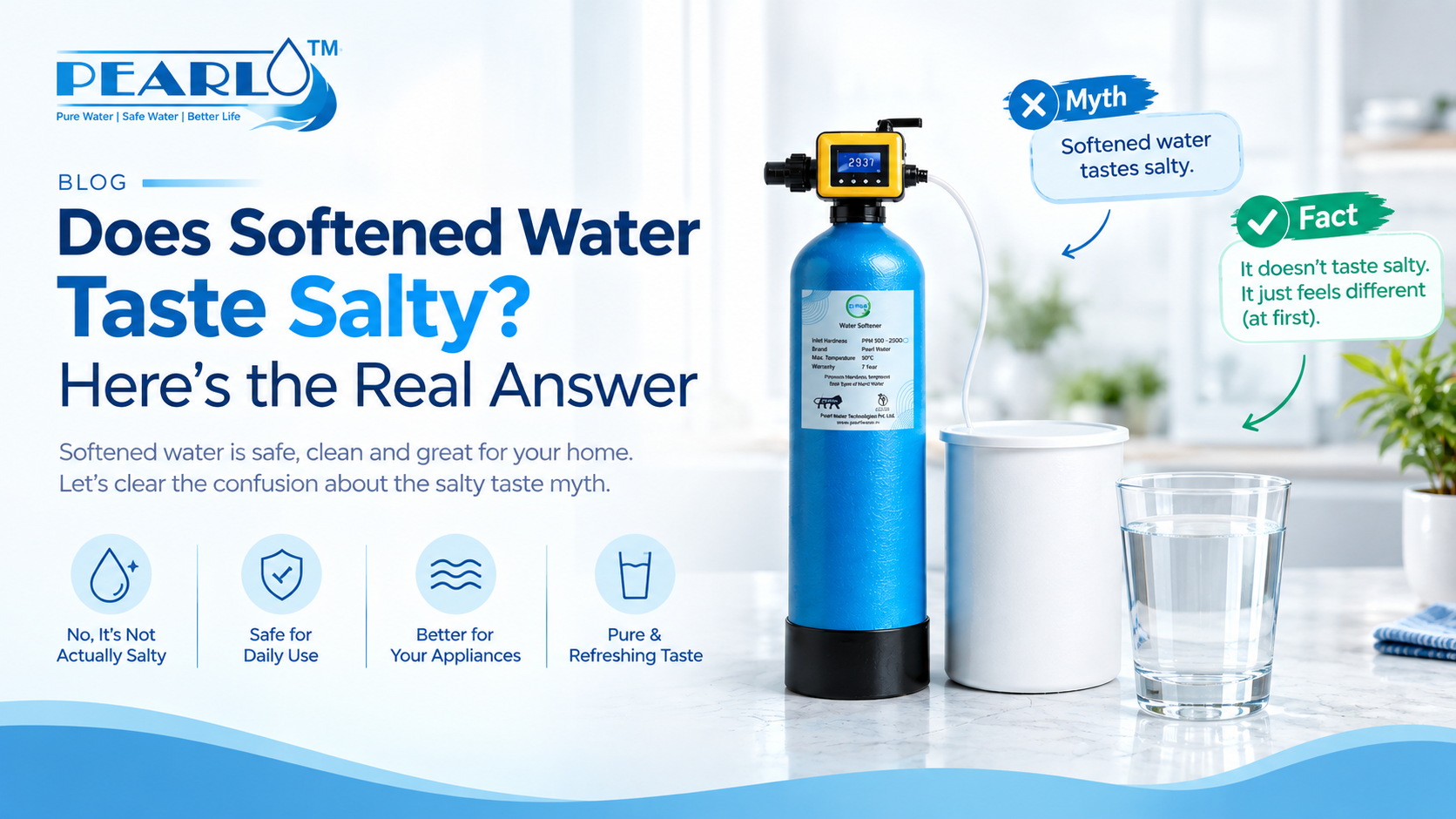
Honestly, this is one of the first questions almost every new customer asks us — usually right after we explain that softening works by swapping hardness minerals for sodium. The word "sodium" immediately makes people think "salty," and it's a completely fair assumption to jump to. So let's actually answer it properly instead of just saying "don't worry about it."
Quick answer: No, softened water doesn't taste noticeably salty to most people. The amount of sodium added during the softening process is small — nowhere close to the concentration your tongue needs to register as "salty." A handful of people who are especially sensitive to sodium, or who are managing a strict low-sodium diet, might notice a very slight difference, but for the vast majority of households, softened water tastes just like regular tap water.
Here's why that's actually true, not just reassuring marketing language.
It comes down to how a water softener actually works. Inside the unit, water passes through a resin bed where calcium and magnesium — the minerals responsible for hardness — get swapped out for sodium ions, through a process called ion exchange. The system uses salt to recharge that resin bed during its regeneration cycle. So yes, salt is genuinely part of the process. That's not in question.
What's less obvious is how much sodium actually ends up in your glass afterward — and this is where the "will it taste salty" worry usually gets ahead of the real numbers.
The amount of sodium added is directly related to how hard your water was to begin with — harder water means more calcium and magnesium being exchanged, which means somewhat more sodium added in return. Even on the harder end of what most Indian homes deal with, the resulting sodium increase is still a small fraction of what your tongue is actually built to detect as "salty."
For context, the human taste threshold for detecting salt in water is considerably higher than the sodium levels typically introduced by softening — which is exactly why the overwhelming majority of people drink softened water every day without noticing any taste difference at all. This isn't a case of "you get used to it" either; it's that the concentration genuinely sits below the threshold most people can perceive in the first place.
A few genuine reasons this comes up, worth being upfront about:
If you're genuinely noticing a strong, unmistakable salty taste — not just a vague sense that something's different — that's worth having your system checked rather than assuming it's expected. It likely points to a regeneration or dosing issue rather than normal operation.
For most people, no — the sodium increase from softening is small enough that it's not considered a meaningful addition to daily sodium intake for the general population. The group worth a specific mention is anyone on a strict medically-advised low-sodium diet, where even small additions matter more than they would for most people. If that applies to you or someone in your household, it's worth discussing with a doctor, and practically, keeping one untreated or separately-filtered tap specifically for drinking is a simple workaround many households use.
This is also a good moment to clarify a separate but related question people often ask alongside this one: softened water isn't the same thing as purified water. A softener removes hardness, not contaminants — it doesn't purify water for drinking safety the way an RO or UV system does. If you're weighing both questions together, this breaks down the difference properly: Water Softener vs Water Purifier: Which Does Your Home Need?
If the idea of any added sodium genuinely bothers you — regardless of how small the actual amount is — salt-free water conditioners are an alternative worth knowing about. They work differently, altering mineral behavior rather than performing a direct ion exchange, which means no sodium gets added at all. The trade-off is that they're generally less effective against genuinely hard water than a true salt-based softener. We've compared the two properly here: Salt vs Salt-Free Water Softener India 2026 Guide.
Another option some households consider is using potassium chloride instead of sodium chloride for the brine solution — this avoids added sodium specifically, though it comes with its own cost and handling differences worth weighing against your actual priorities.
Worth separating this out, because sometimes what people attribute to "the softener" is actually something else entirely. If water tastes off in a way that feels more like a mineral or metallic taste than "salty" specifically, that's more likely related to your water source itself — borewell water in particular can carry iron or other minerals that affect taste independently of softening. If that sounds like your situation, it's worth reading up on borewell-specific water issues: Water Softener Not Working? Fix Borewell Water Hardness in India.
Q: Will my tea or coffee taste different with softened water? Most people don't notice a difference. If anything, some people find tea and coffee taste slightly better with softened water, since hard water minerals can interfere with how flavor compounds extract and dissolve.
Q: Is it safe to cook with softened water? Yes — softened water is fine for cooking for the general population. The same low-sodium-diet consideration mentioned above applies here too, if that's relevant to your household.
Q: Does a bigger or more powerful water softener add more salt to the water? Not directly — the amount of sodium in your output water relates to how hard your incoming water is and how much exchange is happening, not simply the unit's size or capacity. A correctly sized system for your actual hardness level operates as intended regardless of capacity tier.
Q: Can I taste-test this myself before deciding on a softener? Not easily before installation, since the taste difference (where it exists at all) is specific to your own water's hardness level. If you're on the fence, it's worth knowing this is a genuinely minor consideration for most buyers compared to the practical benefits — less scale, better lather, less appliance wear — that tend to matter more day to day.
This answer is based on how water softening chemistry actually works and the taste-perception thresholds generally understood for sodium in water, along with years of fielding this exact question from customers before and after installation. If sodium intake is a specific medical concern for you, it's worth a quick conversation with your doctor alongside anything you read here.
Written by the Pearl Water Technologies team, from our experience installing and supporting water softeners across Indian households.
Leave A Comment