


17-Sep-2026
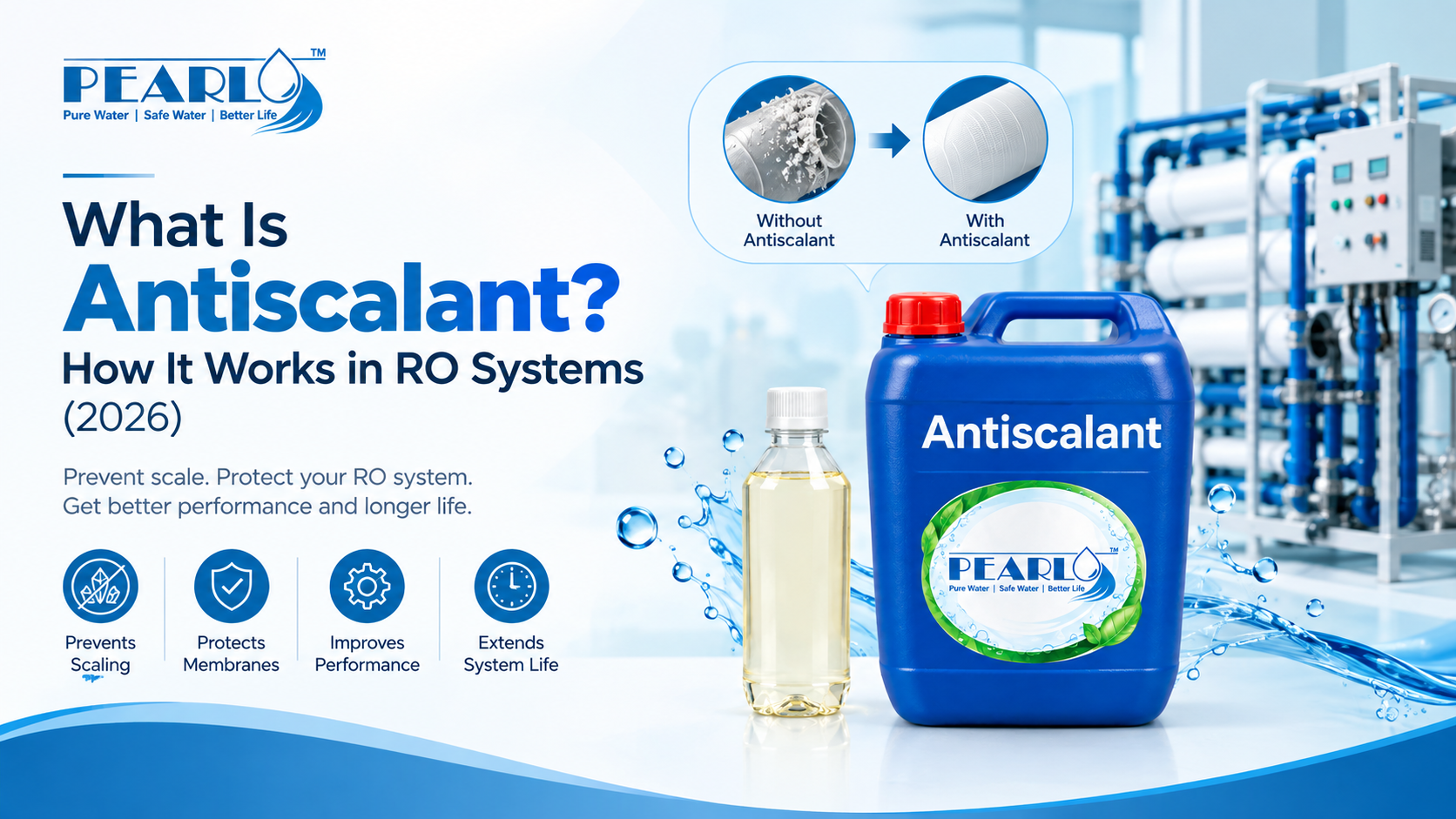
If you run a reverse osmosis plant, you've probably heard technicians say "dose the antiscalant" without ever explaining what that actually means. Here's the short answer: antiscalant is a chemical dosed into feed water before it reaches the RO membrane, and its job is to stop dissolved minerals like calcium and magnesium from crystallizing into hard scale on the membrane surface. No scale, no blockage, no drop in performance — and your RO membrane lasts years longer instead of months.
That one line answers the question most people search for. Everything below explains why it works, how it works at a molecular level, which type you actually need, and how to dose it correctly so you don't waste money or damage your system.
Antiscalant (also called a scale inhibitor) is a water treatment chemical dosed upstream of a membrane system — typically before reverse osmosis (RO), nanofiltration (NF), or ultrafiltration (UF) — to prevent mineral salts from precipitating out of solution and forming scale.
When raw water passes through an RO membrane, pure water is pushed through while dissolved salts, hardness minerals, and other impurities get left behind and concentrated on the reject side. As this concentration rises, minerals like calcium carbonate, calcium sulphate, barium sulphate, and silica can exceed their saturation limit and crystallize directly onto the membrane. That crystal layer is scale, and it's one of the biggest reasons RO membranes lose flow, lose rejection, and fail early.
Antiscalant chemicals are usually organic compounds built around sulphonate, phosphonate, or carboxylic acid functional groups, along with chelating agents such as EDTA. These molecules are specifically designed to interfere with the crystal-forming process before it can damage your system.
This is where most explanations get vague, so let's break it into the three real mechanisms:
1. Threshold inhibition Antiscalant molecules attach themselves to the tiny crystal nuclei that form when calcium, magnesium, or sulphate ions first start to combine. By adsorbing onto these microscopic crystals, the antiscalant physically blocks further growth. The crystal simply never gets large enough to precipitate out of the water and deposit on the membrane — it stays suspended and passes out with the reject stream instead.
2. Crystal distortion Even if a small crystal does form, antiscalant changes its shape. Instead of growing into a hard, sharp, interlocking lattice (which sticks tightly to a membrane surface), the crystal grows into an irregular, soft structure that has far less tendency to adhere. This is why antiscalant-treated systems show loose, easily flushed deposits instead of hard baked-on scale.
3. Dispersion and chelation Many antiscalants carry a negative (anionic) charge. Since most scale-forming crystals are also negatively charged once distorted, the particles repel each other rather than clumping together. Chelating agents inside the formulation additionally bind directly to metal ions like calcium, magnesium, and iron, "trapping" them in a soluble complex so they can never reach saturation point in the first place.
Put together, these three actions create a delay — long enough for feed water to pass completely through the membrane and exit as reject before any scale-forming reaction has time to complete. That's the entire principle behind antiscalant dosing.
Every membrane system concentrates whatever is dissolved in the incoming water. If your source is borewell water or municipal water with even moderate hardness, the recovery process alone is often enough to push mineral concentrations past their solubility limit. Left untreated, this leads to:
Any of these reduce permeate flow, increase feed pressure requirements, lower salt rejection, and shorten membrane life — the same failure patterns covered in our guide on common problems with RO membranes and how to solve them. A correctly dosed antiscalant is what keeps a membrane performing at its rated TDS rejection for years instead of months, and it's far cheaper than replacing a scaled membrane.
This is one of the most common points of confusion, so here's the practical difference:
Factor |
Antiscalant |
Water Softener (Ion Exchange) |
How it works |
Interferes with crystal formation chemically |
Physically replaces calcium/magnesium with sodium |
Best suited for |
Feed hardness under ~100 ppm, most commercial/industrial RO |
Very high hardness feed water |
Operating cost |
Low — dosed in ppm quantities |
Higher — needs salt, regeneration, backwash water |
Maintenance |
Simple dosing pump |
Resin bed, valve, regular regeneration |
In most cases where feed hardness is under 100 ppm, antiscalant is preferred over ion-exchange softening simply because it's cheaper and easier to operate. If your source water is genuinely very hard, the two are often used together — a water softener for bulk hardness removal and antiscalant as a secondary safeguard. If you're unsure which category your water falls into, start with our guide on how to know if your area has hard water and our detailed breakdown of hard water vs soft water.
Standard/Neutral Antiscalant (e.g., RO 1400 type) — general-purpose formulations suited to most feed water conditions across commercial and industrial RO plants, effective against calcium carbonate, calcium sulphate, and general fouling.
Alkaline Antiscalant (e.g., Alkaline 900 type) — formulated specifically for high-pH feed water applications, where standard antiscalants may not perform as reliably.
Pearl Water manufactures both variants — see the full Antiscalant range and Chemicals category for specifications, pricing, and pack sizes.
Dosing is where most operators either waste chemicals or, worse, under-dose and let scale form anyway. General guidelines:
If you're seeing any of these, it usually isn't the membrane that's at fault — it's the pretreatment. Before assuming your membrane is bad, also rule out a counterfeit or low-grade element using our guide on how to spot a fake or duplicate RO membrane.
Is antiscalant harmful to drink? Properly dosed antiscalant is added upstream of the membrane, and the RO membrane itself rejects the vast majority of it along with other dissolved solids, so it doesn't end up in permeate water at meaningful concentrations. Most commercial formulations are also classified as non-hazardous and non-carcinogenic.
How much antiscalant should I dose per liter of water? Most systems run between 3–5 ppm, but the exact figure depends on feed water hardness, silica levels, temperature, pH, and recovery rate. Always verify against your membrane manufacturer's technical manual rather than using a fixed number across all sites.
Can I use antiscalant instead of a water softener? Yes, for feed water hardness under roughly 100 ppm, antiscalant alone is usually sufficient and more economical than ion-exchange softening. For very high hardness, softening plus antiscalant together gives the most reliable protection.
Does antiscalant stop iron fouling too? Yes — antiscalant chelates dissolved iron in addition to calcium and magnesium, which helps prevent iron-based fouling on the membrane surface, though heavily iron-laden water may still need separate iron removal pretreatment.
How often should antiscalant dosing be checked? Check your dosing pump calibration monthly at minimum, and immediately re-verify the dosing rate any time your source water changes (new borewell, seasonal variation, or a spike in feed TDS).
Antiscalant is a small, low-cost part of a water treatment system that has an outsized impact on how long your membranes last and how efficiently your plant runs. Skipping it — or dosing it incorrectly — is one of the fastest ways to turn a membrane rated for years into one that fails in months. If you're setting up a new industrial RO plant or troubleshooting scaling on an existing one, get the antiscalant grade and dosing rate matched to your actual feed water, not a generic number.
Browse Pearl Water's Antiscalant RO 1400 and Alkaline 900 chemicals, or explore the full Chemicals range for pricing and specifications. For current market rates, see our separate guide on antiscalant chemical price per kg in India (2026).
Have questions about which antiscalant grade or dosing rate suits your water source? Contact Pearl Water Technologies at +91-9582215137 for a recommendation based on your feed water report.
Leave A Comment