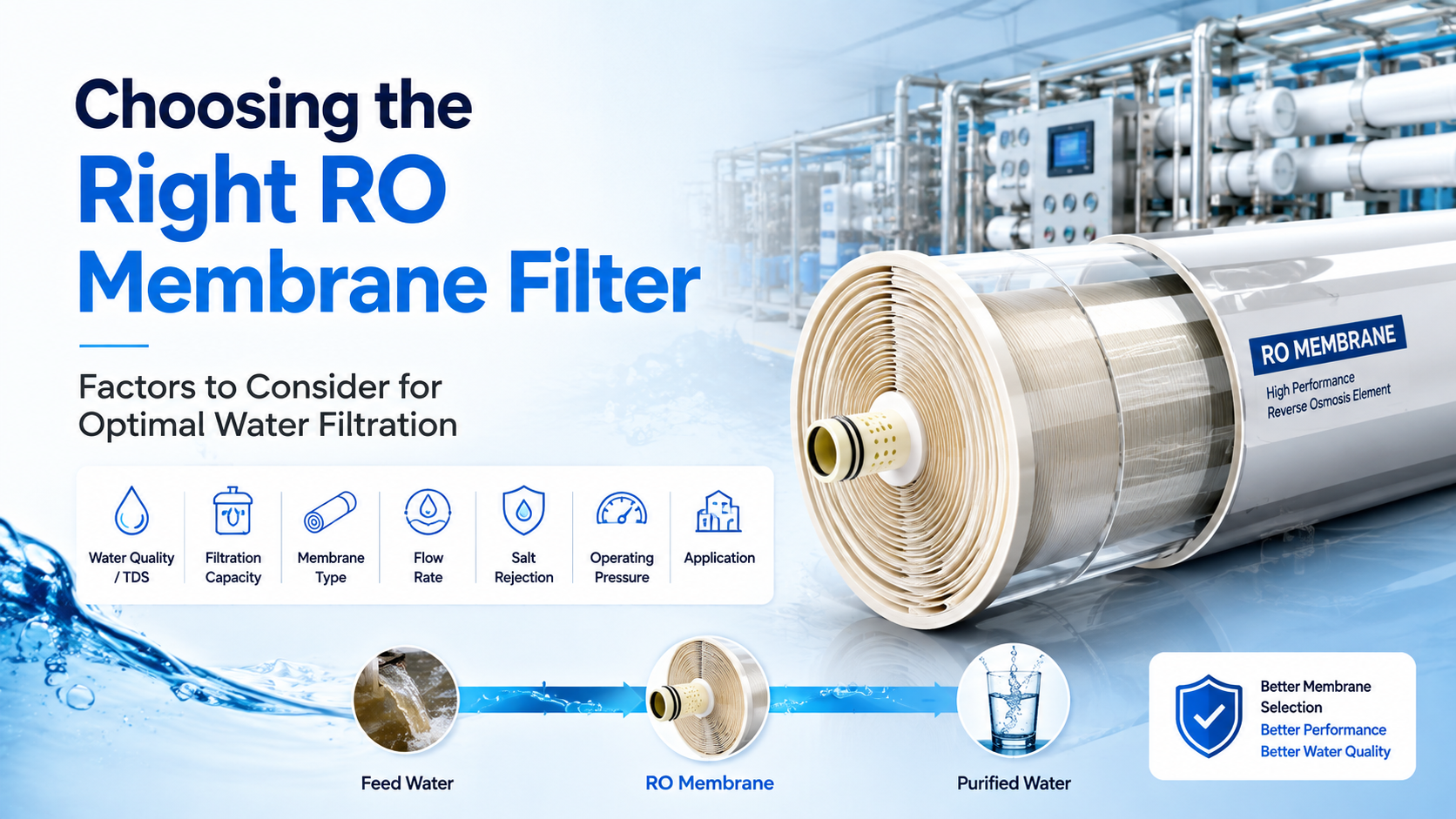
Choosing the Right RO Membrane Filter: Factors to Consider for Optimal Water Filtration
20-Apr-2024
Reverse osmosis is the most effective method available for removing dissolved salts and contaminants from water, and the membrane is the single component that determines how well any RO system actually performs. But "RO membrane" isn't one product — it spans multiple materials, technologies, brands, and formats, and picking the wrong one for your water source or application is a common, avoidable mistake.
Here are the 8 factors that actually determine whether a membrane is right for your system.
1. Membrane Material
Before pore size or rejection rate, material is the foundation everything else is built on. Cellulose Acetate (CA) membranes were the original technology but have largely been phased out for lower salt rejection and weaker chemical resistance. Thin-Film Composite (TFC) membranes are the current standard, offering significantly higher rejection, durability, and chemical tolerance — nearly every membrane Pearl Water stocks, from domestic units to industrial DOW and Toray lines, uses TFC construction.
2. Pore Size
A membrane's pore size determines what it can physically exclude, but for RO membranes specifically, rejection isn't purely about pore size — it's a combination of pore size and the membrane's solution-diffusion selectivity, covered in detail in our TDS removal mechanism guide. Smaller effective pore size generally means better filtration but can increase the pressure required and reduce flow rate — the trade-off every membrane spec sheet is built around.
3. Water Quality
Your water source should drive the membrane choice, not the other way around. High-TDS borewell water needs a membrane rated for higher working TDS capacity; water prone to organic or biological contamination benefits from a low-fouling variant like the Toray TML20D-400; genuine seawater needs a dedicated seawater membrane like the Toray TM820V-400, rated for pressures a standard brackish water membrane can't handle.
4. Operating Conditions
Temperature, pressure, and flow rate requirements vary meaningfully across membrane types. Every membrane has a rated pressure and temperature range — exceeding it, even briefly, risks permanent damage to the active layer. Matching your system's actual operating conditions to a membrane's rated range isn't optional; it's the difference between a membrane reaching its full service life and failing early.
5. Rejection Rate
Rejection rate — the percentage of dissolved salts a membrane blocks — is the number most buyers focus on first, and it should be weighed against water flow and maintenance needs, not maximized in isolation. A 99.5% membrane running poorly maintained pre-filtration will underperform a well-maintained 99% membrane in real-world use. See our common RO membrane problems guide for how fouling and scaling erode rejection rate over time regardless of the membrane's rated spec.
6. Longevity and Maintenance
Fouling, scaling, and chemical degradation all shorten real-world membrane life below its theoretical maximum. Membranes engineered for fouling resistance — like LG's AFR series — cost more upfront but reduce cleaning frequency and extend service life for feed water prone to fouling. Antiscalant dosing is one of the highest-leverage maintenance investments regardless of which membrane you choose.
7. Certifications and Standards
Look for membranes tested against recognized industry standards for water quality and safety, and buy from suppliers who can provide genuine, verifiable spec sheets rather than unverified claims — this matters more for industrial procurement, where an underperforming membrane can affect an entire plant's output quality.
8. Cost Considerations
Evaluate total cost, not just sticker price: initial investment, expected service life, energy consumption (especially for continuous industrial operation — see our LG ES vs R series comparison for how energy-efficient variants pay off over time), and maintenance requirements together. A cheaper membrane that fouls quickly or needs frequent replacement often costs more over its lifetime than a pricier, better-suited option.
1. What's the most important factor when choosing an RO membrane?
There isn't a single most important factor — the right choice depends on matching membrane material, rejection rate, and fouling resistance to your specific water source and system's operating conditions, rather than optimizing one spec in isolation.
2. Does a higher rejection rate always mean a better membrane?
Not necessarily. A higher-rejection membrane running with poor pre-filtration or the wrong pressure setup can underperform a lower-rated membrane that's correctly matched and well-maintained. Rejection rate matters, but only alongside proper system design.
3. How do I know if I need a low-fouling membrane?
If your feed water contains organic matter, is prone to biological growth, or you're seeing frequent fouling-related performance drops, a low-fouling variant is worth the added upfront cost — see our common problems guide for how to recognize fouling specifically.
4. Is a more expensive membrane always the better choice?
No — cost should be weighed against total lifetime value: expected service life, energy consumption, and maintenance frequency, not just the upfront purchase price.
5. Can I use a domestic membrane for a small commercial system?
Generally no — commercial and industrial systems need membranes rated for continuous operation and higher flow, typically in standardized 4040 or 8040 formats rather than domestic sizing.
6. Where can I buy genuine, certified RO membranes in India?
Pearl Water stocks certified DOW, Toray, Hydranautics, and LG membrane lines directly, alongside our own domestic and Ultra XP ranges — browse Industrial RO Spares or Domestic RO Membrane.
Conclusion
Choosing the right RO membrane means weighing all 8 factors together — material, pore size, your actual water quality, operating conditions, rejection rate, longevity, certifications, and total cost — rather than optimizing any single spec in isolation. The right membrane for a fouling-prone borewell system looks very different from the right membrane for a high-volume industrial plant, even if both need strong rejection performance. For the deeper mechanics behind how membranes work, start with What Is an RO Membrane and How Does It Work?; when you're ready to choose, browse Pearl Water's full membrane range or contact our team for help matching a membrane to your specific water source.


Leave A Comment