Added to wishlist.

Common Problems with RO Membranes and How to Solve Them

27-Jan-2025

Common Problems with RO Membranes and How to Solve Them

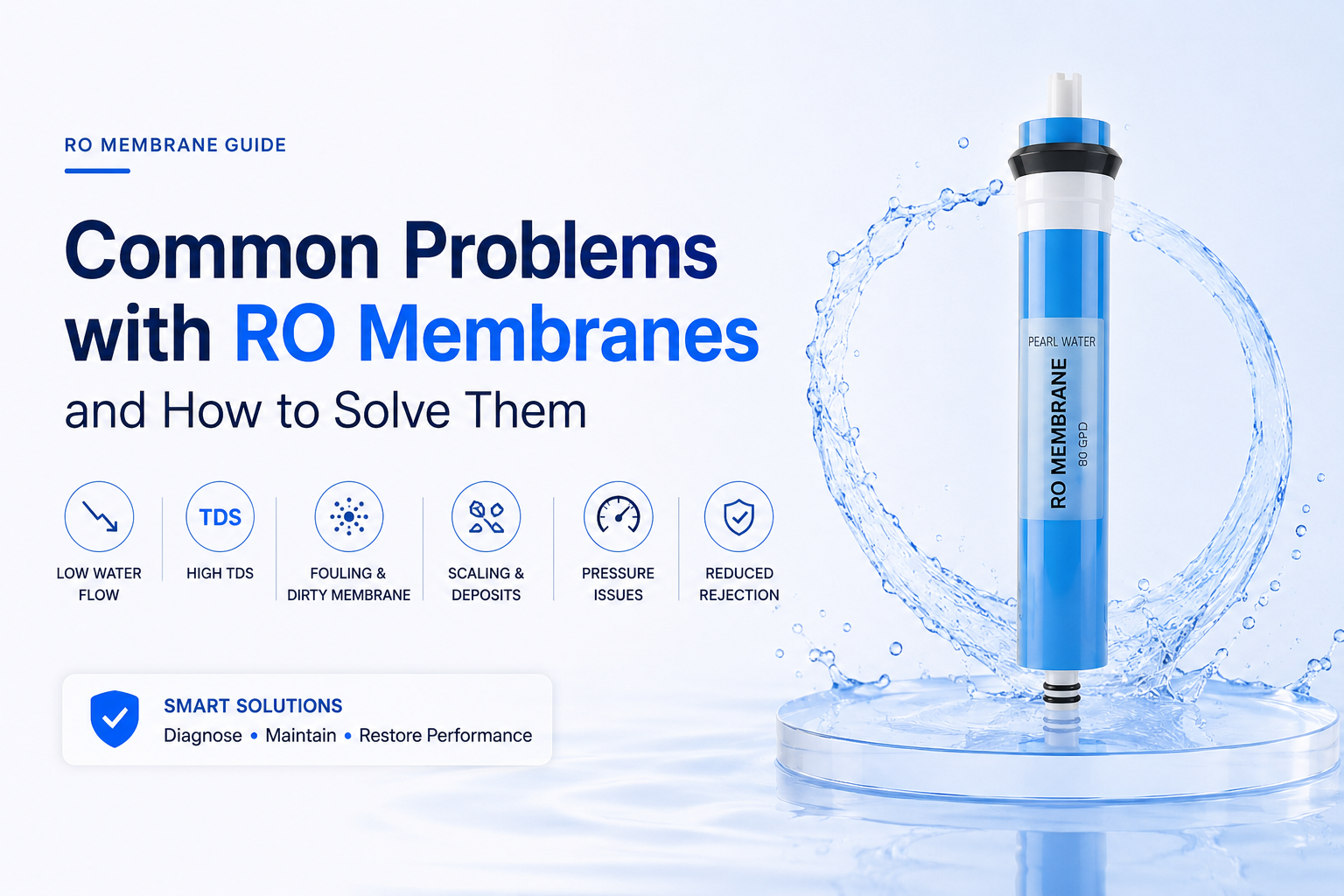
RO membranes are at the heart of clean water production, essential for both domestic and industrial applications. Despite their effectiveness, they can face recurring issues — scaling, fouling, clogging, low pressure, and physical damage — that quietly reduce performance long before a system fails outright. This guide covers what actually causes each problem, how to recognize it early, and the specific fix for each.

If you want to understand the underlying mechanism first — how an RO membrane removes dissolved salts in the first place — see our companion guides: What Is an RO Membrane and How Does It Work? and How Does the RO Membrane Actually Remove TDS?


Table of Contents

  1. What Are RO Membranes?

  2. The 5 Most Common RO Membrane Problems

  3. Quick Diagnosis Table

  4. Solutions, Problem by Problem

  5. Maintenance That Actually Prevents These Problems

  6. When to Replace vs Repair

  7. FAQs


What Are RO Membranes?

An RO membrane is an ultra-thin, semi-permeable filter that removes dissolved salts, heavy metals, bacteria, and other impurities from water. Under applied pressure, water molecules pass through the membrane's polyamide layer while dissolved contaminants are rejected — the mechanism we cover in full detail in How Does the RO Membrane Actually Remove TDS?

Every problem below reduces how well that mechanism actually works — even when the membrane itself isn't fully failed yet.


The 5 Most Common RO Membrane Problems

1. Scaling

Scaling occurs when dissolved minerals — mainly calcium and magnesium — precipitate out of solution and crystallize directly onto the membrane surface, forming a hard mineral layer. This physically blocks part of the active filtration area, reducing both flow rate and rejection rate, and increases the pressure the system needs to maintain output.

2. Fouling

Fouling happens when biological growth (bacteria, algae), organic matter, or colloidal particles build up on the membrane surface — distinct from scaling, which is mineral-based. Fouling reduces water flow and raises operating pressure requirements, and in severe cases creates conditions for bacterial growth within the system itself.

3. Membrane Clogging

Clogging results from sediment, sand, or suspended solids physically blocking membrane surface area — usually a direct consequence of inadequate or worn pre-filtration rather than a membrane defect. This is why a neglected sediment filter is one of the most common indirect causes of membrane problems overall.

4. Low Water Pressure

Reverse osmosis depends on applied pressure exceeding natural osmotic pressure — without it, the whole process stalls. Common causes include a failing booster pump, clogged pre-filters restricting flow before the membrane, or inconsistent incoming water supply pressure.

5. Physical or Chemical Membrane Damage

Tears, punctures, or chemical degradation of the polyamide layer permanently compromise a membrane's integrity — usually from improper handling during installation, incorrect reassembly, or exposure to cleaning chemicals the membrane isn't rated for (chlorine tolerance is a common culprit — see our membrane mechanism guide for why chlorine sensitivity matters).


Quick Diagnosis Table

Symptom

Most Likely Cause

Fix

Gradually declining flow rate, rising pressure needed

Scaling or fouling

Clean with appropriate chemical solution; check antiscalant dosing

Sudden flow drop, visible debris in pre-filter housing

Clogging from worn sediment filter

Replace sediment filter immediately, then reassess membrane

No output at all, or very low pressure

Pump failure or severely clogged pre-filters

Check booster pump function; inspect and replace clogged filters

Rising output TDS despite normal flow

Physical/chemical membrane damage

Test with a TDS meter to confirm; membrane likely needs replacement

Musty smell or slimy residue in system

Biological fouling

Chemical cleaning cycle; review feed water source and pre-treatment


Solutions, Problem by Problem

Preventing Scaling

  • Antiscalants — dosing antiscalant into feed water prevents calcium and magnesium from crystallizing on the membrane surface in the first place, rather than treating scale after it forms

  • Water softening — pre-treating high-hardness feed water with a softener reduces the calcium/magnesium load reaching the membrane entirely

Addressing Fouling

  • Regular chemical cleaning — a scheduled cleaning cycle using membrane-compatible chemical solutions removes biological and organic buildup before it becomes severe

  • Stronger pre-filtration — a properly maintained carbon filter stage removes much of the organic load before it ever reaches the membrane

Solving Clogging

  • Replace pre-filters on schedule, not just when they visibly fail — sediment filters are rated for a specific service life (typically 3–6 months for domestic units); waiting until flow visibly drops means the membrane has likely already been exposed to some particulate load

  • Upgrade pre-treatment for consistently high-sediment feed water (common with borewell sources) — a multi-stage RO Filter Kit provides more thorough protection than a single sediment stage alone

Fixing Low Water Pressure

  • Install or service a booster pump to maintain the pressure differential reverse osmosis actually requires

  • Inspect for clogs systematically — work backward from the membrane through each pre-filter stage rather than guessing at a single cause

Preventing Membrane Damage

  • Follow correct installation procedure — improper seating during a membrane swap is a common, avoidable cause of early failure

  • Use only manufacturer-approved cleaning chemicals — a membrane's chlorine tolerance and pH range are specific; using the wrong chemical can permanently damage the polyamide layer


Maintenance That Actually Prevents These Problems

  • Monitor regularly with a TDS meter — comparing input vs output TDS is the single most reliable early-warning signal, often catching problems before flow rate or taste changes are noticeable. See our TDS Meter and full testing method in How Does the RO Membrane Actually Remove TDS?

  • Build a cleaning schedule around your actual feed water, not a generic calendar — borewell or high-TDS sources need more frequent attention than municipal supply

  • For industrial systems, correct dosing pump antiscalant dosing and rotameter flow monitoring together catch scaling and flow problems before they compound


When to Replace vs Repair

Not every problem calls for a new membrane. As a general guide:

  • Scaling, fouling, clogging → usually recoverable through cleaning and improved pre-treatment, provided damage hasn't progressed too far

  • Physical damage (tears, punctures) → not repairable; replacement is the only real fix

  • Consistently declining rejection rate despite cleaning → the membrane has likely reached the end of its usable life (typically 12–24 months for domestic membranes) and should be replaced rather than repeatedly cleaned

For the full replacement decision guide, see How to Know It's Time to Replace Your RO Membrane. Ready to replace? Browse Pearl Water's Domestic RO Membrane range, including the 80 GPD RO Membrane Classic.


FAQs

1. What is the most common cause of RO membrane failure?

Scaling and fouling together account for the majority of performance issues, both usually preventable with correct pre-treatment (antiscalant dosing and adequate sediment/carbon filtration) rather than something inherent to the membrane itself.

2. How can I tell scaling apart from fouling?

Scaling is mineral-based (calcium, magnesium) and tends to build gradually with hard water sources. Fouling is biological or organic and often comes with a musty smell or slimy residue, sometimes appearing faster in warmer conditions that favor biological growth.

3. Can a scaled or fouled membrane be cleaned, or does it need replacing?

In most cases it can be cleaned with an appropriate chemical solution and restored to close to its original performance — replacement is usually only necessary once physical damage has occurred or cleaning no longer restores rejection rate.

4. How do I know if low output is a pressure problem or a membrane problem?

Check pressure first — if your booster pump is functioning and pre-filters aren't clogged, but output is still low, the membrane itself may be scaled, fouled, or clogged rather than a pressure supply issue.

5. Does hard water make these problems worse?

Yes — high-calcium, high-magnesium feed water significantly increases scaling risk, which is why water softening or antiscalant dosing matters more for hard water sources than for already-soft municipal supply.

6. How often should I have my RO system professionally serviced?

This depends on feed water quality and system type, but as a baseline: check pre-filters every 3–6 months, and schedule a full system inspection at least annually — more frequently for industrial or high-usage systems.


How Pearl Water Technologies Can Help

Our technical team diagnoses and resolves RO membrane issues directly, and we stock the components that actually prevent them:

Partner with Pearl Water for reliable, hassle-free water purification — and for the full picture of how your membrane works in the first place, start with What Is an RO Membrane and How Does It Work?


Share:

Leave A Comment

Thank You for subscribing our newsletter.