


08-Aug-2026
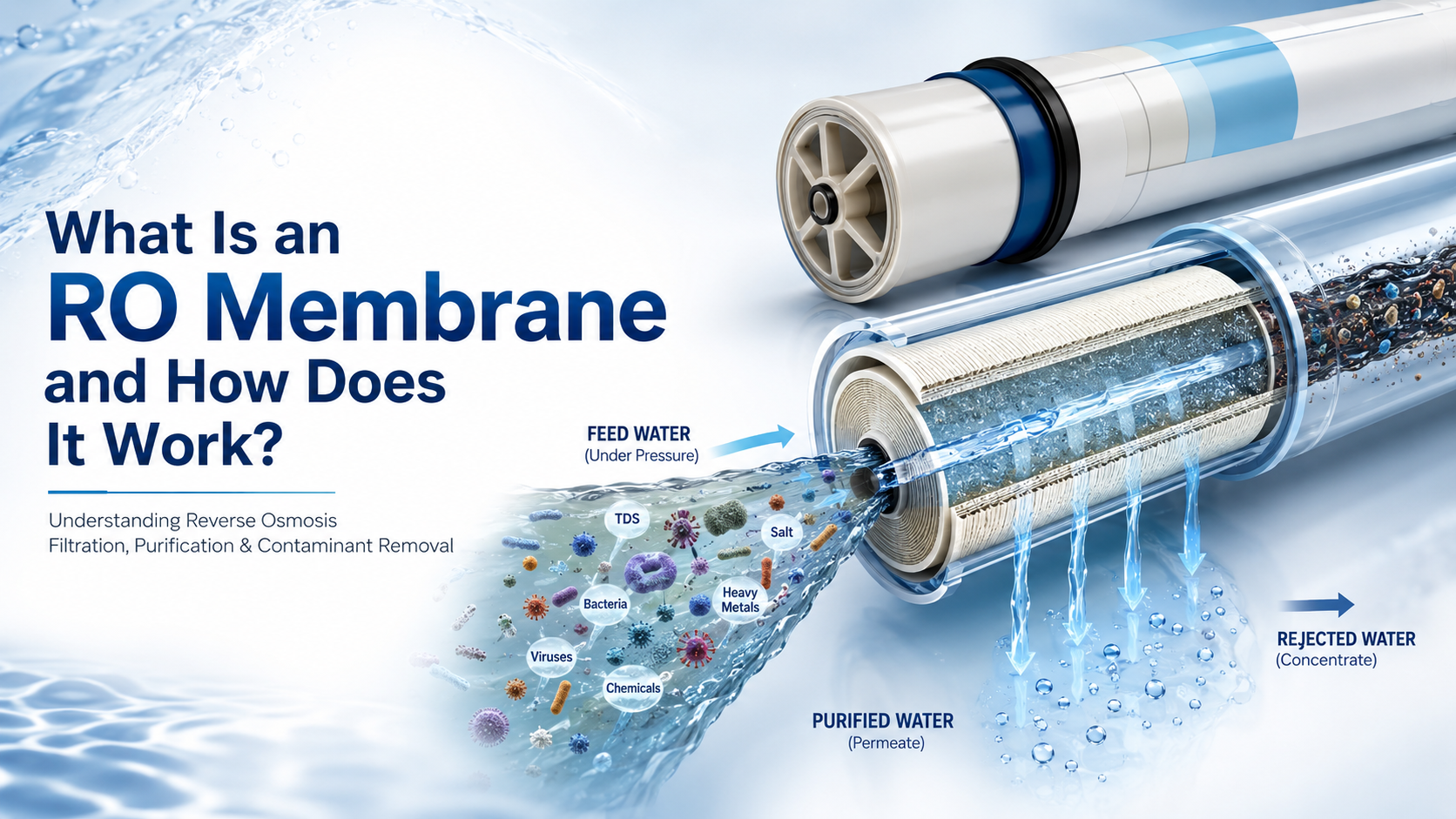
An RO membrane is a semi-permeable filtration sheet inside a reverse osmosis water purifier. Under water pressure, it forces water molecules through pores as fine as 0.0005 micron while blocking dissolved salts, heavy metals, bacteria, and viruses — reducing TDS (Total Dissolved Solids) by 90–99%. It's the single component that determines how "pure" your purified water actually is.
Type |
Description |
Common Use |
|---|---|---|
CTA (Cellulose Triacetate) |
Older technology, tolerant of low-level chlorine but lower rejection rates |
Largely phased out |
TFC / TFN (Thin Film Composite / Nanocomposite) |
Current standard — higher rejection, broader contaminant removal, chlorine-sensitive |
Nearly all modern domestic and industrial membranes |
Brackish Water (BW) membranes |
Optimized for moderate-TDS feed water (borewell, municipal, groundwater) |
Domestic RO, mid-scale commercial |
Seawater (SW) membranes |
Built for very high-salinity water (10,000+ PPM), operate at much higher pressure |
Desalination plants |
Stage |
Removes |
Position |
|---|---|---|
Sediment Filter |
Sand, dust, rust, visible particles |
Stage 1 (first) |
Carbon Filter |
Chlorine, odour, taste compounds |
Stage 2 (pre-membrane) |
RO Membrane |
Dissolved salts, TDS, heavy metals, bacteria, viruses |
Stage 3 (final, finest) |
Leave A Comment