


13-Aug-2026
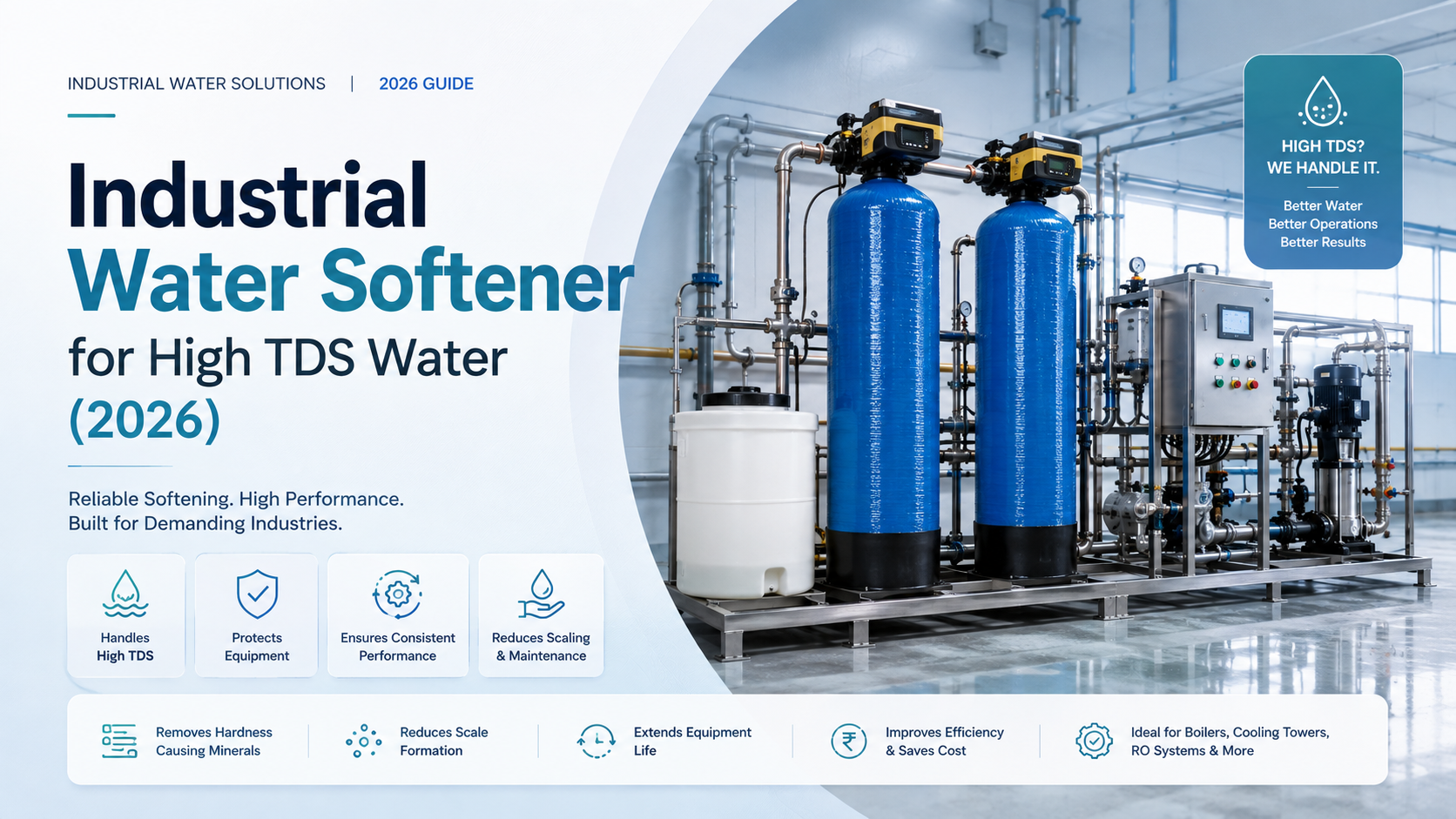
Quick answer: A water softener does not reduce overall TDS — it removes hardness (calcium and magnesium) only. If your facility has both high hardness and high TDS, you typically need a softener as pre-treatment plus an RO system for TDS reduction. Industrial softener pricing scales mainly with capacity (500–3000+ LPH), automation level (semi vs fully automatic), and inlet hardness rating. Full breakdown below.
If you're researching "industrial water softener for high TDS cost," this is worth clarifying before we get into pricing — because it changes what you should actually be buying.
A water softener does not lower your water's overall TDS. It removes hardness-causing minerals specifically — calcium (Ca²?) and magnesium (Mg²?) — by exchanging them for sodium ions through an ion-exchange resin bed. Total dissolved solids can stay roughly the same, or shift only slightly, since sodium ions replace hardness ions rather than being removed from the water altogether.
So what should you actually buy?
Not sure which applies to your facility? Start with our guides on how to know if your area has hard water and the difference between hard and soft water — and if your concern is specifically about drinking water TDS rather than industrial hardness, our Ideal TDS Level for Drinking Water guide covers that separately.
Once you've confirmed a softener is the right fit, pricing depends on these specific factors:
The single biggest cost driver. Industrial softeners are sized by how much water they can soften per hour, typically ranging from 500 LPH for small facilities up to 3000+ LPH for larger industrial operations. Higher capacity means a larger resin vessel, bigger brine tank, and more robust valve/control assembly — all adding to cost.
Systems rated for higher inlet hardness (e.g., up to 1500 ppm vs up to 500 ppm) typically use a larger resin volume to handle the higher mineral load without frequent regeneration — affecting both unit cost and ongoing salt consumption.
FRP (Fibre Reinforced Plastic) tanks are cost-effective and common for most industrial applications. Stainless steel builds cost more but offer longer service life and are often preferred in food & beverage or pharma settings with stricter hygiene requirements.
ISO-certified systems typically carry a premium over uncertified equipment, but this generally reflects better component quality, consistent performance, and reliable long-term support — worth it for continuous industrial use where downtime is expensive.
Beyond unit price, factor in installation charges, the initial resin/salt charge, and whether you want an Annual Maintenance Contract (AMC) covering periodic resin top-ups, valve servicing, and troubleshooting support.
Capacity |
Best Suited For |
Automation Options |
Explore |
500 LPH |
Small facilities, single boiler/cooling unit, small hotels, clinics |
Fully Automatic |
View 500 LPH Softener |
1000 LPH |
Mid-size factories, hospitals, hotels, food processing units |
Semi-Automatic or Fully Automatic |
Semi-Automatic · Fully Automatic |
2000 LPH |
Larger industrial operations, multi-unit cooling systems |
Fully Automatic |
View 2000 LPH Softener |
3000 LPH |
Large-scale industrial plants, high-volume process water needs |
Fully Automatic |
View 3000 LPH Softener |
Exact pricing varies by capacity, automation level, and inlet hardness rating. As a reference point, our 500 LPH Industrial RO Plant — a different but comparably-sized system — is priced at approximately ?1,39,999 (exclusive of taxes). Water softener pricing follows a broadly similar structure scaled by capacity and automation, but varies based on the specific factors above. For an exact, current quote on any softener capacity, check the individual product pages linked above, or request a custom quote — pricing is updated regularly and depends on your specific inlet hardness and application.
Question |
If Yes → |
If No, and TDS is still high → |
Is scaling on equipment (boilers, cooling towers, pipes) your main issue? |
Water Softener |
Consider RO |
Do you need genuinely low-TDS output water (drinking, F&B production)? |
RO System |
Softener alone won't achieve this |
Is your source water both hard AND high-TDS? |
Softener (pre-treatment) + RO (final polish) |
- |
If your feed water TDS is above roughly 3000 ppm, industrial RO systems typically need a custom configuration — our Industrial RO Plant page has more detail, or you can reach out directly for a system sized to your exact feed water. If you're seeing inconsistent output even with an existing RO system, our troubleshooting guide on why industrial RO plants stop reducing TDS is worth checking too — it's often a sign hardness scaling has already reached the membrane, reinforcing the case for softening as pre-treatment.
Industrial water softeners are long-term infrastructure investments — a poorly built system means repeated resin replacement, inconsistent output, and potential downtime on equipment that depends on soft water. When evaluating suppliers, look for:
Pearl Water Technologies has supplied ISO-certified industrial water softeners and RO systems across food & beverage, hospitality, healthcare, and manufacturing sectors in India for over 10 years, with systems ranging from 500 LPH to 3000+ LPH — see our full Water Softener range for current specifications across capacities.
Does a water softener reduce TDS? No — a water softener specifically removes hardness (calcium and magnesium) by exchanging it for sodium ions. It does not meaningfully lower your water's overall TDS. If your goal is lower TDS, you need an RO system, not a softener.
How much does an industrial water softener cost in India? Cost depends primarily on capacity (LPH), automation level (semi vs fully automatic), and inlet hardness rating. Pricing scales with these factors — check individual product pages for current pricing on each capacity, or request a custom quote for your specific requirement.
Do I need a water softener or an RO plant for high TDS water? If your problem is scaling on equipment, a softener is the right tool. If you need genuinely low-TDS output water, you need an RO system. Many industrial setups use a softener as pre-treatment ahead of RO for the best of both — see our industrial RO plant guide for how the two systems work together.
What size industrial water softener do I need? This depends on your facility's hourly water consumption and inlet hardness level. As a rough guide, 500–1000 LPH suits small-to-mid facilities, while 2000–3000 LPH suits larger industrial operations — though exact sizing should account for your specific usage pattern.
Is a fully automatic water softener worth the extra cost over semi-automatic? For continuous industrial operations, usually yes — fully automatic systems reduce labor overhead and maintain more consistent water quality since regeneration happens reliably without manual intervention.
Can a water softener be used before an RO plant? Yes, and it's a common and recommended setup. Softening the water before it enters an RO system removes hardness that would otherwise cause scaling on the RO membrane, extending membrane life and maintaining consistent TDS rejection performance over time.
What is the difference between industrial and domestic water softeners? Industrial softeners are built for higher continuous flow rates (500–3000+ LPH vs typically under 50 LPH for domestic units), heavier-duty components for constant operation, and often stainless steel or reinforced tank construction suited to industrial environments.
Not sure whether your facility needs a softener, an RO system, or both? Get in touch with our water treatment engineering team for a water quality assessment and a system sized to your exact inlet hardness and TDS — browse our Water Softener range or Industrial RO Plants to get started.
Leave A Comment