


16-Sep-2026
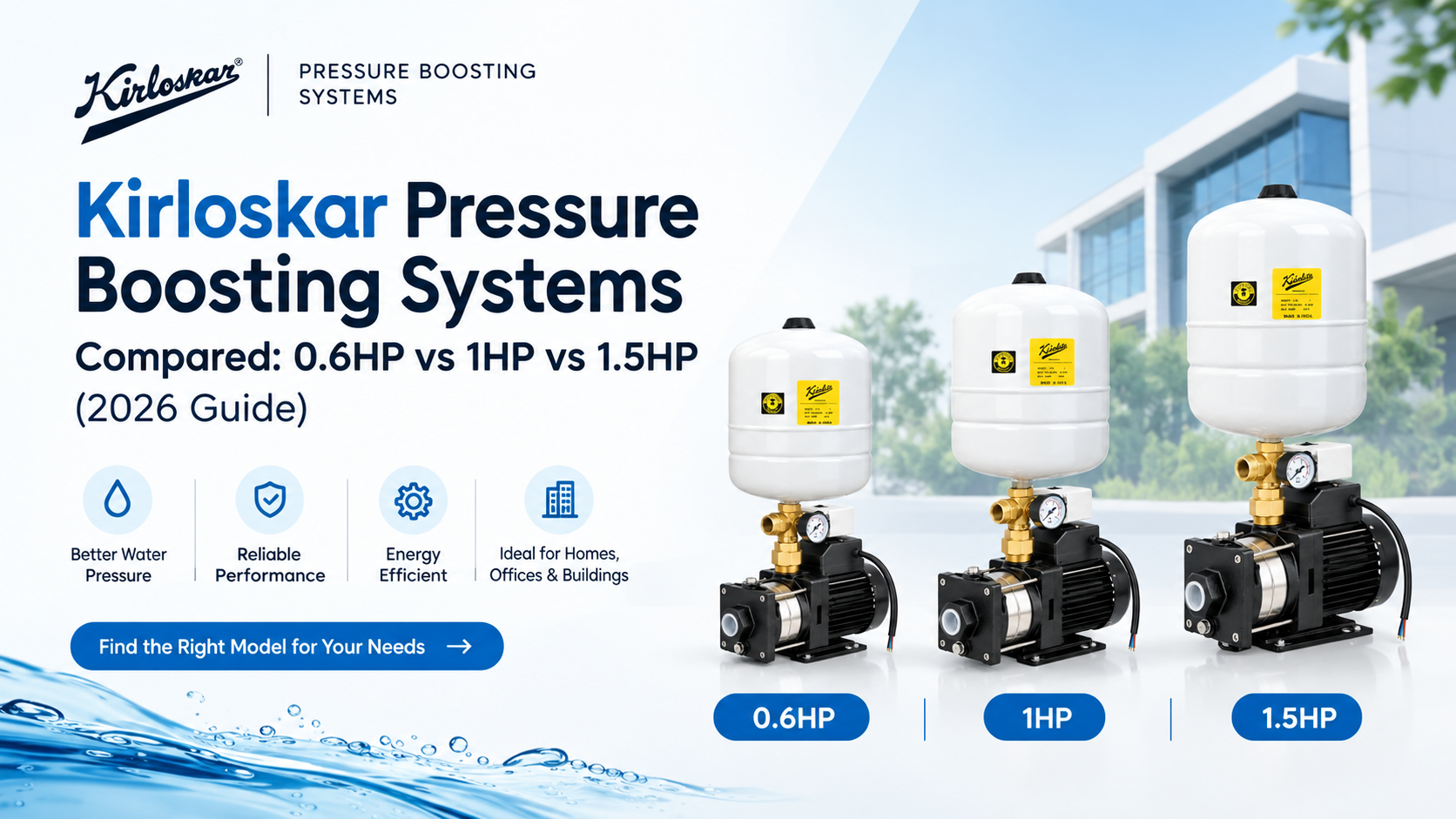
We get some version of this question almost every week: "Which Kirloskar pressure booster pump should I buy for my house?" Usually the person has already spent an hour on Google, ended up more confused than when they started, and just wants someone to tell them straight — 0.6HP, 1HP, or 1.5HP.
Fair enough. The spec sheets don't make it obvious, and most listings just show horsepower and price without explaining what that actually means for your shower, your top floor, or your electricity bill. So here's the comparison we wish existed when we started selling these — written from actual installations, not just the catalogue.
If you don't want to read the whole thing:
That's the rule of thumb 90% of buyers actually need. If your situation is closer to the edge cases — a 3-bathroom duplex with a rooftop garden tap, say — keep reading, because that's exactly where people get it wrong.
Here's the thing nobody explains on a spec sheet: horsepower is really just a proxy for how many outlets can draw water at the same time without pressure sagging. A single bathroom opened for a shower needs far less simultaneous flow than three bathrooms, a kitchen, and a washing machine all pulling from the same line during the 7 AM rush.
So when you're comparing "kirloskar pressure booster pump price," don't just look at the number on the tag. Ask yourself: how many points in my house could realistically be drawing water at once? That number — not the size of your house in square feet — is what actually decides the right HP.
This is also why buying bigger "just to be safe" isn't free. A 1.5HP motor pulls more current than a 0.6HP one every time it cycles on, whether or not you're using the extra capacity. Oversizing doesn't just waste money upfront — it adds to your monthly bill for as long as you own the pump.
|
|
0.6 HP |
1 HP |
1.5 HP |
Best for |
1BHK/2BHK flats, single bathroom |
Independent houses, bungalows, 2–3 bathrooms |
Villas, multi-storey homes, 4–5+ bathrooms |
Simultaneous outlets |
1–2 |
Up to 4 |
5+ |
Power draw |
0.45 kW |
0.75 kW |
1.1 kW |
Typical setup |
Ground/low-rise flat, small overhead tank |
Overhead tank feeding 2–3 floors |
Large tank feeding multiple floors + outdoor points |
Running cost |
Lowest in the range |
Moderate |
Highest, but proportionate to demand |
Where it struggles |
3+ bathrooms running together |
4+ bathrooms or tall multi-storey homes |
Overkill for a single bathroom or small flat |
This is the one we sell to people renovating a single-bathroom flat where the shower barely dribbles. It's sized for exactly that: one or two outlets, nothing more. We've had customers ask if they should get the 1HP "to be future-proof," and honestly, for a 1BHK or 2BHK, that's usually money spent on capacity you'll never use.
Where it doesn't work: if you're planning to add a second bathroom later, or you already have three wet points in the house, don't go with 0.6HP just because it's cheaper. Full breakdown here: Kirloskar 0.6 HP Pressure Boosting System → .
If you look at our sales data, this is by far the most common variant we install — which makes sense, because 2–3 bathroom independent houses and bungalows are the most common home type asking for a booster pump in the first place.
The scenario this fixes almost every time: someone showers upstairs while the kitchen tap runs downstairs, and pressure at both points used to drop noticeably. A correctly sized 1HP HYPN unit holds pressure steady through that. It's also the unit we recommend when a customer says water pressure gets weak "sometimes" but not always — that's usually a multi-outlet demand issue, which is exactly what 1HP is built to absorb.
One thing worth flagging: if your house has 4 bathrooms or more, don't default to 1HP just because it's the popular choice. We've had a few calls from customers who installed 1HP in a 4-bathroom home and were back within a year asking why it still struggled during peak hours. Full spec sheet: Kirloskar 1 HP Pressure Boosting System → .
This is the variant for houses where "how many bathrooms" starts sounding more like a hotel question than a home question — 4, 5, sometimes more, plus a garden hose or a car wash point outside. G+2 villas in particular tend to need this, because height adds resistance that the pump has to work against on top of simultaneous demand.
It's also the one we point light-commercial buyers toward — guest houses, small farmhouses with a rental portion, that sort of thing. The extra draw (1.1kW vs 0.75kW for the 1HP) is real, but so is the alternative: running a smaller pump flat-out under a load it wasn't built for, which wears it down faster and still leaves your top floor with a weak shower. Details here: Kirloskar 1.5 HP Pressure Boosting System → .
Buying based on house size instead of bathroom count. A large house with one bathroom needs less pump than a compact house with four. Square footage isn't the variable that matters here.
Assuming bigger is always better. It isn't — you pay for that extra capacity every single month whether you use it or not, and a pump running well below its rated load doesn't actually perform "better," it just cycles less efficiently.
Ignoring pipe size. Even the right pump won't hit its rated flow through undersized delivery pipes. If your existing plumbing is old or narrow, mention this before you buy — it changes what the pump can actually deliver.
Not accounting for future additions. If you're planning to add a bathroom in the next year or two, it's worth discussing sizing now rather than replacing the pump later.
Count the bathrooms and any other regular water points (kitchen, washing machine, outdoor tap) that could realistically run at the same time during your household's busiest hour — usually early morning. That number, more than anything else, tells you which HP you need:
If you're genuinely on the edge between two sizes, it's worth a quick call rather than guessing — undersizing means you're back here in a year, and oversizing means you're overpaying every month until then.
Is it better to size up "just in case"? Not usually. The extra power draw is permanent and recurring, while the benefit only shows up if your usage actually grows into it. Size for your current bathroom count, not a hypothetical future one — unless that future is already planned and imminent.
Can I upgrade from 1HP to 1.5HP later if I add bathrooms? Yes, in most cases the existing tank and plumbing can be reused, and only the pump unit needs replacing. It's still worth getting your setup checked before assuming this, since pipe sizing matters too.
Does a higher HP mean noisier operation? Not significantly — all three Kirloskar HYPN variants are built for residential use and operate at comparable noise levels. Placement (a wall-mounted, ventilated spot away from bedrooms) affects perceived noise more than HP does.
What if my home doesn't fit neatly into these categories — say, 3 bathrooms but on 3 floors? This is exactly the edge case worth a quick conversation rather than a guess. Floor height adds resistance the pump has to overcome, so a 3-bathroom home spread across 3 floors may need more than a 3-bathroom home on one floor. Contact us → and we'll help size it properly.
Are these genuine Kirloskar units with warranty? Yes — we're an authorized dealer, so every unit comes with full manufacturer warranty and access to genuine spares. See the complete Kirloskar pressure boosting range →.
Still not sure which one fits your home? Get in touch → and tell us your bathroom count and floor layout — we'll tell you straight, the same way we would a neighbour, not just upsell you the bigger unit.
Leave A Comment