


12-Jun-2026
RO Filter Kit Price in India (2026): Complete Buying Guide for RO Water Purifier Filters & Service Kits
An RO filter kit price in India typically ranges from 400 to 2,500, depending on the number of filters, brand, and whether it is a basic sediment-carbon set or a complete service kit with membrane and UF filter. A standard RO service kit (sediment + pre-carbon + post-carbon) costs 500-1,200, while a complete RO filter set with membrane can cost 1,500-3,500.
Introduction
If your RO water purifier has started giving water with a strange taste, slower flow, or more wastewater than usual, it's probably time to think about an RO filter kit. Every RO purifier — whether it's a kitchen-top unit or a wall-mounted system — relies on a series of filters that trap dust, chlorine, bad odour, bacteria, and dissolved impurities before the water reaches your glass.
Over time, these filters get clogged. A clogged sediment filter can choke water flow. A used-up carbon filter stops removing chlorine and bad smell. A worn-out membrane lets more TDS pass through. This is why every RO purifier needs a filter kit replacement at regular intervals — usually once or twice a year.
A water purifier filter kit is simply a bundle of these replacement filters, sold together so you don't need to buy each part separately. Buying a complete kit instead of individual filters is usually cheaper, more convenient, and ensures all filters are changed together — which keeps your purifier running at its best.
In this guide, we cover everything about RO filter kit price, RO service kit price, individual filter costs, replacement schedules, and how to choose the right kit for your home or office.
[Get Best Price on RO Filter Kits →]
What is an RO Filter Kit?
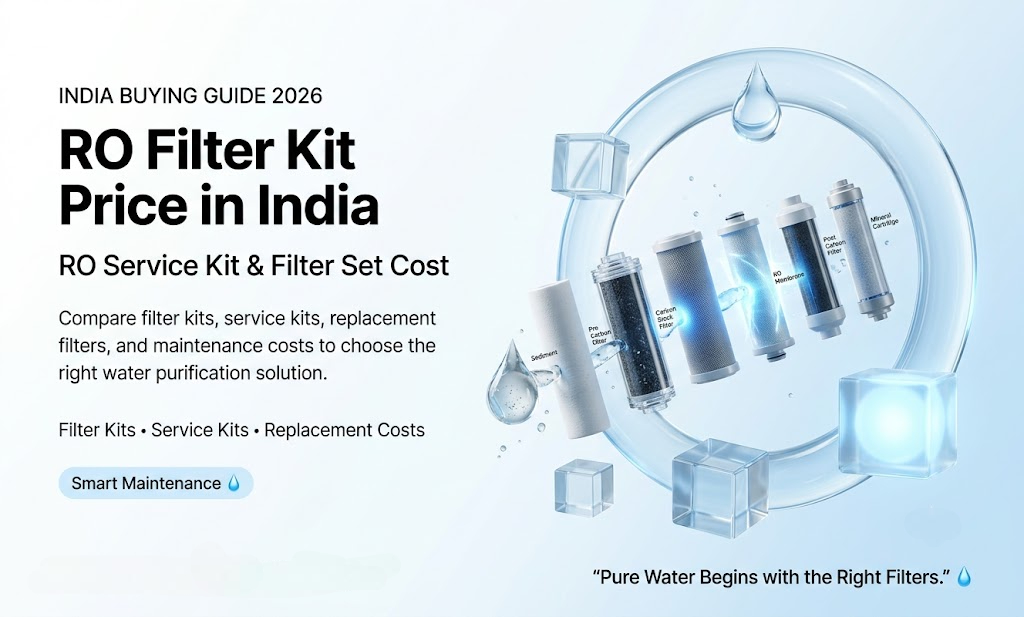
An RO filter kit is a set of replacement filters designed to restore your RO water purifier's performance. A typical kit includes some or all of the following components:
Sediment Filter – This is the first line of defence. It removes mud, sand, rust particles, and visible dirt from the incoming water. Think of it as a coarse strainer that protects the finer filters downstream from getting clogged too quickly.
Pre Carbon Filter – Made from activated carbon, this filter removes chlorine, pesticides, and bad odour before the water reaches the RO membrane. Without it, chlorine can damage the membrane prematurely.
Carbon Block Filter – A denser, compressed carbon filter that provides more thorough removal of chemicals, chlorine, and organic compounds compared to a granular pre-carbon filter.
Inline Carbon Filter – A smaller carbon cartridge placed just before or after the membrane, fine-tuning taste and odour removal in a compact format.
Post Carbon Filter – This is the final polishing filter. It improves the taste of water just before it reaches the storage tank or tap, removing any residual odour.
UF Filter (Ultrafiltration Filter) – Found in RO+UF systems, this filter removes bacteria, viruses, and suspended solids using a fine membrane, even without electricity in some models.
TDS Controller – This component balances the mineral content (TDS) of the purified water. For water with very high input TDS, it ensures the output isn't "too pure" and retains some essential minerals.
Mineral Cartridge – Adds back essential minerals like calcium and magnesium that the RO membrane removes, improving taste and health value.
Real-world example: A typical Indian household using municipal water with moderate TDS (around 300-500 ppm) usually needs a kit with a sediment filter, pre-carbon filter, post-carbon filter, and occasionally a membrane — covering the core RO water purifier filter requirements for one year. A good reverse osmosis water filter setup combines all these stages for safe, great-tasting drinking water.
RO Filter Kit Price in India
Here is a general pricing overview based on common kit types available in the Indian market:
Product Type |
Average Price Range |
RO Filter Kit (Sediment + Carbon, basic) |
400 - 900 |
RO Service Kit (3-4 filters) |
500 - 1,200 |
Complete RO Filter Set (with membrane) |
1,500 - 3,500 |
Water Purifier Filter Kit (with UF + Mineral Cartridge) |
800 - 2,000 |
Factors That Affect Water Purifier Kit Price
Expert Recommendation: For most homes, a mid-range complete filter set offers the best balance of cost and performance. Avoid the cheapest unbranded kits, as they often use low-grade carbon that wears out within 2-3 months.
RO Service Kit Price Explained
The term "RO service kit" is commonly used by technicians during annual maintenance visits. Here's how different types compare:
Standard Service Kit (?500-?900) – Includes sediment filter, pre-carbon, and post-carbon filters. Suitable for routine 6-month or annual servicing where the membrane and UF are still in good condition.
Annual Maintenance Replacement Kit (?900-?1,500) – A more complete bundle that includes the three carbon/sediment filters plus an inline filter or UF filter, designed for once-a-year full servicing.
Premium Branded Filter Kits (?1,200-?2,500) – Original equipment manufacturer (OEM) kits matched exactly to a specific purifier model. These cost more but ensure perfect fitting and consistent quality.
Universal Filter Kits (?400-?1,000) – Compatible with multiple brands and models. Budget-friendly, but it's important to check the filter dimensions and thread type before buying.
RO Filter Price List
Below is a breakdown of individual RO filter prices along with how often each one typically needs replacement:
Filter Type |
Average Price |
Replacement Frequency |
Sediment Filter |
100 - 250 |
Every 3-4 months |
Pre Carbon Filter |
150 - 350 |
Every 4-6 months |
Carbon Block Filter |
200 - 450 |
Every 6-8 months |
Post Carbon Filter |
150 - 350 |
Every 6-12 months |
Inline Filter |
100 - 300 |
Every 6-12 months |
UF Filter |
?400 - ?900 |
Every 12-18 months |
Mineral Cartridge |
?250 - ?600 |
Every 6-12 months |
RO Membrane (50/75/100 GPD) |
?600 - ?1,800 |
Every 12-24 months |
Key Takeaway: Sediment and pre-carbon filters wear out fastest because they handle the heaviest impurity load. The membrane lasts the longest but is also the costliest part to replace.
How Often Should RO Filters Be Replaced?
Replacement frequency depends on your water quality, usage, and filter type. Here's a general schedule:
Every 3 months – Sediment filter, especially if your water source has high turbidity (muddy or hard borewell water).
Every 6 months – Pre-carbon filter, carbon block filter, and post-carbon filter for average households with moderate water usage.
Every 12 months – UF filter, mineral cartridge, and RO membrane in low-to-moderate TDS areas with regular maintenance.
Every 24 months – RO membrane in households using good-quality input water with annual servicing and filter changes done on time.
Signs Your RO Filters Need Replacement
If you notice two or more of these signs, it's time to check your RO filter kit price options and plan a replacement.
Benefits of Buying a Complete Water Purifier Filter Kit
Cost Savings – Buying a bundled kit is usually 15-25% cheaper than purchasing each filter separately, plus you save on multiple service visit charges.
Better Water Quality – When all filters are replaced together, each stage works at full efficiency, resulting in cleaner, safer drinking water.
Longer Membrane Life – Fresh sediment and carbon filters protect the membrane from chlorine and particulate damage, extending its lifespan significantly.
Easier Maintenance – One kit, one service visit, one record to track — instead of juggling multiple purchase dates for different filters.
Improved Taste and Odour – Fresh carbon filters immediately improve the taste and smell of water, which is often the first noticeable difference after a kit replacement.
RO Filter Kit vs Individual Filters
Aspect |
RO Filter Kit |
Individual Filters |
Cost |
Lower (bundled discount) |
Higher (per-piece pricing) |
Convenience |
High – one-time purchase |
Low – multiple purchases needed |
Maintenance Tracking |
Easy – single replacement date |
Difficult – different schedules |
Best For |
Annual full servicing |
Replacing only one worn-out filter |
Compatibility |
Pre-matched components |
Requires individual verification |
Expert Recommendation: Choose a complete kit during annual servicing, but keep a spare sediment filter on hand for emergency mid-cycle replacement if your water source is particularly dirty.
How to Choose the Best RO Water Purifier Kit
Water Source – Borewell or tanker water with high sediment needs kits with a heavier-duty sediment filter and more frequent carbon changes. Municipal water generally needs lighter filtration.
TDS Level – If your input water TDS is above 500 ppm, prioritize kits with a high-rejection membrane and a properly functioning TDS controller.
Family Size – Larger families (5+ members) consume more water, meaning filters reach capacity faster — consider kits with higher-capacity cartridges or shorter replacement cycles.
Brand Compatibility – Always check that the kit's filter dimensions, thread size, and connector type match your purifier model, whether you're buying an OEM kit or a universal one.
Certification – Look for filters tested under recognized water quality standards, which indicate the materials and performance have been verified.
Food-Grade Materials – Ensure carbon and housing materials are food-grade and BPA-free, as these come into direct contact with your drinking water.
Common Mistakes While Buying RO Filter Kits
Expert Tips for Increasing RO Filter Life
[Contact Our Water Treatment Experts →]
Frequently Asked Questions
Q1. What is RO kit price? An RO kit price generally ranges from ?400 to ?2,500, depending on the number of filters included and whether it contains a membrane.
Q2. What is RO service kit? An RO service kit is a bundle of filters — typically sediment, pre-carbon, and post-carbon — used during routine maintenance to restore purifier performance.
Q3. What is RO service kit price? A standard RO service kit costs between ?500 and ?1,200, while premium branded kits can cost up to ?2,500.
Q4. Which filter should be replaced first? The sediment filter is usually replaced first, as it handles the heaviest load of dirt and clogs fastest among all filter stages.
Q5. How much does RO filter replacement cost? RO filter replacement cost ranges from ?100 for a single sediment filter to ?3,500 for a complete set including the membrane.
Q6. What is the price of a complete RO filter set? A complete RO filter set, including sediment, carbon filters, and membrane, typically costs between ?1,500 and ?3,500.
Q7. Can I replace RO filters myself? Yes, sediment, pre-carbon, and post-carbon filters are generally easy to replace at home with basic tools. Membrane replacement is best done by a technician.
Q8. Which RO filter kit is best? The best RO filter kit depends on your input water quality and purifier model, but a complete kit with sediment, carbon, UF, and mineral cartridge generally suits most Indian households.
Q9. How often should RO filters be changed? Sediment filters every 3-4 months, carbon filters every 6 months, and membranes every 12-24 months, depending on water quality.
Q10. What is the difference between RO filter and RO membrane? RO filters (sediment, carbon) are pre/post-treatment stages, while the RO membrane is the core component that removes dissolved salts and contaminants.
Step-by-Step Guide: How to Replace Your RO Filter Kit
Understanding RO filter kit price and replacement schedules helps you maintain consistently clean drinking water without unexpected breakdowns. Whether you choose a basic RO service kit or a complete water purifier filter kit, timely replacement is the single most important factor in keeping your purifier efficient and your water safe.
Looking for genuine, affordable RO filter kits, water filter kits, and filter kits
Leave A Comment