


27-Aug-2026
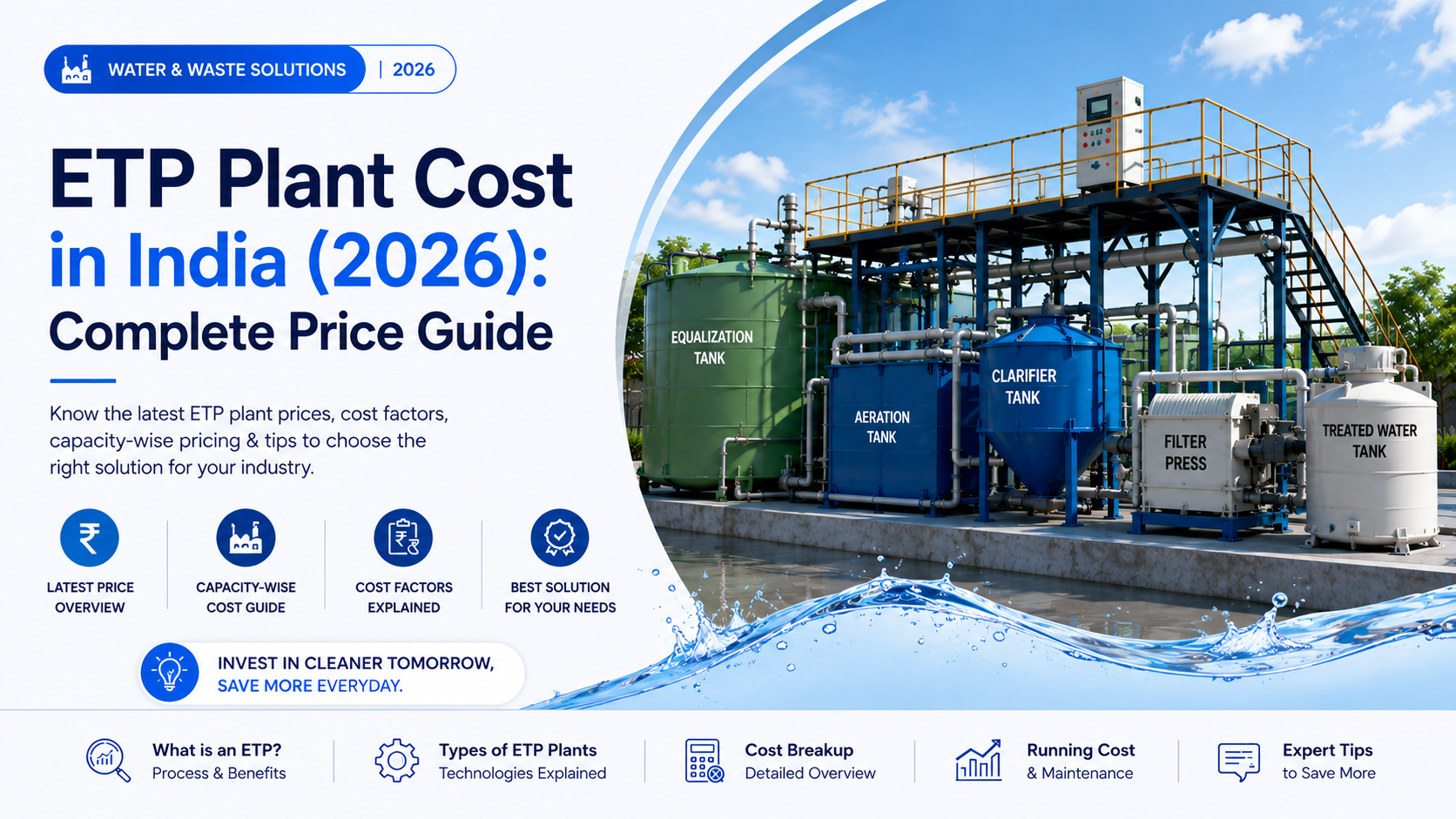
Last updated: August 2026 · By the Pearl Water Technologies Engineering Team · ISO-certified water & wastewater treatment manufacturer, offices in Gurgaon, Bengaluru & Lucknow
ETP plant cost in India typically ranges from ?45,000 to ?2,00,000 per KLD (kilolitre per day) of installed capacity, depending on the industry, wastewater strength, treatment technology, and level of automation. In absolute terms:
These are indicative 2026 market ranges for installed-and-commissioned plants (equipment + civil + electrical + commissioning), excluding land cost. Your exact price depends on your effluent's actual pollutant load — get a free quote based on your effluent analysis.
Unlike domestic sewage, no two industrial effluents are the same — which is exactly why a single "cost per KLD" figure is only a starting point. Six factors move an ETP quotation up or down:
Related reading: For the fundamentals of how these treatment stages work, see our guide on what is an ETP plant, its uses, advantages and workflow, and the role an ETP plays in industrial water treatment.
The table below gives realistic 2026 installed-and-commissioned cost ranges — covering equipment, civil construction, piping, electrical work, and commissioning. Treat these as an order-of-magnitude guide, not a fixed quote; your final price depends on your specific effluent characterisation.
ETP Capacity |
Typical Use Case |
Indicative Total Cost (?) |
Approx. Cost per KLD |
1 KLD |
Small workshop, lab, single-line unit |
?1.2 lakh |
~?1,20,000/KLD |
2 KLD |
Small manufacturing unit |
?1.8 lakh |
~?90,000/KLD |
5 KLD |
Small industrial unit |
?3 lakh – ?6 lakh |
?60,000–1,20,000/KLD |
10 KLD |
Small-to-mid manufacturing facility |
?6 lakh – ?15 lakh |
?60,000–1,50,000/KLD |
25 KLD |
Mid-sized factory |
?12 lakh – ?28 lakh |
?48,000–1,12,000/KLD |
50 KLD |
Mid-to-large manufacturing unit |
?20 lakh – ?50 lakh |
?40,000–1,00,000/KLD |
100 KLD |
Large manufacturing / dairy / food & beverage plant |
?35 lakh – ?80 lakh |
?35,000–80,000/KLD |
500 KLD |
Large industrial estate / cluster |
?1.5 crore – ?4 crore |
?30,000–80,000/KLD |
1 MLD (1,000 KLD)+ |
Large integrated industrial plant |
?2 crore – ?5 crore+ |
?20,000–50,000/KLD |
Note: These are civil-and-mechanical installed costs. If your project requires Zero Liquid Discharge, multiply the above figures by 1.4x–3x (see ZLD section). Prices at the small end (1–2 KLD) are for semi-automatic packaged units, like Pearl Water's own 1 KLD and 2 KLD ETP plants, which are designed to be compact, portable, and cost-effective for small industrial units — browse the full ETP plant range here.
Because effluent composition varies drastically by sector, the same capacity costs differently across industries:
Industry |
Relative ETP Cost |
Why |
Food & beverage / dairy |
Baseline |
Mostly organic load, biodegradable — simpler biological treatment suffices |
Automobile / general engineering |
Baseline to +15% |
Oil, grease, and heavy metals require additional physico-chemical stages |
Textile |
+30–50% above baseline |
High COD, dyes, and colour removal require advanced chemical/oxidation treatment |
Pharmaceutical |
+30–50% above baseline |
Complex, often toxic compounds; stricter discharge norms; frequently need ZLD |
Chemical manufacturing |
+40–60% above baseline |
Wide-ranging, often hazardous pollutants; highly customised design |
Tannery / leather |
+40–60% above baseline |
Chromium and high-salinity effluent need specialised removal stages |
Paper & pulp |
+20–40% above baseline |
High organic load and colour, large volumes |
If your unit falls in the pharmaceutical, textile, chemical, or tannery categories, budget toward the higher end of the capacity table above — and get your effluent tested before requesting quotes, since this single factor swings pricing more than any other.
The purchase price is only part of the picture. An ETP is a 15–20 year asset, and its running cost (power, chemicals, sludge disposal, manpower, and maintenance) often exceeds the capital cost over the plant's lifetime.
Where your Pollution Control Board mandates zero discharge or full water reuse, your ETP grows a tertiary polishing stage:
This tail alone can multiply total project cost by 3–5x, and running cost jumps too — evaporation is energy-intensive (roughly 12–18 kWh per m³ even in optimised MVR systems). As a result:
If ZLD is mandatory for your unit (common for textile, pharma, and chemical industries in water-stressed states), request separate CAPEX and OPEX estimates for the ZLD stage — it is frequently the larger half of the budget, not the smaller one.
A reliable manufacturer will never quote you a firm price without first understanding your effluent. Before requesting quotations, gather:
With this data, a manufacturer can size your plant correctly the first time. Undersizing is the costliest mistake in this industry — a plant running above capacity produces non-compliant effluent within months, and retrofitting typically costs 2–3x the original installation.
Ready for a quote? Get in touch with Pearl Water Technologies with your effluent details, or call our toll-free number (+91) 9582215137 for a sized estimate.
At Pearl Water Technologies, we design ETP systems only after analysing your effluent samples against real parameters — not a generic template. Our approach:
We are ISO-certified, with delivery and service capability across Gurgaon (NCR), Bengaluru, and Lucknow, and export certification for international orders.
Browse our full ETP plant range →
Q1. What is the average cost of an ETP plant in India? A: On average, ETP plant cost in India falls between ?45,000 and ?2,00,000 per KLD of installed capacity, depending on the industry, effluent strength, and treatment technology. A small 1–2 KLD packaged plant costs around ?1.2–1.8 lakh, while a 100 KLD plant typically costs ?35–80 lakh.
Q2. What is the cost of a 10 KLD ETP plant? A: A 10 KLD ETP plant typically costs between ?6 lakh and ?15 lakh for installation, including equipment, civil work, and commissioning — the exact figure depends on effluent strength and the technology used.
Q3. Why do ETP plants cost more than STP plants of the same capacity? A: Industrial effluent (treated by an ETP) generally contains chemicals, oils, heavy metals, and higher pollutant loads than domestic sewage (treated by an STP), which needs more intensive physico-chemical treatment stages. A domestic STP might cost ?15,000–35,000 per KLD, while an industrial ETP commonly costs ?60,000–2,00,000 per KLD. Read our full comparison in ETP vs STP: What's the Difference.
Q4. Does Zero Liquid Discharge (ZLD) really cost 3x more? A: Yes — adding RO, evaporation (MEE/MVR), and crystallisation (ATFD) stages for ZLD can multiply total project cost by 3–5x compared to a conventional ETP of the same capacity, because these stages are capital- and energy-intensive.
Q5. Is the ETP plant cost per KLD the same at every capacity? A: No. Cost per KLD falls as capacity increases — a 5 KLD plant may cost ?80,000–1,00,000 per KLD, while a 200 KLD plant of the same technology can cost as little as ?35,000–45,000 per KLD, because civil work and infrastructure scale more efficiently at larger sizes.
Q6. What's included in the ETP plant price — equipment only, or the full installation? A: A proper ETP quotation should be a turnkey, installed-and-commissioned price — covering equipment supply, civil construction (tanks/foundations), piping, electrical work, and commissioning. Always confirm what's included before comparing quotes across vendors, since some vendors quote equipment-only prices that look cheaper but exclude civil work.
Q7. How much does it cost to run (operate) an ETP plant every month? A: Monthly operating cost (O&M) ranges from around ?10,000 for a small packaged plant to ?1–2 lakh/month for a 100 KLD plant, depending on power, chemical dosing, sludge disposal, and staffing. Signing an AMC with your manufacturer typically reduces this by 20–30% versus ad-hoc repairs.
Q8. Is an ETP plant mandatory for all industries in India? A: Under the Water (Prevention and Control of Pollution) Act, 1974 and the Environment (Protection) Act, 1986, industries generating wastewater above prescribed limits must install and operate an ETP and obtain consent from their State Pollution Control Board before discharge. Requirements vary by industry category and state — check with your SPCB for your specific obligation.
Q9. Which industries need the most expensive ETP plants? A: Textile, pharmaceutical, chemical manufacturing, and tannery/leather industries typically need the most expensive ETPs — 30–60% above baseline cost — because their effluent contains higher COD, dyes, heavy metals, or hazardous compounds that require advanced or multi-stage treatment.
Have specific effluent parameters and want an accurate quote? Contact Pearl Water Technologies or call (+91) 9582215137.
Explore our complete ETP plant range, learn what an ETP plant is and how it works, or read ETP vs STP: what's the difference if you're still deciding which system your facility needs.
Leave A Comment