


|
Product name |
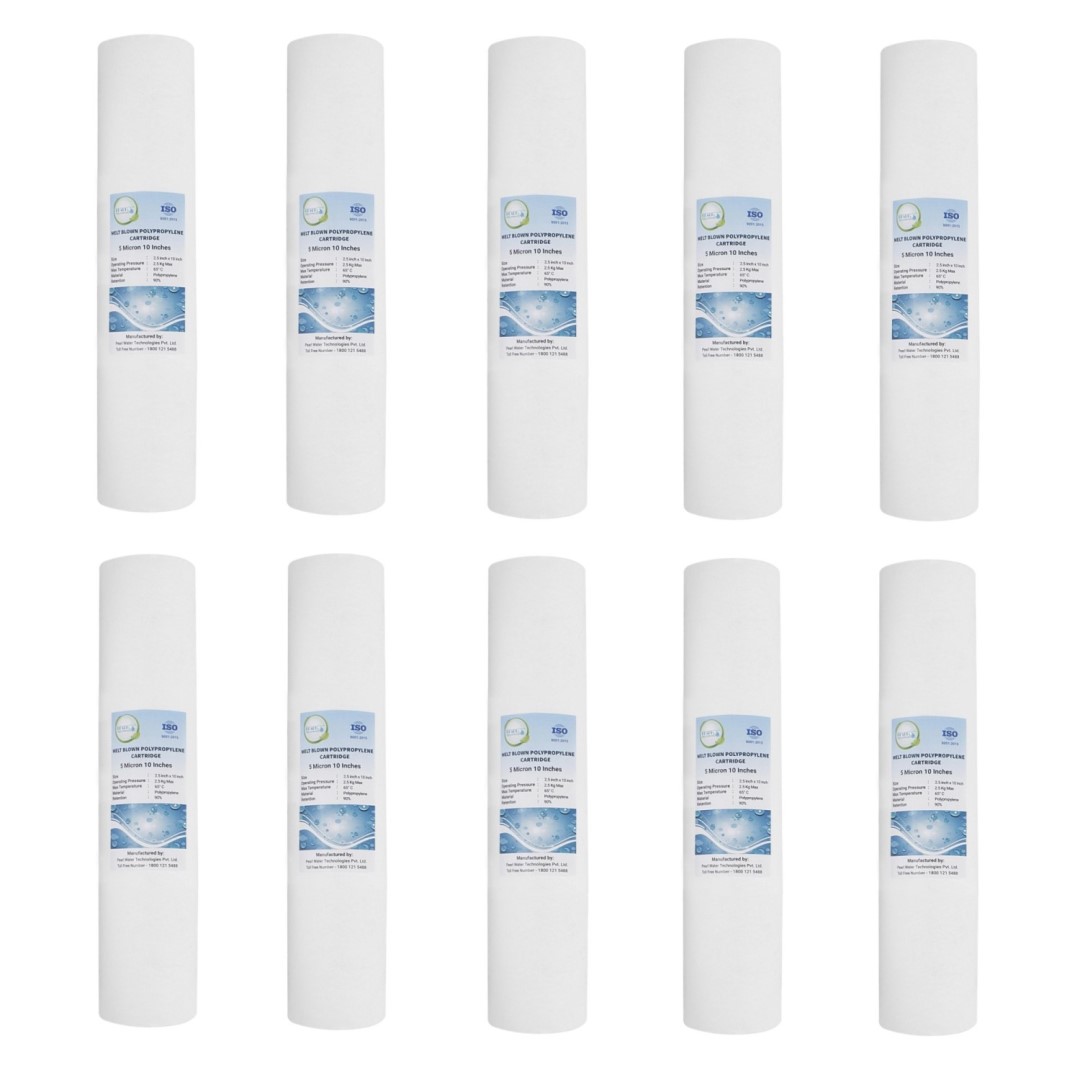
Pearl Water Filter Cartridge 10 Inch |
|
Filter type |
PP Spun (Polypropylene, Melt Blown) |
|
Micron rating |
5 micron |
|
Length |
10 inches (standard) |
|
Diameter |
Standard 2.5" / 63mm (fits standard 10" housings) |
|
Filtration type |
Depth filtration, graded density |
|
Material |
100% Polypropylene, no binders or chemicals |
|
Compatible housings |
Standard universal 10 inch cartridge filter housings |
|
Recommended use |
RO pre-filtration, sediment removal |
|
Water source compatibility |
Borewell, municipal, tanker, tank-stored water |
|
Recommended replacement |
Every 2–4 months, depending on water quality |


Pearl Water Filter Cartridge 10 Inch (PP Spun, 5 Micron)
If your RO purifier is clogging fast, losing pressure, or letting cloudy water through, the problem usually isn't the membrane — it's what's happening before the membrane. The Pearl Water Filter Cartridge is a 10 inch PP spun cartridge filter built to trap sand, rust, silt, and suspended solids at 5 micron accuracy, before that dirt ever reaches your RO system. Made from layered polypropylene using melt blown technology, it's a standard-size cartridge filter that fits most universal RO housings used in Indian homes, offices, and small commercial setups. Whether your supply is borewell water, municipal water, or tanker water, this cartridge acts as the first line of defense in your water purification system — protecting the membrane, improving flow rate, and cutting down on maintenance costs. It's a small, inexpensive part that quietly does a lot of heavy lifting.
What Is a 10 Inch PP Spun Cartridge Filter?
A PP spun filter cartridge is a cylindrical sediment filter made by spinning strands of polypropylene fiber around a hollow core. As the fibers wind layer over layer, they create a gradient density structure — looser on the outside, tighter toward the core. Water has to pass through all of these layers, and each one catches progressively finer particles.
This matters because raw water, especially from borewells or overhead tanks, carries physical impurities that have nothing to do with dissolved salts or bacteria. Sand, rust flakes from old pipes, mud, and general sediment are mechanical problems, and they need a mechanical solution. That's exactly what a PP spun cartridge is for.
Every RO purifier — domestic or commercial — needs a pre filter cartridge like this one because the RO membrane itself is extremely fine and easily damaged. Without sediment filtration ahead of it, particles scratch the membrane surface, block its pores, and shorten its working life dramatically. A 10 inch PP filter is the industry-standard size for most household RO systems in India, which is why it's often called a universal RO filter cartridge.
How Does It Work?
The filtration process is straightforward, but it's worth understanding step by step:
Water enters the housing and flows around the outer surface of the cartridge.
Coarse particles get trapped first by the looser outer layers of spun polypropylene fiber.
Water moves inward through progressively denser layers of fiber.
Fine particles down to 5 microns are captured as water works toward the cartridge's hollow core.
Filtered water exits through the core and moves on to the next stage — typically a carbon filter or the RO membrane itself.
Because the filtration happens gradually across the depth of the cartridge (not just on the surface), the filter has a high dirt holding capacity. It doesn't clog instantly the way a simple screen filter would; it fills up gradually from the outside in, which means longer service life between replacements.
Key Features
5 micron filtration rating — fine enough to remove sand, silt, rust particles, and visible suspended solids while maintaining good water flow.
Melt blown / spun polypropylene construction — creates a graded density structure for depth filtration rather than surface-only trapping.
10 inch standard length — fits standard housings used across most domestic and commercial RO systems in India.
High dirt holding capacity — the layered design means the filter can absorb more sediment before pressure drop becomes an issue.
No chemical treatment — made purely from polypropylene, safe for drinking water pre-filtration with no leaching of odor or taste.
Universal compatibility — works with most standard 10 inch cartridge filter housings, regardless of purifier brand.
Lightweight and easy to handle — simple to install or replace without tools in most housings.
Benefits
Better water quality. Removing sediment before the water reaches later stages means cleaner-tasting, clearer drinking water at the tap.
Membrane protection. The RO membrane is the most expensive part of your purifier. A good pre filter cartridge absorbs the physical wear that would otherwise fall on the membrane.
Longer RO life. With less sediment reaching downstream components, RO systems run into fewer blockages and last longer between major services.
Lower maintenance cost. Replacing a ?100–?300 cartridge every few months is far cheaper than replacing a damaged RO membrane.
Higher flow rate. A clean, properly sized sediment filter keeps water moving efficiently, instead of forcing your pump or purifier to fight against a clogged system.
Easy installation. No special tools or plumbing knowledge needed — it fits directly into a standard 10 inch cartridge housing.
Universal compatibility. As a standard-size cartridge, it works as a drop-in RO replacement filter across many purifier brands and models.
Applications
Homes and apartments — the most common use case, protecting kitchen RO purifiers from tank or municipal water sediment.
Restaurants and hotels — higher water usage means more sediment load; regular cartridge changes keep service consistent.
Schools and hospitals — where consistent, clean drinking water access is essential and downtime isn't an option.
Commercial RO plants — used as a pre-filtration stage ahead of higher-capacity membranes.
Industrial pre-filtration — protecting pumps, valves, and downstream equipment from abrasive particles.
Borewell water systems — borewell water often carries high sediment and mineral content, making pre-filtration especially important.
Municipal water connections — even treated municipal water can carry sediment from aging pipelines.
Tanker-supplied water — water stored and transported in tankers often picks up rust and sediment along the way.
|
Product name |
Pearl Water Filter Cartridge 10 Inch |
|
Filter type |
PP Spun (Polypropylene, Melt Blown) |
|
Micron rating |
5 micron |
|
Length |
10 inches (standard) |
|
Diameter |
Standard 2.5" / 63mm (fits standard 10" housings) |
|
Filtration type |
Depth filtration, graded density |
|
Material |
100% Polypropylene, no binders or chemicals |
|
Compatible housings |
Standard universal 10 inch cartridge filter housings |
|
Recommended use |
RO pre-filtration, sediment removal |
|
Water source compatibility |
Borewell, municipal, tanker, tank-stored water |
|
Recommended replacement |
Every 2–4 months, depending on water quality |
| Customer Rating | |
| Price |
₹99
|
| Availability |
10 in stock
|
Why Choose Pearl Water?
Pearl Water has built its reputation on getting the unglamorous parts of water purification right — the pre-filters, cartridges, and housings that most people never think about until something goes wrong. Every batch of cartridges goes through quality checks for consistent micron rating, so you're not left guessing whether a "5 micron" filter is actually performing at that level.
The manufacturing process uses genuine melt blown polypropylene rather than cheaper alternatives that shed fibers or degrade quickly. Pearl Water also backs its products with responsive customer support for sizing questions or compatibility concerns, along with fast delivery across India so a clogged filter doesn't turn into days without clean water. With years of focus specifically on water filtration components, Pearl Water understands the practical, everyday problems Indian households and businesses face with their water supply — and builds accordingly.
Buying Guide: How to Choose the Right Cartridge
Micron rating — For general sediment removal (sand, rust, silt), 5 micron is the standard, effective choice for most homes. Lower micron ratings (1 micron) are for finer filtration but clog faster; higher ratings (10–20 micron) are better suited to heavily silted water as a first-stage filter.
Replacement schedule — Base this on your water source. Borewell or tanker water with visible sediment may need monthly changes; cleaner municipal supply might stretch to 3–4 months.
Water quality — If your water has high turbidity or visible particles, consider a two-stage sediment setup (a coarser filter followed by this 5 micron cartridge) to extend the life of both.
Housing compatibility — Confirm your housing accepts a standard 10 inch PP filter cartridge; this is the most common size, but always check before ordering a replacement.
Flow rate needs — Higher household water usage (larger families, commercial use) benefits from more frequent replacement to maintain consistent flow rate.
Installation Guide
Turn off the water supply to your RO system and release any pressure by opening the purifier's tap.
Unscrew the cartridge housing using the housing wrench provided with your purifier (or by hand if it's a screw-fit design).
Remove the old cartridge and dispose of it — note the direction it was seated for reference.
Rinse the housing with clean water to remove any accumulated sediment at the bottom.
Insert the new Pearl Water cartridge, making sure it seats correctly on the base and around the central stem.
Reattach the housing and tighten by hand or with the wrench — avoid over-tightening, which can crack the housing.
Turn the water supply back on and check for leaks at the housing joint.
Run the system for a few minutes and discard the first batch of filtered water to clear out any loose fiber or air in the line.
Maintenance Tips
Replace the cartridge every 2–4 months, or sooner if you notice reduced water flow or pressure.
If your water source is borewell or tanker-supplied, check the cartridge monthly since sediment load is typically higher.
Keep a spare cartridge on hand so a sudden flow drop doesn't mean days without filtered water.
Clean the housing each time you replace the cartridge — sediment can build up on the housing walls even after the filter is removed.
Avoid running the RO system with a highly clogged cartridge, as this puts extra strain on the pump and can push more debris toward the membrane.
Pair this pre filter with a downstream activated carbon filter and RO membrane for complete filtration coverage.
Comparison: PP Spun Filter vs Sediment Filter vs Carbon Filter vs RO Membrane
|
Filter Type |
What It Removes |
Best Used For |
Limitation |
|
PP Spun Filter (this product) |
Sand, rust, silt, suspended solids down to 5 microns |
First-stage pre-filtration for any RO or purification system |
Doesn't affect taste, odor, or dissolved solids |
|
Sediment Filter (general) |
Larger particles, similar role to PP spun but sometimes pleated or string-wound |
Pre-filtration where PP spun isn't available |
Varies in micron accuracy by construction type |
|
Activated Carbon Filter |
Chlorine, odor, taste, some organic compounds |
Second-stage filtration, after sediment removal |
Doesn't remove sand, rust, or dissolved salts |
|
RO Membrane |
Dissolved salts, heavy metals, most microorganisms |
Final purification stage for drinking-quality water |
Gets damaged quickly without pre-filtration; needs sediment and carbon stages ahead of it |
Each stage plays a different role — this is why a complete water purification system layers sediment filtration, carbon filtration, and RO membrane filtration together rather than relying on just one.
Required fields are marked *
What is a cartridge filter used for? A cartridge filter is a pre-filtration device that removes physical impurities like sand, rust, and sediment from water before it reaches sensitive components like an RO membrane. It's typically the first stage in a multi-stage water purification system, protecting downstream filters from mechanical damage and buildup.
How does a PP spun filter work? A PP spun filter is made of polypropylene fibers wound into layers of varying density. Water passes through the outer, looser layers first, where larger particles get trapped, then moves through progressively tighter inner layers that catch finer sediment, all the way down to the rated micron size.
What does a 5 micron filter remove? A 5 micron filter removes particles larger than 5 microns, including sand, rust flakes, silt, mud, and general suspended solids. It does not remove dissolved salts, bacteria, or dissolved chemicals, which require RO membranes, UV treatment, or carbon filtration respectively.
Why is pre-filtration important for RO systems? Pre-filtration protects the RO membrane, which is both the most expensive and most delicate part of the system. Without it, sediment particles scratch and clog the membrane surface, reducing water output and shortening the membrane's lifespan significantly.
How often should cartridge filters be replaced? Most households should replace a PP spun cartridge every 2 to 4 months, though this depends on water quality. Borewell or tanker water with higher sediment content may require monthly replacement, while cleaner municipal water can sometimes stretch longer.
Which cartridge filter is best for home use? For most Indian homes, a 10 inch, 5 micron PP spun cartridge filter offers the right balance between filtration accuracy and flow rate. It's fine enough to catch common sediment while not clogging too quickly under normal household water usage.
Can this cartridge be used for borewell water? Yes, this cartridge is well suited for borewell water, which commonly carries higher sediment, sand, and mineral particle content. In such cases, more frequent cartridge changes are recommended to maintain consistent water flow.
Is this filter cartridge compatible with all RO systems? It's built to the standard 10 inch cartridge size, which fits most universal RO housings used across Indian purifier brands. It's always worth confirming your specific housing dimensions before purchase, but compatibility issues are rare with this standard size.
How does this cartridge protect the RO membrane? By trapping sand, rust, and sediment before water reaches the membrane, the cartridge prevents physical particles from scratching the membrane surface or clogging its pores, which are two of the most common causes of premature membrane failure.
How do I install this cartridge filter? Turn off the water supply, unscrew the housing, remove the old cartridge, rinse the housing, insert the new cartridge, and reattach the housing securely. Full step-by-step instructions are covered in the installation guide above.
What maintenance does a cartridge filter need? Beyond periodic replacement, the main maintenance task is cleaning the housing itself when you swap cartridges, since sediment can accumulate on the housing walls. Watching for reduced water flow is the clearest sign it's time for a change.
Does this filter remove bacteria or viruses? No. A PP spun sediment filter only removes physical particles like sand and rust. Microbiological safety requires additional stages such as UV treatment or an RO membrane rated for microorganism removal.
Can I use this filter for tanker-supplied water? Yes. Tanker water often picks up rust and sediment during storage and transport, making a sediment pre filter especially useful for protecting your purifier's later stages.
What's the difference between PP spun and melt blown filters? In practice, "PP spun" and "melt blown" often describe closely related manufacturing processes for polypropylene filters, both producing a layered, graded-density fiber structure. This cartridge uses melt blown technology to achieve consistent, reliable micron-level filtration.
Will this filter reduce my water flow rate? A clean cartridge shouldn't noticeably reduce flow rate for typical household use. Flow rate drops occur mainly as the cartridge accumulates sediment over time, which is the signal that it's due for replacement.
Can this cartridge be used in commercial RO setups? Yes, standard 10 inch PP spun cartridges are commonly used as a pre-filtration stage in small commercial RO setups such as restaurants, clinics, and offices, though higher water usage typically means more frequent replacement.
Does hard water affect this filter? Hard water itself (dissolved calcium and magnesium) passes through a sediment filter, since it addresses physical particles, not dissolved minerals. However, hard water sources often carry more scale particles, which this cartridge does help capture.
What size housing does this cartridge fit? This is a standard 10 inch cartridge designed for standard 2.5-inch diameter housings, which is the most widely used size across domestic and small commercial RO systems in India.
How do I know when to replace the cartridge? The clearest signs are reduced water flow, longer time to fill a glass or tank, or a noticeable drop in RO system output. If it's been more than 3–4 months since the last change, it's worth inspecting regardless of visible symptoms.
Is a PP spun filter enough on its own for drinking water? No. A PP spun filter only handles sediment removal. For safe drinking water, it should be paired with activated carbon filtration and an RO membrane (or UV treatment), each addressing a different category of impurity.



ABHIJEET (17-May-2024)
BEST AND AMAZING PRODUCT