Added to wishlist.

How Long Does an RO Membrane Last?

21-Aug-2026

How Long Does an RO Membrane Last?


How Long Does an RO Membrane Last?

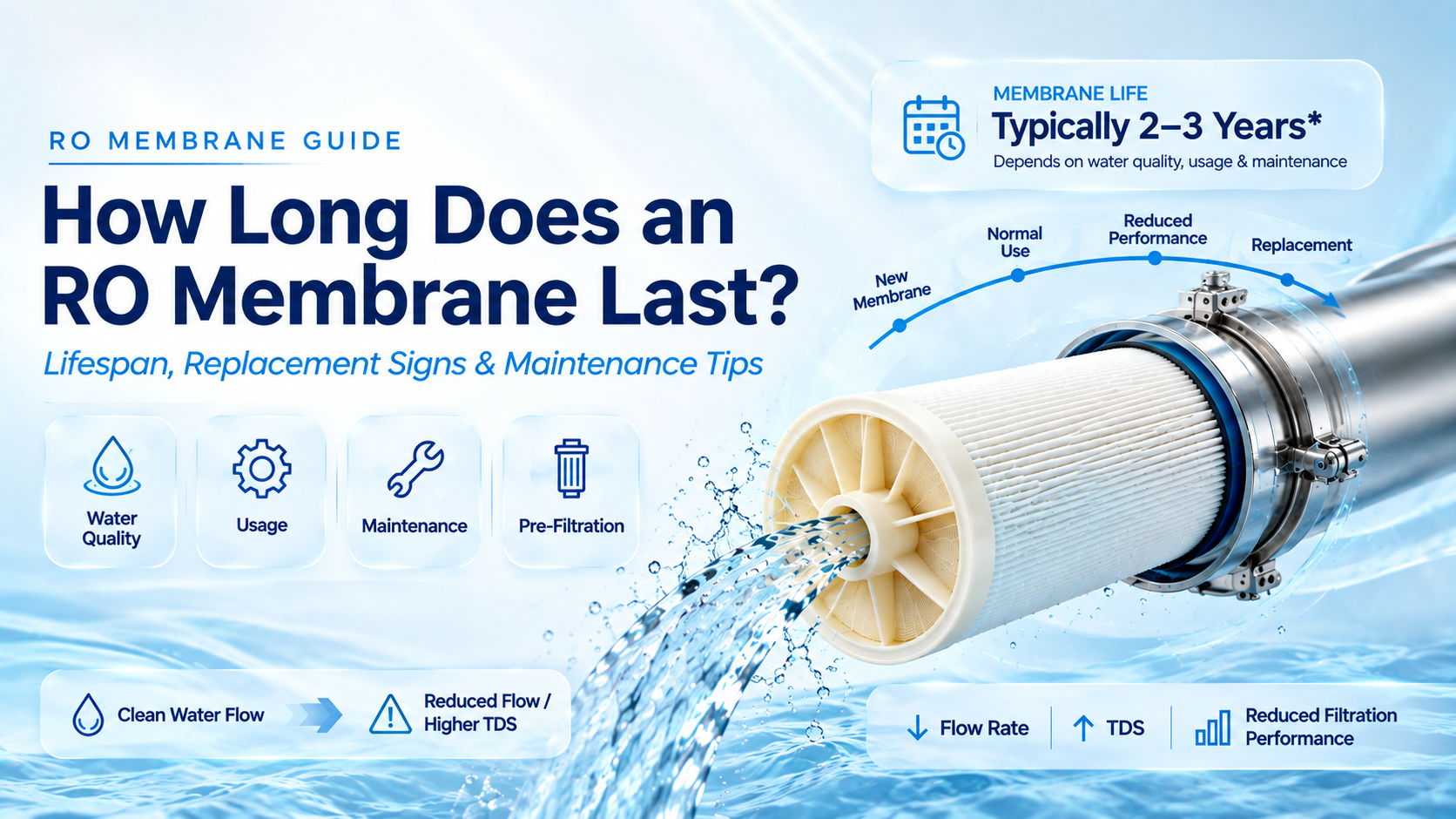
An RO membrane commonly lasts around 2–3 years in a properly maintained domestic RO system, but there is no universal replacement date. Feed-water quality, pretreatment, daily usage, membrane quality, operating conditions, and maintenance can significantly affect RO membrane lifespan. Commercial and industrial RO membranes may require a different replacement approach based on actual performance rather than age alone.

The best way to determine whether an RO membrane needs replacement is to monitor changes in permeate quality, salt rejection, flow rate, pressure, and overall system performance.


How Long Does an RO Membrane Last?

The lifespan of an RO membrane depends heavily on where and how it is used.

Application

Typical Replacement Approach

Domestic RO

Often around 2–3 years, depending on water quality and maintenance

Commercial RO

Depends on usage, feed-water quality, pretreatment and operating conditions

Industrial RO

Usually determined through performance monitoring, cleaning history and membrane condition

These are general guidelines, not guarantees. A membrane operating with well-controlled feed water and good pretreatment may maintain useful performance longer, while a membrane exposed to severe fouling, scaling or unsuitable operating conditions may deteriorate much sooner.

For industrial systems, manufacturers recommend monitoring normalized performance to distinguish genuine membrane degradation from changes caused by temperature, pressure, recovery or feed-water conditions.


What Determines RO Membrane Lifespan?

Several factors determine how long an RO membrane remains effective.

1. Feed-Water Quality

The quality of water entering the membrane has a major effect on membrane life.

Important parameters include:

  • TDS and dissolved salts

  • Hardness

  • Chlorine or other oxidants

  • Iron and manganese

  • Silica

  • Turbidity

  • Suspended solids

  • Organic matter

  • Biological contamination

  • SDI

Poor feed-water quality can increase the risk of membrane fouling and scaling. These deposits can reduce water production and increase the amount of cleaning required.

Feed-water temperature, pH and salt concentration can also affect RO membrane performance.

2. Pretreatment

Good pretreatment is one of the most important ways to protect an RO membrane.

Depending on the water source, an RO system may use:

  • Sediment filtration

  • Activated carbon filtration

  • Cartridge filtration

  • Water softening

  • Antiscalant dosing

  • Dechlorination

  • Multimedia filtration

  • Other application-specific treatment

Pretreatment requirements vary according to feed-water chemistry and the membrane manufacturer's specifications.

For example, chlorine exposure can be a serious concern for polyamide RO membranes, so appropriate dechlorination may be required where applicable.

3. Usage

An RO system operating occasionally in a home experiences different conditions from one operating continuously in a commercial or industrial facility.

Membrane life can be influenced by:

  • Daily operating hours

  • Water consumption

  • Number of users

  • System capacity

  • Recovery rate

  • Feed-water quality

  • Frequency of operation

More intensive operation does not automatically mean a membrane will fail sooner, but it can increase the importance of proper pretreatment and performance monitoring.

4. Membrane Quality

Membrane quality and correct model selection also matter.

A membrane should be selected according to:

  • Feed-water characteristics

  • Required permeate flow

  • Salt rejection requirements

  • Operating pressure

  • Temperature

  • Recovery

  • System configuration

Using the correct membrane for the application helps the RO system operate within appropriate design conditions.

5. Operating Conditions

RO membrane performance is affected by operating conditions such as:

  • Pressure

  • Temperature

  • Feed flow

  • Recovery

  • pH

  • Feed-water concentration

Operating outside the manufacturer's recommended limits can negatively affect membrane performance and service life.


Signs Your RO Membrane Needs Replacement

Age alone should not be the only reason for RO membrane replacement. Look for changes in actual system performance.

1. TDS Rejection Has Dropped

One important indicator is increasing TDS or conductivity in the permeate.

A basic salt-rejection calculation is:

Salt Rejection % = [(Feed TDS − Permeate TDS) ÷ Feed TDS] × 100

For example, if feed water measures 500 ppm TDS and permeate measures 10 ppm:

Salt rejection = [(500 − 10) ÷ 500] × 100 = 98%

However, TDS should not be used as the only replacement criterion. Feed-water temperature, pressure and other operating conditions can affect readings.

2. Permeate Production Has Decreased

A noticeable decline in treated-water production can indicate:

  • Fouling

  • Scaling

  • Pressure problems

  • Pretreatment failure

  • Temperature changes

  • Membrane deterioration

For industrial RO systems, normalized permeate flow is more useful than simply comparing raw flow readings because temperature and other operating conditions influence production.

DuPont recommends performance normalization to separate normal operating changes from actual deterioration.

3. Permeate Water Quality Has Worsened

If permeate conductivity or TDS begins increasing consistently, investigate the cause.

Possible causes include:

  • Membrane deterioration

  • Fouling

  • Incorrect operating conditions

  • O-ring or seal problems

  • Membrane damage

  • Pretreatment problems

Don't immediately replace the membrane without first diagnosing the system.

4. Frequent Cleaning Is Required

A membrane that repeatedly fouls or scales may require increasingly frequent cleaning.

However, frequent fouling does not necessarily mean the membrane itself is defective. It can indicate problems with:

  • Pretreatment

  • Feed-water quality

  • Recovery

  • Chemical dosing

  • Operating conditions

DuPont's current technical manual identifies normalized performance changes as useful indicators for determining when cleaning is required.

5. Cleaning No Longer Restores Performance

If appropriate cleaning does not restore membrane performance, permanent deterioration or damage may have occurred.

At that point, membrane replacement may be more practical than continuing repeated cleaning cycles.


Can You Extend RO Membrane Life?

Yes. Proper operation and maintenance can help maintain membrane performance.

Follow these practices:

  • Replace sediment filters when required.

  • Maintain activated carbon filtration.

  • Control scaling.

  • Monitor feed-water quality.

  • Prevent unsuitable chlorine exposure.

  • Maintain appropriate operating pressure.

  • Avoid unnecessarily high recovery.

  • Monitor permeate TDS or conductivity.

  • Monitor permeate flow.

  • Record operating conditions.

  • Clean membranes according to manufacturer recommendations.

  • Investigate pretreatment problems quickly.

Early detection is important. DuPont recommends recording and normalizing RO system performance because early identification of fouling or scaling allows corrective action before performance deteriorates further.


How Often Should You Check an RO Membrane?

The frequency of monitoring depends on the type of RO system.

Domestic RO

Home users can regularly check:

  • Permeate TDS

  • Water production

  • Filter condition

  • Changes in water quality

  • Unusual taste or odor

If TDS rises significantly or production falls, have the complete RO system inspected rather than replacing the membrane immediately.


Commercial and Industrial RO

Larger systems should have more detailed monitoring.

Track:

  • Feed pressure

    • Permeate pressure

    • Concentrate pressure

    • Feed conductivity

    • Permeate conductivity

    • Feed flow

    • Permeate flow

    • Recovery

    • Differential pressure

    • Normalized permeate flow

    • Normalized salt passage

For industrial systems, performance trends are generally more meaningful than simply saying “the membrane is three years old.”


RO Membrane Cleaning vs Replacement

Cleaning and replacement are not the same thing.

Cleaning

Replacement

Removes certain types of fouling

Replaces a deteriorated or damaged membrane

May restore performance

Used when acceptable performance cannot be recovered

Depends on fouling type

Requires the correct replacement model

Requires compatible cleaning chemicals

Requires correct installation

Can extend useful operating life

Restores performance when the old element is no longer suitable

A drop in performance does not automatically mean the membrane must be replaced.

First investigate temperature, pressure, recovery, pretreatment, scaling, fouling and other possible causes.

Manufacturer guidance should be followed for membrane cleaning chemistry and operating limits.


How Much Does RO Membrane Replacement Cost?

There is no single RO membrane replacement cost because prices vary considerably.

Factors affecting price include:

  • Membrane brand

  • Membrane model

  • Membrane size

  • 4040 or 8040 configuration

  • Domestic or industrial application

  • Membrane performance specifications

  • Genuine versus compatible membrane

  • Number of membranes required

  • Installation or service charges

A domestic RO membrane and an industrial 8040 RO membrane serve very different applications, so their prices cannot be compared simply by looking at the word “RO membrane.”

Before purchasing, compare the model number, size, specifications and application compatibility, not just price.


4040 vs 8040 RO Membrane Lifespan

4040 and 8040 primarily describe membrane element size/configuration; they do not guarantee a particular membrane lifespan.

A 4040 membrane is generally used in smaller-capacity systems, while 8040 elements are commonly used in larger commercial and industrial RO systems.

Membrane life for either configuration depends on:

  • Feed-water quality

  • Pretreatment

  • Operating pressure

  • Recovery

  • Temperature

  • Fouling

  • Scaling

  • Cleaning

  • System design

  • Operating hours

Therefore, an 8040 membrane does not automatically last longer than a 4040 membrane.

If you're choosing between them, select the size and membrane model according to the RO system design and required production.


How to Know if an RO Membrane Is Still Good

A simple evaluation checklist can help.

Ask:

Is permeate TDS stable?

Is water production close to the expected performance?

Has normalized permeate flow remained stable?

Has salt passage increased?

Has pressure drop increased?

Is the pretreatment system working correctly?

Has the membrane recently been cleaned?

Did cleaning restore performance?

If several performance indicators are deteriorating simultaneously, the membrane and the rest of the RO system should be investigated.


Frequently Asked Questions

How long does an RO membrane last?

A domestic RO membrane commonly lasts around 2–3 years, but actual life varies with feed-water quality, pretreatment, usage, operating conditions and maintenance. Commercial and industrial RO membranes may have different service intervals, so performance monitoring is more useful than relying only on age.

How do I know when my RO membrane needs replacement?

Common signs include consistently higher permeate TDS or conductivity, reduced water production, declining normalized permeate flow, increased salt passage and performance that does not recover after appropriate cleaning. However, pretreatment and operating problems should be ruled out before replacing the membrane.

Can an RO membrane last 5 years?

It can be possible under suitable conditions, but five years should not be treated as a standard lifespan or guarantee. Membrane life depends on feed-water quality, pretreatment, operating conditions, fouling, scaling, cleaning and system maintenance.

Does high TDS reduce RO membrane life?

High TDS does not by itself determine membrane lifespan. However, higher dissolved-solids concentration can increase osmotic pressure and may require different operating conditions and system design. Scaling and fouling risks associated with feed-water chemistry can also affect membrane performance.

Can cleaning extend RO membrane life?

Appropriate cleaning can restore performance when fouling or scaling is responsible for the decline. However, cleaning cannot permanently repair every type of membrane damage or deterioration. Follow the specific membrane manufacturer's cleaning instructions and limits.

How often should an RO membrane be replaced?

There is no universal replacement schedule. Domestic membranes are often replaced after a few years, while commercial and industrial membranes should be evaluated using performance data. Replacement should consider permeate quality, normalized flow, salt passage, pressure drop and cleaning response.

What causes RO membranes to fail?

Common causes include fouling, scaling, unsuitable chemical exposure, poor pretreatment, incorrect operating conditions, excessive recovery, mechanical damage and prolonged deterioration. Diagnosing the underlying cause is important because replacing a membrane without fixing the root problem can lead to another premature failure.

How can I extend RO membrane life?

Maintain appropriate pretreatment, control scaling and fouling, monitor feed and permeate performance, maintain suitable operating conditions, replace upstream filters as required and clean the membrane according to manufacturer recommendations.


Conclusion

So, how long does an RO membrane last? A domestic RO membrane commonly lasts around 2–3 years, but the actual RO membrane lifespan depends on water quality, pretreatment, usage, operating conditions, membrane quality and maintenance.

For commercial and industrial systems, membrane replacement should be based more heavily on measured performance trends than on a fixed calendar date. Monitoring permeate flow, salt rejection, conductivity, pressure drop and normalized performance can help identify deterioration early.

A well-maintained RO system is also essential for protecting the membrane. Good pretreatment, appropriate operating conditions and timely cleaning can help maintain performance and potentially extend useful membrane life.

If your RO membrane is showing declining performance, don't replace it based on age alone. First identify whether the problem is caused by fouling, scaling, pretreatment, pressure, temperature, recovery or actual membrane deterioration. Then select a replacement membrane based on your system's specifications and the manufacturer's recommendations.


Share:

Leave A Comment

Thank You for subscribing our newsletter.