


30-Jun-2026
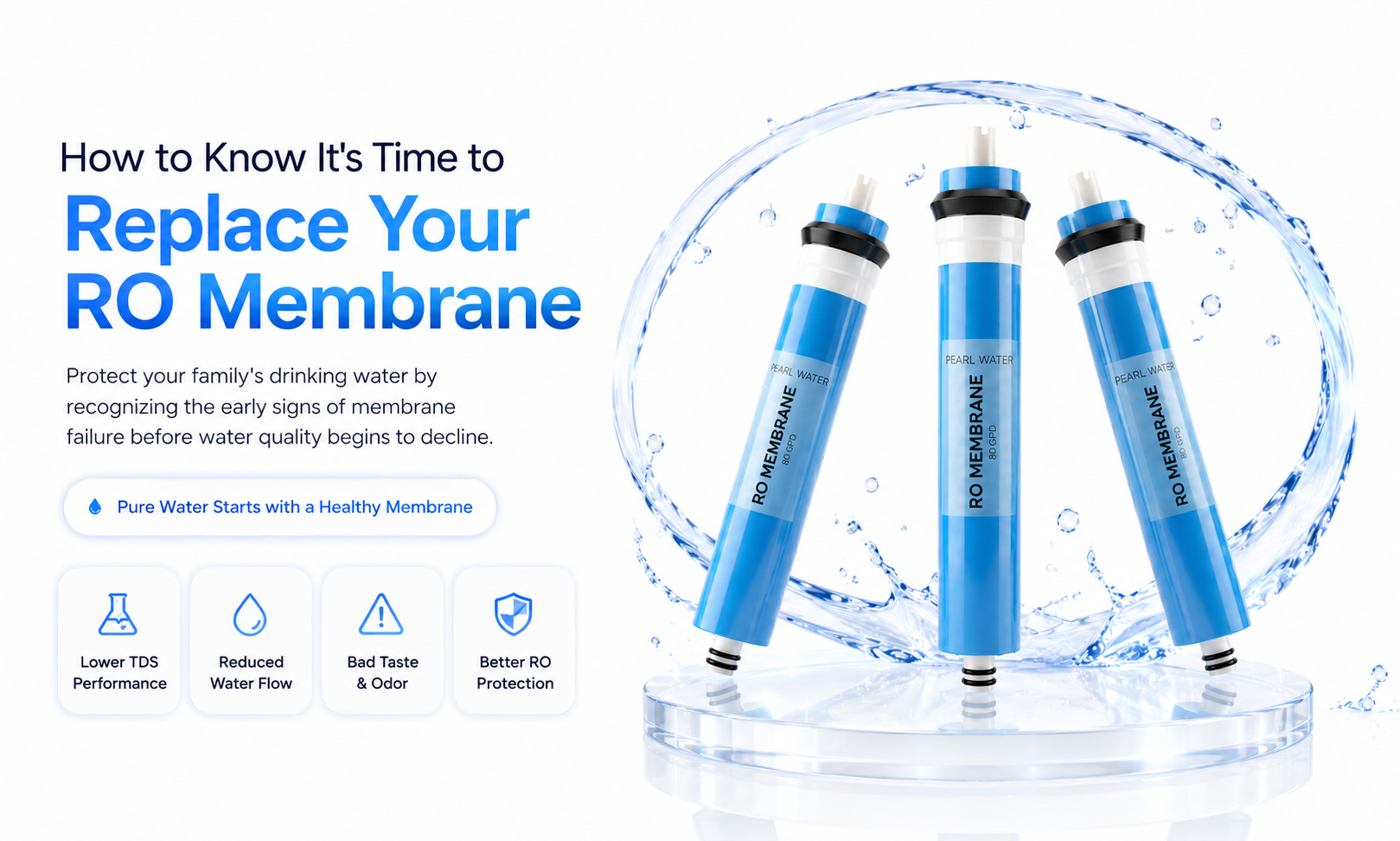
How to Know It's Time to Replace Your RO Membrane
If your RO purifier has started giving water that tastes a little "off," fills the tank slower than before, or just doesn't feel as fresh as it used to, the membrane is usually the first place to look. The RO membrane is the heart of any reverse osmosis system — it's the component actually responsible for removing dissolved salts, heavy metals, and harmful microorganisms from your drinking water. When it wears out, every other part of the purifier is working with compromised input.
How often should an RO membrane be replaced? In most Indian homes, an RO membrane should be replaced every 12 to 24 months, depending on input water TDS, usage volume, and how well the pre-filters (sediment and carbon) have been maintained. Households with high TDS borewell water often need replacement closer to the 12-month mark, while those on low-TDS municipal supply may stretch it to 18–24 months.
This guide walks through exactly how to know your membrane has reached the end of its life, what happens if you ignore it, and how to choose a reliable replacement such as an 80 GPD or 100 GPD domestic RO membrane for your home.
What Is an RO Membrane?
An RO membrane is a thin, semi-permeable layer inside your purifier that filters water at a microscopic level, removing dissolved salts, heavy metals, bacteria, and viruses while allowing clean water molecules to pass through.
The membrane is made of a tightly wound, multi-layer composite material — typically a thin-film polyamide layer over a support structure. Water is pushed through this layer under pressure, and because the pores are smaller than 0.0001 microns, almost nothing except water molecules can pass through.
Here's what it actually does inside your purifier:
In short, every other filter in your purifier (sediment, carbon, post-carbon) supports the membrane's job — but the membrane is what actually does the purification.
How Long Does an RO Membrane Last?
A domestic RO membrane typically lasts 12 to 24 months, though this range depends heavily on the quality of input water and how consistently the purifier is maintained.
Key Factors Affecting Membrane Lifespan
Comparison Table: Membrane Lifespan by Water Source
Water Source |
Typical Input TDS |
Expected Membrane Life |
Recommended Replacement Frequency |
Municipal/Corporation Water |
150–400 PPM |
18–24 months |
Every 18–24 months |
Borewell Water (Moderate TDS) |
400–1000 PPM |
12–18 months |
Every 12–18 months |
Borewell Water (High TDS) |
1000–2500 PPM |
8–12 months |
Every 8–12 months |
Tanker/Mixed Water Supply |
Variable |
10–15 months |
Every 10–15 months |
Key takeaway: The higher your input TDS, the more frequently your membrane should be checked and replaced. A TDS meter is the simplest way to track this over time.
10 Signs It's Time to Replace Your RO Membrane
Knowing the warning signs early can save you from drinking poorly purified water and from costlier repairs down the line.
1. Low Water Flow
Problem: Water trickles out slowly from the purifier tap. Reason: A clogged or damaged membrane restricts water passage, reducing output flow. Solution: If pre-filters are clean and flow is still weak, the membrane likely needs replacement.
2. High TDS in Purified Water
Problem: TDS meter readings on purified water are noticeably higher than usual. Reason: A worn membrane loses its ability to reject dissolved salts effectively. Solution: Compare current TDS to your purifier's expected rejection rate; if it's significantly higher, replace the membrane.
3. Bad Taste
Problem: Water tastes salty, metallic, or simply different from before. Reason: Dissolved solids and minerals are passing through an aging membrane instead of being rejected. Solution: Rule out filter expiry first, then replace the membrane if taste doesn't improve.
4. Bad Odor
Problem: Water smells musty, chemical, or unusual. Reason: Bacterial growth or chemical breakdown on a degraded membrane surface can cause odor. Solution: Replace both the membrane and any expired carbon filters together.
5. Tank Fills Slowly
Problem: The storage tank takes much longer than usual to fill completely. Reason: Reduced membrane permeability slows down overall purified water production. Solution: Check the membrane and flow restrictor; replace the membrane if it's past its expected lifespan.
6. Frequent Servicing Required
Problem: Your purifier needs technician visits more often than before. Reason: A failing membrane often triggers cascading issues elsewhere in the system, like pump strain. Solution: Ask your technician to test the membrane's rejection rate during the next service visit.
7. High Rejection (Waste) Water Ratio
Problem: The purifier seems to waste much more water than it purifies. Reason: An inefficient membrane forces the system to reject more water to maintain purification quality. Solution: Compare your purifier's waste-to-pure water ratio against its rated specification; a major deviation signals membrane wear.
8. Membrane Older Than Recommended Lifespan
Problem: It's simply been over 12–24 months since the last replacement. Reason: Even without obvious symptoms, membrane efficiency naturally declines with age and usage. Solution: Replace proactively rather than waiting for visible problems, especially with high-TDS input water.
9. Cloudy or Hazy Water
Problem: Purified water looks slightly cloudy instead of crystal clear. Reason: Physical degradation of the membrane surface allows fine particulates to pass through. Solution: Replace the membrane immediately, as this often indicates significant membrane damage.
10. Poor Overall Purification Performance
Problem: Water just doesn't feel "purified" anymore, even though the purifier is running normally. Reason: Combined wear across TDS rejection, taste, and clarity points to membrane failure. Solution: A full membrane and filter replacement is usually the most reliable fix.
What Happens If You Don't Replace an RO Membrane?
Ignoring a worn-out RO membrane doesn't just affect taste — it directly compromises the safety and quality of the water your family drinks daily.
How to Check If Your RO Membrane Needs Replacement
Here's a simple, step-by-step way to assess your membrane's condition at home before calling a technician.
Step 1: Test with a TDS meter. Measure the TDS of both the input water and the purified water. Divide purified TDS by input TDS — if the result is significantly higher than your purifier's rated rejection rate (most membranes reject 90–99% of TDS), the membrane is likely failing.
Step 2: Taste the water. A salty, metallic, or unusual taste compared to when the purifier was new is a strong indicator of membrane wear.
Step 3: Check water flow. Time how long it takes to fill a glass or the storage tank. A noticeable slowdown, after ruling out clogged pre-filters, often points to the membrane.
Step 4: Do a visual inspection. Cloudy or hazy purified water, even after settling, suggests particles are passing through a damaged membrane.
Step 5: Get a professional service check. A technician can test the actual rejection rate and flow rate against the membrane's rated specifications, giving you a definitive answer.
How to Extend the Life of Your RO Membrane
While every membrane eventually needs replacement, the following habits can help you get the most out of it:
Which RO Membrane Should You Choose?
The right membrane capacity depends on your daily water consumption and family size — for most Indian households, an 80 GPD or 100 GPD membrane is sufficient.
Membrane Capacity |
Best Suited For |
Approx. Daily Output |
Typical Family Size |
80 GPD |
Small households, low-to-moderate usage |
Sufficient for daily drinking and cooking needs |
2–4 members |
100 GPD |
Larger households, higher daily consumption |
Higher output for frequent use |
4–6 members |
If your input water has high TDS, a slightly higher-capacity membrane helps maintain consistent output even as rejection rates increase. For most standard installations, Pearl Water's Domestic RO Membrane range covers both capacities along with bundled and accessory options to match different purifier models.
Why Buy Genuine RO Membranes from Pearl Water?
Pearl Water Technologies has been manufacturing water and wastewater treatment equipment for over 15 years, and applies the same engineering standards to its domestic membrane range. Choosing a genuine membrane matters because performance, consistency, and safety all depend on manufacturing quality.
For everyday home use, the RO Membrane Filter 15 LPH Classic is a dependable, budget-friendly 80 GPD option, also available in Pack of 2, Pack of 3, and Pack of 5 for households or dealers wanting to stock up. If your purifier needs a faster output, the RO Membrane Filter 20 LPH Ultra is a higher-capacity 100 GPD membrane, similarly available in Pack of 2, Pack of 3, and Pack of 5.
For households whose membrane is rejecting too much water along with worn output, the RO Membrane Filter 15 LPH Classic with Flow Resistor and RO Membrane Filter 20 LPH Ultra with Flow Resistor come with a built-in flow resistor for proper pressure balance. And if your old housing is damaged or leaking, the Domestic RO Membrane Filter Housing with Connectors offers a complete replacement housing setup.
Browsing the full Domestic RO Membrane collection lets you compare capacities and pack sizes to match your purifier model and household needs.
Frequently Asked Questions
How often should I replace my RO membrane? Most domestic RO membranes should be replaced every 12 to 24 months. Households using high-TDS borewell water often need replacement closer to the 12-month mark, while those on lower-TDS municipal water supply can typically stretch to 18–24 months. Regular TDS testing helps you track exactly when replacement is due rather than guessing based on time alone.
Can I clean an RO membrane instead of replacing it? Membranes can sometimes be flushed or chemically cleaned to remove surface deposits and slightly extend life, but this isn't a permanent fix. Once a membrane has degraded structurally — losing its ability to reject TDS or showing physical damage — cleaning won't restore original performance. At that point, replacement is the more reliable and cost-effective option.
How do I know if my membrane is damaged? The clearest signs are a noticeable rise in purified water TDS, a change in taste or odor, slower flow rate, or cloudy water. A TDS meter reading on both input and output water gives the most objective answer — compare it against your purifier's rated rejection percentage to confirm membrane damage.
Can a bad membrane increase TDS in purified water? Yes. The membrane's core function is rejecting dissolved solids, so as it wears out, more salts and minerals pass through into the purified water. This is one of the most reliable indicators of membrane failure and is easy to confirm with a simple TDS meter test.
Does the membrane affect the taste of purified water? Yes, significantly. A healthy membrane removes excess dissolved minerals and contaminants that affect taste. As the membrane wears down, more of these pass through, often resulting in a salty, metallic, or simply "off" taste compared to fresh RO water.
Can I replace the RO membrane myself? With basic tools and some technical comfort, many users do replace membranes themselves, since most domestic membranes slide into a standard housing. That said, if you're unfamiliar with your purifier's internal setup, it's safer to have a trained technician handle it to avoid incorrect installation or fitting damage.
Which GPD membrane is best for my home? For a small household of 2–4 members with moderate water consumption, an 80 GPD membrane is usually sufficient. Larger households of 4–6 members, or homes with higher daily usage, typically benefit from a 100 GPD membrane for better output and consistency.
How long does RO membrane replacement take? A straightforward membrane replacement, done by an experienced technician, usually takes 15 to 30 minutes. If other components like filters or the housing also need attention, the full service visit may take slightly longer.
Should I replace the sediment filter before the membrane? Yes, ideally. The sediment filter protects the membrane from particles and debris, so replacing it on schedule helps maintain membrane performance and can even extend its life. If the sediment filter has been neglected for a long time, it's worth replacing it alongside the membrane.
Is a genuine RO membrane really better than a cheaper alternative? Generally, yes. Genuine membranes are manufactured and tested to consistent quality standards, ensuring reliable TDS rejection and a predictable lifespan. Lower-quality alternatives can degrade faster, perform inconsistently, or even cause damage to other purifier components over time.
Conclusion
Your RO membrane works quietly in the background, but it's doing the most important job in your purifier — separating clean water from everything you don't want to drink. Watching for the signs covered here, from low flow and rising TDS to taste changes and cloudy water, helps you catch membrane wear before it compromises your water quality. Pairing that awareness with simple habits like timely pre-filter changes and periodic TDS checks goes a long way toward extending membrane life.
When it is time to replace, don't compromise on quality. Explore Pearl Water's Domestic RO Membrane collection to find the right 80 GPD or 100 GPD membrane for your purifier, backed by reliable manufacturing and pan-India delivery.
Leave A Comment