27-Oct-2026
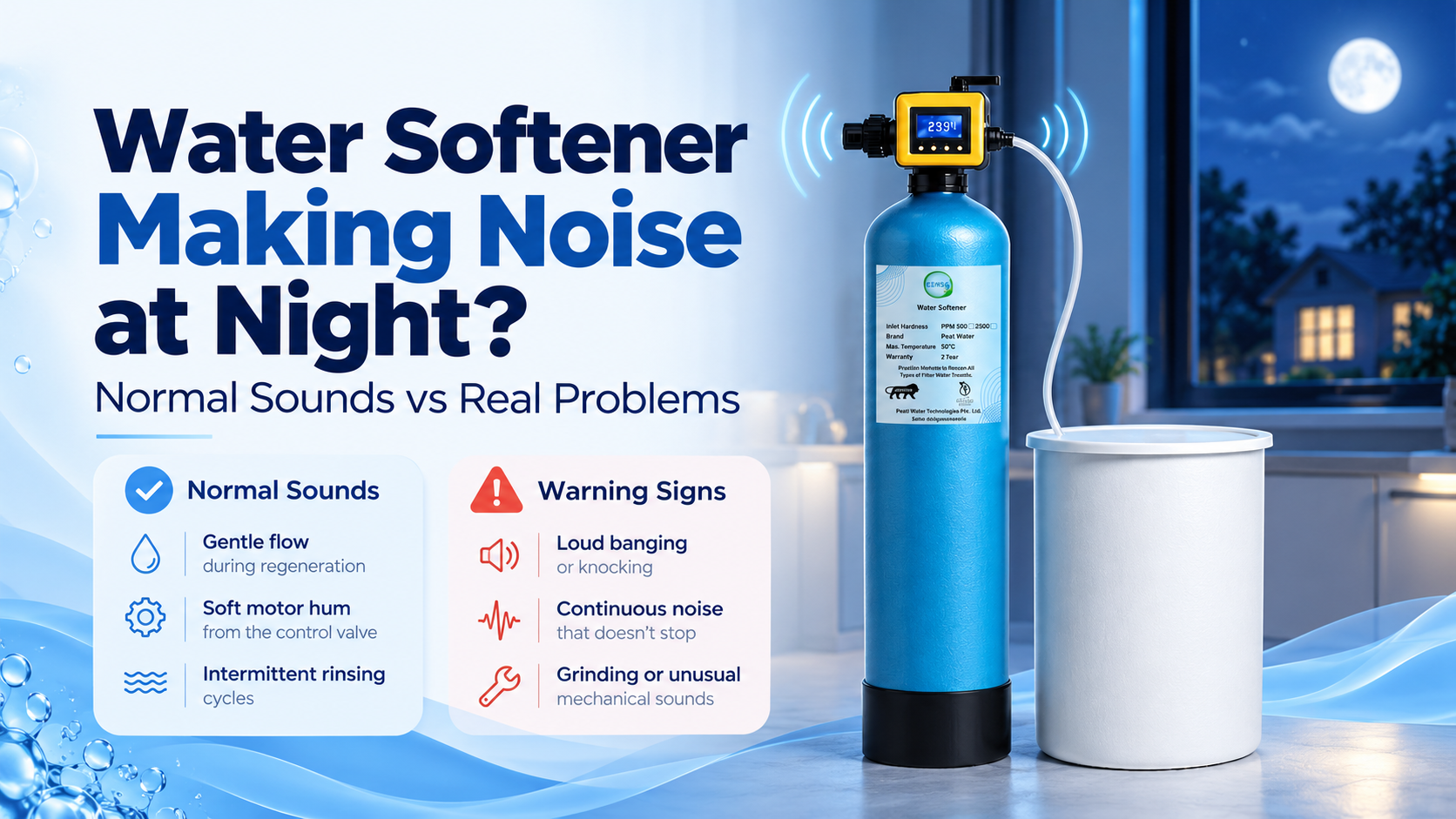
It's the middle of the night, the house is quiet, and from somewhere near the utility area you can hear water rushing, a gurgle, maybe a soft click. Most people's first thought is the same: is my water softener broken?
Usually, no. Fully automatic water softeners are normally set to regenerate overnight, so night is exactly when you'll hear them working. But a few sounds do point to a real fault, and it helps to know which is which before you lose sleep over it, or ignore something that needs fixing.
Quick answer: Rushing water, gurgling, soft clicking and a slow trickle that all end on their own within about one to two hours are normal regeneration sounds. Constant hissing, loud banging, grinding, or any noise that keeps going long after the cycle should be over is not normal, and is worth checking or calling for service.
Key takeaways
Yes. If you have a fully automatic water softener, noise at night is normal because regeneration is typically scheduled for the quietest, lowest-usage hours so it doesn't interrupt your morning routine. The sounds come from water flowing through the resin tank, brine being drawn from the salt tank, and the control valve moving between stages. What matters is whether the noise matches the pattern of a cycle and then stops.
Every softener has a resin bed that traps the calcium and magnesium that make water hard. Once that resin is saturated, it has to be recharged with salt brine. That recharging process is called regeneration, and it temporarily takes the unit out of normal service. Running it at night means you're not using water while it happens.
It doesn't happen every night. Depending on your water hardness and how much water your household uses, most homes see regeneration every 3 to 7 days. For the full picture of how the process works, see our guide: Water Softener for Home in India: Complete Guide to Price, Benefits, Working & Selection.
Regeneration has several stages, and each makes its own sound. Hearing them in order is one of the easiest ways to confirm everything is working.
Stage |
What you'll hear |
Normal? |
1. Backwash |
Steady rushing of water toward the drain line |
Yes |
2. Brine draw |
Gurgling or slurping near the salt tank as brine is pulled into the resin tank |
Yes |
3. Slow rinse |
A quieter, slower flow while brine moves through the resin |
Yes |
4. Fast rinse |
Another burst of flowing water as leftover brine is flushed out |
Yes |
5. Brine tank refill |
A gentle trickle as the salt tank refills for next time |
Yes |
6. Between stages |
Soft clicks or a low hum from the control head as the valve motor moves |
Yes |
If the sounds you're hearing fit that sequence and end within a couple of hours, you're listening to a healthy softener.
Sound |
Likely cause |
Normal? |
What to do |
Rushing water from the drain |
Backwash or fast rinse |
Yes |
Nothing, it stops by itself |
Gurgling near the salt tank |
Brine draw |
Yes |
Nothing |
Soft clicking or brief humming from the control head |
Valve motor changing position |
Yes |
Nothing |
Slow trickle that fades out |
Brine tank refilling |
Yes |
Nothing |
Constant hissing, or water running to drain outside the cycle |
Valve not seating, worn seal, or injector problem |
No |
Switch to bypass, call service |
Loud banging or knocking |
Water hammer, high pressure, loose pipes |
No |
Secure pipes, check pressure, get it inspected |
Grinding, squealing or a straining motor |
Worn motor or gears in the control head |
No |
Service visit |
Constant buzzing or rapid repeated clicking |
Control board, timer or electrical fault |
No |
Unplug if there's any burning smell, then call service |
Rattling or vibration |
Loose mounting or unsecured drain hose |
Fixable |
Secure the drain line and pipe supports |
Gurgling is one of the most common regeneration sounds. It happens during the brine draw, when salt brine is pulled from the tank into the resin tank. A few minutes of gurgling or slurping near the salt tank is normal. If you hear gurgling constantly, at times the softener isn't regenerating, it can point to trapped air or a partly blocked drain line, and it's worth having checked.
A short hiss during rinse stages is normal, since water is moving quickly through narrow passages. A hiss that never stops, or one that continues with water running to the drain after the cycle should be finished, usually means a valve isn't sealing fully or a seal has worn. Put the unit on bypass and arrange service rather than letting it run.
A low hum while the control head motor is moving is normal. A loud, continuous buzz, or a hum that doesn't settle, points to an electrical or control board problem. Pumps, geysers and RO systems nearby can also hum, so check whether the sound lines up with the regeneration schedule first. If you smell burning, unplug the unit and call for service.
Banging in the pipes, especially at the moment a valve changes position, is usually water hammer: water flowing at pressure is suddenly stopped or redirected, sending a shock through the pipes. High water pressure and loosely supported pipes make it worse. Securing the pipes helps, and a plumber can fit a water hammer arrestor if the problem keeps happening. If the knocking started right after installation, the setup is worth rechecking: Can I Install a Water Softener Myself Without a Plumber?
Clicking is normal when the valve motor moves between stages. It becomes a concern when clicking is rapid, repeated, and happens outside a regeneration cycle. That pattern usually means the control head is struggling to find its position, which can come from a motor, timer or board issue.
If water keeps flowing to the drain well past the usual one to two hours, the valve may be stuck partway through a cycle, a seal may be worn, or debris may be holding the valve open. This wastes water and stops the softener from working properly. Switch to bypass and call for service. It's also worth checking whether your water has gone hard, since a stuck cycle often goes with that problem: Why Is My Water Softener Not Producing Soft Water?
After a power cut, many control heads lose their clock setting. When power returns, the unit may run regeneration at an odd hour, such as during the day or in the evening, because its clock now shows the wrong time. Resetting the time on the control head usually fixes it. This is one of the most common "my softener is noisy at strange hours" cases we see.
Some sputtering, gurgling or spitting from taps in the first few days is normal, since air gets into the lines during installation and works its way out. Persistent banging, hissing or vibration beyond the first few days isn't, and it's worth having the installation checked.
A fully automatic water softener regenerates on its own, so the sounds above can happen at night. A semi-automatic water softener doesn't regenerate on a schedule; you trigger the cycle yourself using the multiport valve. So if you own a semi-automatic unit and hear water noise in the middle of the night, it isn't regeneration. Look at a pump starting up, an overhead tank float valve, a dripping tap, your geyser, or an RO system draining. If you're still choosing between the two types, you can compare them in our water softener system range.
Often it isn't. Softeners usually sit in a utility area with pumps, geysers, RO units and pipework, and from a distance these sound alike. A simple test: check the regeneration schedule on the control head. If the noise happens at times the softener isn't scheduled to run, it's probably something else nearby.
A fully automatic control head uses very little power and sits idle most of the time, so noise doesn't mean a big electricity cost. We covered that here: Does a Water Softener Increase Your Electricity Bill?
Usually yes, but you may get hard water during that window, since the unit is temporarily out of service while it recharges. That's one more reason regeneration is scheduled for the middle of the night.
Don't wait it out if:
A clogged or worn injector, a tired valve seal, or a control head motor nearing the end of its life can all show up first as an unusual sound. Genuine replacement parts such as injectors and brine valves are available here: water softener spares. If the resin bed itself is old, that can also affect how the system behaves; this explains how resin works and how long it lasts: What Is Water Softener Resin, How It Works, Advantages.
If you're shopping for a water softener for home use and noise is a concern, a few things matter more than people expect:
To compare options and see current specifications, browse our water softener systems. For help picking among brands and types, this guide is a good companion: Best Water Softener in India: Home & Society Expert Guide.
Is it normal for a water softener to run at night? Yes. Fully automatic softeners are usually scheduled to regenerate overnight, when household water use is lowest. It happens every few days, not every night.
How long does a water softener regeneration cycle last? Most household units take roughly one to two hours, depending on the model and settings. A cycle that runs far beyond that, or keeps restarting, isn't normal.
Why does my water softener make a gurgling noise? Gurgling is normal during the brine draw stage, when brine is pulled from the salt tank. Constant gurgling outside a cycle can indicate trapped air or a partly blocked drain line.
Why is my water softener hissing all the time? A brief hiss during rinse is normal. Continuous hissing, or water running to the drain after the cycle should have ended, usually points to a worn seal or a valve not seating properly.
Can I stop my water softener from running at night? You can usually change the regeneration time on the control head. Switching regeneration off entirely isn't advisable, because the resin bed needs recharging to keep softening your water.
Does a noisy water softener mean it's broken? Not necessarily. Rushing, gurgling and soft clicking are normal. Grinding, banging, constant buzzing and non-stop hissing are the sounds that suggest a fault.
Why did my water softener start regenerating in the evening? A power cut can reset the control head's clock. When power returns, the unit may regenerate at the wrong hour. Resetting the time usually fixes it.
Does a semi-automatic water softener make noise at night? Not from regeneration, because you trigger the cycle manually. Night noise from a semi-automatic unit is almost always coming from something else nearby.
This guide is based on how regeneration actually sounds across the household units we install and service, and on the calls we get from customers who hear something at an odd hour and aren't sure what it is. Every model sounds a little different, so if a noise doesn't match anything above, describing it to our service team is always better than guessing.
Written by the Pearl Water Technologies team, from years of installing and servicing water softeners across Indian homes.
Action completed successfully.

Leave A Comment