


07-Aug-2026
If your industrial RO plant is producing water with higher TDS than it should, something in the system — usually the membrane, a seal, the pretreatment, or occasionally the measurement itself — isn't doing its job. The good news is that high permeate TDS almost always follows one of a small number of recognizable patterns, and once you know which pattern you're looking at, the fix is usually straightforward.
This guide walks through the actual causes, how to test for each one, and when the right answer is cleaning, repair, or membrane replacement. It's written for industrial RO plants — factories, pharma and food-processing units, hotels, hospitals — not domestic under-sink purifiers. If you're troubleshooting a home RO unit, the causes are related but the scale, testing method, and thresholds are different; see our guide on the difference between domestic and industrial RO membranes first.
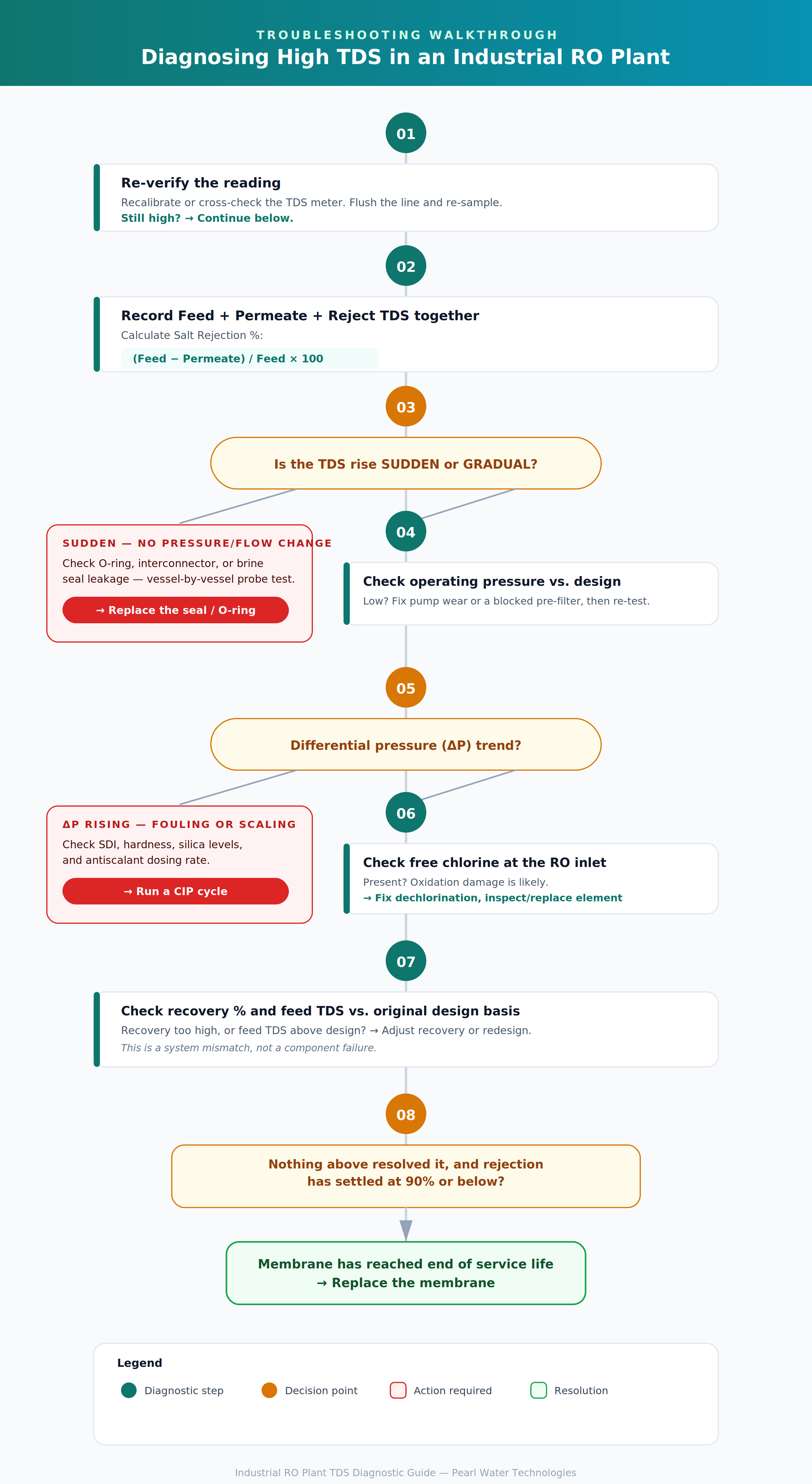
High permeate TDS in an industrial RO plant is almost always caused by one of five things: an aging or damaged membrane, a leaking O-ring or seal letting raw water bypass the membrane, scaling or fouling on the membrane surface, chlorine/oxidation damage, or a pretreatment failure (softener, dechlorination, or antiscalant dosing) allowing hardness or oxidants to reach the membrane. Less commonly, the problem isn't the plant at all — it's a miscalibrated TDS meter or an incorrect sampling technique.
Most troubleshooting only looks at two numbers — the TDS going in and the TDS coming out — but an industrial RO plant actually gives you three, and each one tells you something different. If you want the underlying mechanics first, our guide on what industrial RO membranes are and how they work covers the basics this section builds on.
Tracking all three together, rather than just permeate TDS in isolation, is what lets you tell the difference between "the membrane is failing" and "the feed water changed" or "the recovery setting is off." This is the single most useful habit missing from most day-to-day RO monitoring.
Permeate TDS alone can be misleading. A plant treating 15,000 ppm feed water and producing 150 ppm permeate is performing excellently (99% rejection). A plant treating 1,000 ppm feed water and producing 150 ppm permeate is performing poorly (85% rejection). The number that actually tells you how the membrane is doing is salt rejection, not raw permeate TDS.
Salt Rejection (%) = [(Feed TDS − Permeate TDS) / Feed TDS] × 100
Worked example (industrial scale):
A rejection rate of 95% isn't a failure, but it's below the healthy range for a properly functioning industrial membrane — which is exactly the kind of result that should prompt you to start working through the diagnostic steps below, rather than waiting until the number gets dramatically worse.
There's no single number every RO membrane "should" always hit. Expected rejection depends on the membrane's specification, the feedwater's ionic composition (not just total TDS), operating pressure relative to osmotic pressure, temperature, the recovery setpoint, how well the pretreatment is working, and the membrane's age and condition. What matters is tracking rejection over time against your own system's baseline — a steady decline or a sudden drop both mean something, even if the absolute number still looks acceptable in isolation.
As a general industry benchmark, a new or well-maintained industrial RO membrane typically rejects 96–99% of feedwater TDS. Rejection at or below 90% is the commonly used threshold at which membrane replacement — rather than cleaning — becomes the right call. Anywhere between those two figures is a "watch and investigate" zone, not an emergency, but not something to ignore either. For context on what TDS level your product water should actually be targeting in the first place, see our guide on recommended TDS levels for RO water.
Every membrane loses performance gradually over its service life as the active layer compacts under sustained pressure. This shows up as a slow, steady rise in permeate TDS over months or years, usually alongside a gradual decline in flow — not a sudden jump. If you're not sure whether you're looking at normal ageing or something more urgent, see how to know it's time to replace your RO membrane.
Material in the feedwater — organics, colloids, biofilm — builds up on the membrane surface, increasing resistance and letting more salt pass through. Watch for rising differential pressure (ΔP) alongside declining flow and creeping TDS. High SDI (silt density index) in the feed is usually the underlying cause. Fouling is one of several overlapping failure modes covered in our broader roundup of common RO membrane problems and how to solve them.
When dissolved salts like calcium carbonate, calcium sulfate, or silica exceed their solubility limit as water concentrates through the system, they precipitate onto the membrane surface — most often at the tail-end elements, where concentration is highest. Scaling shows up much like fouling: rising ΔP and declining rejection, but the root cause is feedwater hardness/silica and inadequate antiscalant dosing rather than organic load.
Residual chlorine reaching the membrane oxidizes the thin-film layer, breaking it down and creating micro-channels that let salt pass through. One counterintuitive pattern worth knowing: rejection can briefly appear to improve in the very early stages of oxidation before it deteriorates — so a short-term uptick isn't proof the membrane is fine. Confirm with a free-chlorine test at the RO inlet.
A worn or improperly seated O-ring, a damaged interconnector, or a torn brine seal lets raw or partially treated water bypass the membrane's active layer entirely. This is one of the few causes that produces a sudden TDS jump with no corresponding change in pressure or flow — which is exactly what makes it easy to misdiagnose as membrane failure when it's actually a worn seal. Genuine industrial RO spares — O-rings, interconnectors, and housings — are inexpensive and worth stocking so this fix doesn't turn into extended downtime. Worn seals and vessel-mounting issues can also show up as unusual vibration or noise — see why an industrial RO plant makes loud noise if that's an accompanying symptom.
Elements installed with damaged or poorly lubricated O-rings, incorrect torque, or in the wrong orientation can underperform from day one rather than degrading over time. If a system has never hit its rated rejection since commissioning, installation is worth checking before assuming the membrane itself is defective — this is also a common explanation covered in why a new RO membrane produces less water than its rated GPD, a related symptom with overlapping causes.
Reverse osmosis needs enough pressure to overcome the feedwater's osmotic pressure and drive water through the membrane. When pressure drops — due to pump wear, clogged pre-filters, or line blockages — both flow and rejection typically decline together, which is the tell that distinguishes this from a pure membrane problem.
Recovery is the percentage of feed water converted to permeate; the rest exits as concentrate. Pushing recovery higher than the system was designed for concentrates salts more aggressively at the membrane surface (concentration polarization), raising both scaling risk and reject TDS — and eventually pulling permeate TDS up with it, especially at the back-end elements in a multi-stage array.
If the feedwater today has meaningfully more TDS than it did when the system was designed — a new borewell, seasonal groundwater changes, a different water source — the plant can be working exactly as designed and still miss its permeate TDS target, because the target was set for a different feed condition. This isn't a fault; it's a design mismatch that needs a design response (see the India feedwater section below).
The RO membrane is only as good as what reaches it. A softener that's lost capacity lets hardness through and drives scaling. Inadequate dechlorination lets chlorine through and drives oxidation damage. Under-dosed or miscalibrated antiscalant fails to keep dissolved salts in solution. In all three cases, the RO membrane takes the blame for a problem that actually started upstream.
An uncalibrated meter, a faulty probe, or an inconsistent sampling point (measuring from different taps, before vs. after flushing, at different times relative to a shutdown) can produce a TDS reading that looks like a plant failure but is actually a measurement artifact. This is genuinely common in the field and is one of the most overlooked causes in most troubleshooting guides — always worth ruling out early, since it's the fastest thing to check.
RO membrane rejection is typically referenced to a standard temperature (commonly 25°C). Colder feedwater can make rejection appear worse than it actually is, purely as a measurement effect, not a real drop in membrane performance. Comparing readings without normalizing for temperature can send you chasing a fault that isn't there.
Cause |
Symptom |
How to Check |
Solution |
Membrane ageing |
Gradual TDS rise over months/years |
Track rejection % against baseline |
Replace once rejection is at/below 90% |
Fouling |
ΔP rising, flow declining, TDS creeping up |
Check SDI, inspect lead element |
CIP with appropriate cleaning chemistry |
Scaling |
ΔP rising, TDS rising at back-end elements |
Feed hardness/silica test |
CIP with acid-based cleaner; adjust antiscalant dosing |
Chlorine/oxidation damage |
Sudden TDS increase, possible brief improvement first |
Free-chlorine test at RO inlet |
Replace damaged element; fix dechlorination |
O-ring/interconnector/seal leak |
Sudden TDS jump, no pressure/flow change |
Vessel-by-vessel permeate probe test |
Replace seal/O-ring/connector |
Low operating pressure |
Flow and rejection both drop together |
Check feed pressure vs. design spec |
Fix pump/pretreatment blockage |
Excessive recovery |
Rising reject TDS, back-end element rejection drops |
Check recovery % vs. design |
Reduce recovery to design point |
High feed TDS vs. design |
Underperforms even with a clean membrane |
Compare current feed TDS to design basis |
Redesign staging or blend/dilute feed |
Pretreatment failure |
Scaling or oxidation pattern |
Test hardness, chlorine, dosing rate |
Repair/recalibrate softener, dechlorination, or dosing pump |
Measurement error |
Reading inconsistent with flow/pressure trend |
Cross-check with a second calibrated meter |
Calibrate or replace meter; standardize sampling point |
Temperature effect |
Rejection looks worse in cold feedwater |
Check feed temperature |
Normalize reading; not a real fault if within range |
Yes, but only when the underlying cause is fouling or scaling — CIP (Clean-in-Place) redissolves and flushes out the deposits sitting on the membrane surface, which restores both flow and rejection. CIP will not help if the real cause is a torn O-ring, chlorine oxidation damage, or membrane ageing/compaction — cleaning a mechanically or chemically damaged membrane just wastes chemicals and downtime without fixing the actual problem. That's why identifying the cause before cleaning matters more than defaulting to CIP as a first response. For the actual cleaning procedure, see our step-by-step guide to cleaning an RO membrane.
If replacement is the right call, matching the correct membrane spec to your feedwater matters more than picking a brand by reputation alone — see our comparison of industrial RO membrane brands in India, or browse industrial RO membranes directly.
Groundwater across much of industrial India carries higher hardness, silica, and seasonal TDS variability than the water most global RO troubleshooting guides are written around — particularly borewell-sourced feedwater in Delhi NCR, Rajasthan, Gujarat, and Haryana. Two practical implications:
For the reasoning behind these intervals, see how often an industrial RO plant should be serviced.
Handle it in-house when the diagnostic flow above points to a clear, low-risk fix — a pre-filter change, a dosing pump recalibration, a straightforward O-ring replacement you're equipped to do safely. Call a service engineer when: rejection has dropped and stayed below 90% after cleaning, you suspect scaling or fouling but don't have the equipment to run a proper CIP, there's evidence of chlorine damage across multiple elements, or the feedwater chemistry itself appears to have shifted enough that the system may need redesigning rather than repairing. If your plant will be down for repair or replacement and you can't afford a production gap, industrial RO plants on rent can cover the interim.
If your feedwater TDS has genuinely outgrown what your current system was designed for — rather than the plant simply needing cleaning or a seal replaced — the right fix is a system redesign, not another round of troubleshooting. That can mean higher-pressure staging, a second RO pass, or a plant specified correctly for your actual feed TDS and recovery needs from the start. Pearl Water's Industrial RO Plants are built for exactly this range of Indian feedwater conditions, with models specified up to 3,000 ppm feed TDS as standard, and custom configurations available for higher-TDS or higher-recovery requirements — reach out to Pearl Water's team for a water-analysis-based recommendation rather than guessing at a spec.
Why is my industrial RO plant not reducing TDS? Most commonly it's membrane fouling, scaling, chlorine/oxidation damage, membrane ageing, or a leaking O-ring/seal letting untreated water bypass the membrane. Less often, it's a pretreatment failure or a measurement error rather than a real plant problem.
How do I calculate RO salt rejection? Rejection (%) = [(Feed TDS − Permeate TDS) / Feed TDS] × 100. For example, a feed of 2,000 ppm and permeate of 100 ppm gives 95% rejection.
What is a normal RO TDS rejection rate? A healthy industrial RO membrane typically rejects 96–99% of feedwater TDS. Rejection at or below 90% is the usual threshold for considering membrane replacement.
Can CIP reduce high TDS in an RO plant? Yes, when the cause is fouling or scaling. CIP won't help with a torn O-ring, chlorine damage, or a membrane that has simply reached the end of its service life — those need repair or replacement, not cleaning.
When should an industrial RO membrane be replaced? When salt rejection is at or below 90% and doesn't recover after a proper CIP, when there's confirmed chemical or physical damage, or when the membrane is old enough that compaction has permanently reduced performance.
What is the difference between salt rejection and salt passage? Salt rejection is the percentage of dissolved salts the membrane keeps out of the permeate. Salt passage is the percentage that gets through. They're complementary — a 95% rejection rate means a 5% salt passage rate.
Can an O-ring cause high RO TDS? Yes. A worn or improperly seated O-ring lets raw or partially treated water bypass the membrane's active layer, which shows up as a sudden TDS increase with no corresponding change in pressure or flow.
Can chlorine damage an RO membrane? Yes. Residual chlorine oxidizes the membrane's thin-film layer, creating micro-channels that let salt pass through. A short-term improvement in rejection can occasionally appear in the very early stages before it worsens, so a brief uptick isn't proof the membrane is undamaged.
What causes a sudden vs. a gradual TDS increase? A sudden increase with no change in pressure or flow usually points to a seal or O-ring leak. A gradual increase over weeks or months, especially alongside rising differential pressure, usually points to fouling, scaling, or normal membrane ageing.
Does high feed TDS affect RO rejection? It affects permeate TDS directly, but not necessarily the rejection percentage — a membrane can maintain 98% rejection on a higher-TDS feed and still produce more permeate TDS in absolute terms than a lower-rejection membrane on cleaner water. That's why tracking rejection %, not just permeate TDS, gives the clearer picture.
Can hard borewell water cause high TDS in RO output? Indirectly, yes. Hard, high-silica borewell water — common across much of industrial India — increases scaling risk if softening and antiscalant dosing aren't matched to that specific feedwater chemistry, and scaling is one of the most common causes of rising permeate TDS over time.
How often should industrial RO membranes be tested for rejection? Daily TDS logging with a monthly rejection-percentage calculation against your system's baseline is standard practice. This catches gradual decline early, before it reaches the point where replacement is the only option.
High permeate TDS in an industrial RO plant is rarely a mystery once you work through it systematically: verify the reading first, calculate actual salt rejection rather than looking at permeate TDS alone, then work through mechanical, chemical, and pretreatment causes in order of how quickly they typically show up. Most of the time the fix is a cleaning cycle, a seal replacement, or a pretreatment recalibration — not a full system replacement. When the feedwater itself has genuinely changed or the membrane has reached the end of its service life, that's the point to bring in a service engineer or reconsider the system design.
If you'd rather have Pearl Water's team run the diagnosis for you — or if your feedwater has outgrown your current setup — get in touch about Industrial RO Plants and service built for high-TDS Indian feedwater conditions.
Leave A Comment