28-Oct-2026
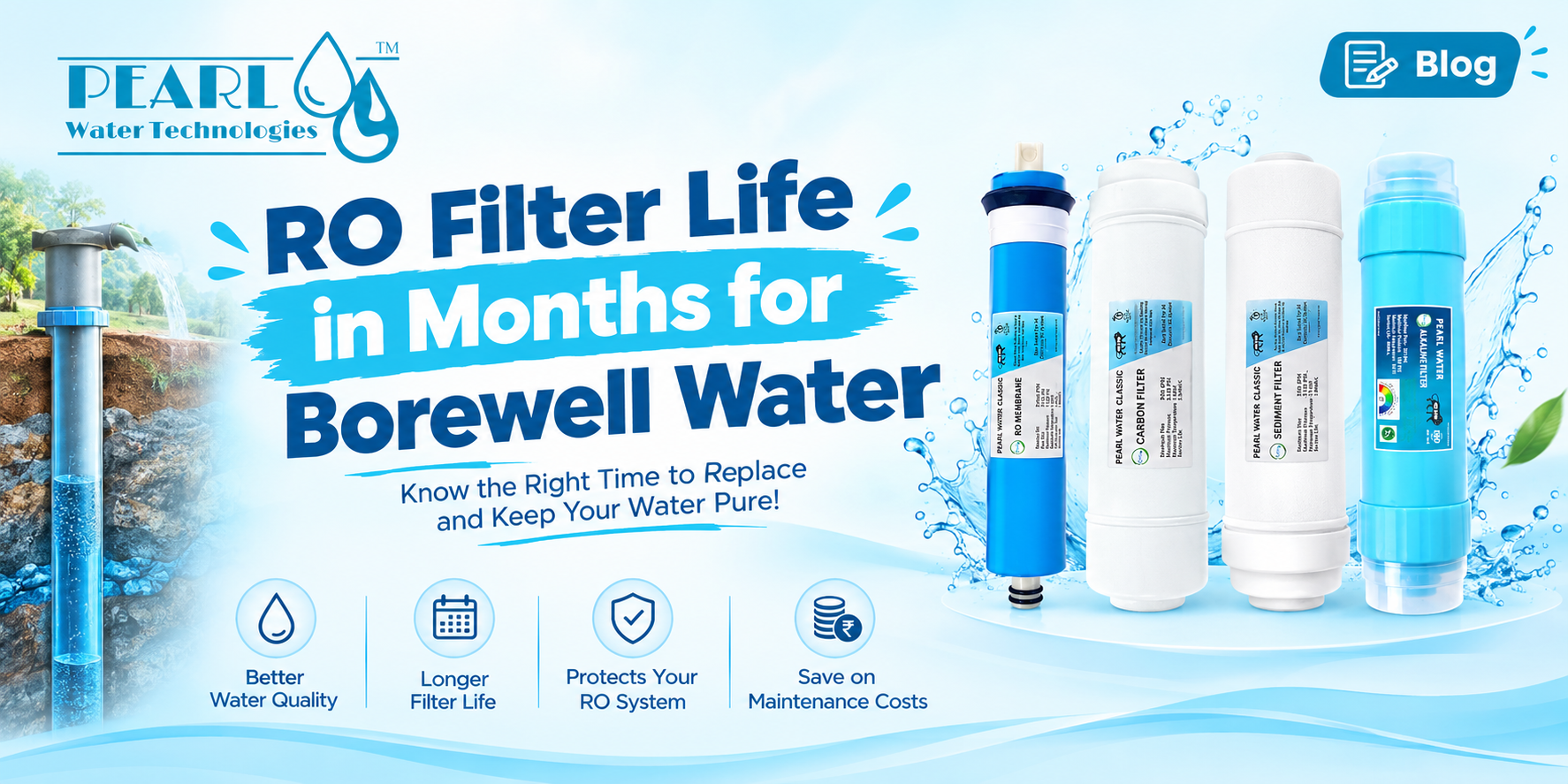
With borewell water, RO filters usually last about 1 to 3 months for the sediment filter, 4 to 6 months for the carbon filter, and 12 to 18 months for the RO membrane. That is shorter than the 6-month and 2 to 3 year figures often quoted for municipal supply, because borewell water carries more silt, iron, hardness and dissolved salts. Adding a softener or iron pre-filter can push these numbers back up.
RO stage |
Borewell water (typical) |
Municipal water (typical) |
Main reason for the gap |
|---|---|---|---|
Sediment filter |
1 to 3 months |
3 to 6 months |
Silt, sand and rust particles |
Pre carbon filter |
4 to 6 months |
6 to 9 months |
Organic matter and odour compounds |
Post carbon filter |
6 to 9 months |
6 to 12 months |
Taste polishing, lower load |
RO membrane |
12 to 18 months |
2 to 3 years |
High TDS and hardness scaling |
UV lamp |
12 months |
12 months |
Time-based, not water-based |
These are general field ranges. Your actual life depends on your water report and daily use. Always follow your cartridge or membrane datasheet.
Borewell water comes from underground, so it picks up whatever the soil and rock hold. Compared with treated municipal supply, it often carries:
The result is simple: filters clog and scale faster, so they need to be changed sooner.
The single best way to plan is to test your water. Check these four values:
A TDS meter costs very little and gives you a quick reading at home. For full numbers, use a lab or field test. See our guide on water testing before installing an RO to know what to check, and browse RO water purifiers suited to high-TDS supply.
A sediment filter usually lasts 1 to 3 months with borewell water. If your water is muddy or rust-coloured, check it monthly. A dark, clogged cartridge is your sign to replace it. A fresh RO sediment filter in the right micron rating protects every stage after it.
Carbon filters last about 4 to 6 months on borewell supply. They remove odour, organic matter and chemicals that spoil taste. Once exhausted, they stop protecting the membrane. Choose a suitable RO carbon filter for the pre and post stages.
An RO membrane usually lasts 12 to 18 months in borewell conditions, and sometimes less if TDS is above 2,000 ppm or the water is very hard. With good pre-treatment it can reach 2 years or more. Compare your options on the RO membrane page, including premium brands like DOW RO membrane and Hydranautics RO membrane.
The cheapest filter change is the one you never have to make early. Use this checklist:
Do not wait for the calendar if you notice any of these:
If your water turns cloudy right after a change, that is a separate issue. Read why RO water turns cloudy after a new filter.
Usually, yes. Changing the full set together keeps results consistent and avoids repeat visits. A complete RO filter kit with sediment, carbon and membrane is better value than buying parts one by one. If your pre-treatment (softener and sediment filter) is working well, you can change the cheaper filters more often and the membrane on its own schedule, as long as output TDS stays in range.
The filters are the same type, but the system should match your water. For high TDS and hard water, look for a purifier with a strong pump, a good-quality membrane (75 to 100 GPD) and pre-treatment. Ask for a water test before you buy. A purifier that is too basic for your water will need constant filter changes.
Change it every 12 to 18 months in most borewell homes. If TDS is above 2,000 ppm or hardness is very high, plan for 8 to 12 months unless you use a softener.
About 1 to 3 months. Muddy or iron-rich water can clog it even sooner, so check the colour of the cartridge every month.
Yes. A softener removes hardness before the water reaches the membrane, which reduces scaling and can add months or even a year to membrane life.
The filter types are the same, but borewell water wears them out faster. You will need to change them more often, or add pre-treatment to match municipal-water life.
Use a TDS meter. If output TDS rises above 50 to 75 ppm, or the water tastes salty and flow drops, the membrane is likely worn. Check the pre-filters first, then the membrane.
Not sure how soon your filters need changing? Share your water TDS and daily usage with the Pearl Water team and we will suggest the right schedule and parts. Browse the RO filter kit, or read more maintenance guides on the Pearl Water blog.
Action completed successfully.

Leave A Comment