


04-Aug-2026
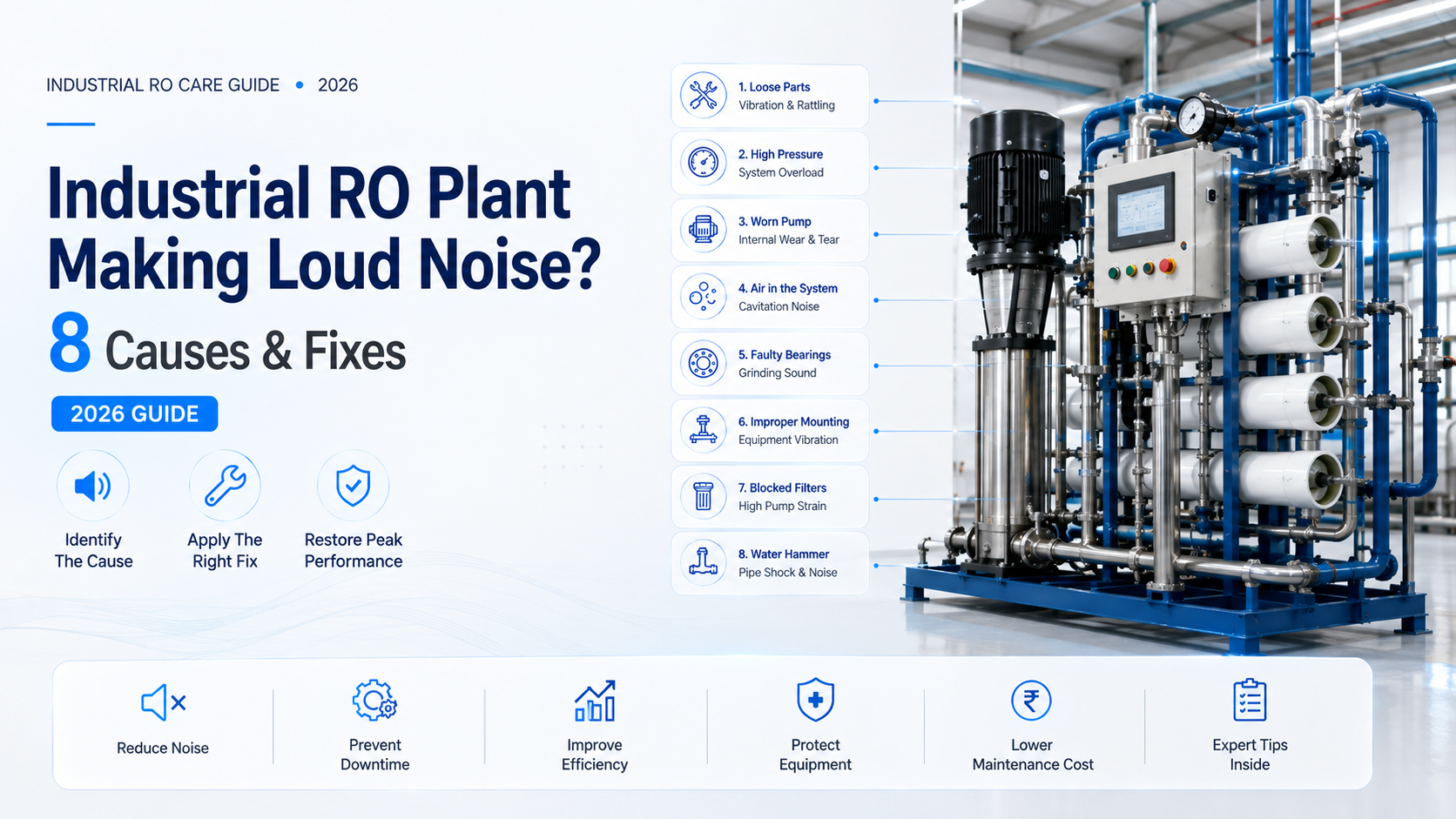
Every industrial RO plant has a normal running sound — a low hum from the motor and pump, the steady rush of water through the pipes. The moment that sound changes, something has changed inside the system too. It's one of the earliest warnings an industrial reverse osmosis system gives before a real breakdown, and honestly, it's one of the calls our service team across Delhi NCR, Gurgaon, Bangalore, and Lucknow gets most often. Someone on the shop floor notices the plant "sounds different" and wants to know if it's serious.
Most of the time it is fixable, and cheaply, if you catch it early. This guide covers what different noises usually mean, how to trace the source yourself before calling anyone, and when it's genuinely time to bring in a technician.
Loud noise from an industrial RO plant almost always traces back to one of a handful of things: the high-pressure pump cavitating because it isn't getting enough water, worn motor bearings, air trapped somewhere in the piping, a pre-filter so clogged the pump is struggling to pull water through it, loose clamps or brackets vibrating against the frame, or a multiport valve on its way out. Grinding or screeching points to the pump or motor. Rattling and buzzing usually mean loose mounting or trapped air. A sharp knock right when a valve opens or closes is water hammer.
It's tempting to turn the volume down mentally and keep running the plant — production doesn't stop for a funny noise. But left alone, this pattern tends to play out the same way each time: output starts dropping because whatever's causing the noise is also cutting into system efficiency, the pump or motor wears out faster than it should, and eventually you're looking at unplanned downtime instead of a scheduled fix. A seized pump doesn't wait for a convenient day.
If you're seeing weaker output alongside the noise, it's worth reading our piece on why a new RO membrane produces less water than its rated GPD — the two symptoms often share the same root cause.
1. Pump cavitation. This is behind most cases of a high-pressure pump making a grinding or "marbles in a blender" sound. What's happening is the pump isn't getting enough water on the suction side, so tiny vapor bubbles form and collapse violently inside the pump chamber. Usually the culprit is a clogged pre-filter or cartridge filter starving the inlet, a partly closed inlet valve, low feed pressure, or a feed pump that's simply undersized for the plant's rated capacity. Start by checking and replacing the pre-filter — our guide on cleaning an industrial cartridge filter walks through it. That alone resolves most cavitation cases. If the noise doesn't go away, get someone to check feed pressure against what the pump actually needs at the suction side.
2. Worn motor bearings. A constant whine, or a grind that keeps getting worse over a few days, points to bearing wear in the motor or pump shaft. This is fairly normal after three to five years of heavy industrial use — it's wear and tear, not a defect. The pump brand matters more than people expect here; we've written about why Kirloskar pumps tend to hold up better under continuous duty. Either way, bearings should get inspected and re-greased or replaced as part of routine servicing. Ignore it too long and the motor can seize completely, which is a far more expensive fix than a bearing swap.
3. Trapped air in the piping. Rattling, banging, or a gurgling sound as water moves through is often just air that got into the system — commonly after commissioning, after a filter or membrane change, or any time the piping was recently opened up. Most systems have an air release valve at the highest point of the run; bleeding the air out usually clears this up in minutes.
4. A pre-filter that's overdue for replacement. This one's sneaky because it doesn't just reduce output — it also makes the pump work harder, which is a straight line to the cavitation problem in #1. It's the first thing our technicians check on any noise call, mostly because it's the easiest thing to fix and gets missed the most. There's more detail on what these filters actually do in our post on cartridge filters in RO plants. As a rule, cartridge filters need swapping every one to three months depending on feed water quality — high-sediment borewell water eats through them faster.
5. Loose clamps, brackets, or mounting bolts. Vibration finds its way through unsecured piping and metal frames and shows up as a buzz or rattle that sounds worse than it is. This tends to happen after a plant's been moved or after any pipework was recently touched. A quick physical inspection and re-tightening usually sorts it out — five minutes, no cost.
6. A multiport valve on the way out. If the noise only shows up during the backwash or regeneration cycle, and stays quiet the rest of the time, look at the multiport valve first. You might also notice the rotameter reading is off when this happens. These valves are serviceable — worn seals or internals can usually be replaced without swapping the whole unit. Our guide on maintaining and restoring a multiport valve covers the inspection steps in detail.
7. Water hammer. A sharp knock exactly when a valve opens or closes — especially with solenoid valves in automatic plants — is water hammer, caused by fast-moving water stopping suddenly in the pipe. A water hammer arrestor, or adjusting how fast the valve closes on PLC-controlled systems, generally fixes it.
8. Pump and motor slightly out of alignment. If the plant's been serviced recently, or moved, or someone's worked on the pump-motor coupling, even a small misalignment between the shafts can cause a persistent grind or knock under load. This isn't something to try yourself — it needs a technician with proper alignment tools — but it's a fast check for anyone experienced.
| Noise Type | Most Likely Cause | Check This First |
|---|---|---|
| Grinding / screeching | Cavitation or bearing wear | Pump inlet pressure, pre-filter condition |
| Rattling / buzzing | Loose mounting or trapped air | Pipe clamps, air release valve |
| Knocking on valve open/close | Water hammer | Solenoid valve, pipe supports |
| Constant high-pitched whine | Motor bearing wear | Motor bearing condition |
| Noise only during backwash | Multiport valve | Valve seals, rotameter reading |
Filter condition, loose bolts, obvious air in the line, and whether the noise lines up with a specific cycle — all of that you can check on your own without any special tools.
Where it's worth calling someone: the noise is grinding or screeching and a fresh filter didn't fix it, you suspect the bearings, the pump housing is hot to the touch, or the noise is showing up alongside falling output or a rising reject-water ratio. Any of those together usually means the pump itself needs proper attention, not a quick DIY fix.
One thing worth saying plainly: ignoring pump noise almost never saves money. What starts as a ?5,000–15,000 filter or bearing job has a way of turning into a ?50,000+ pump or motor replacement if it sits for a few months.
We're an ISO-certified industrial RO plant manufacturer with service teams in Delhi NCR, Gurgaon, Bangalore, and Lucknow, and noise calls are something we deal with regularly — on plants we've supplied and on third-party installations under AMC. Our technicians run through the same diagnostic checks every time: filter condition, feed pressure, bearings, valves, before recommending any part gets replaced. If a spare part genuinely needs replacing — pump, multiport valve, membrane, filter — our industrial RO spares range covers the major components.
A lot of this is avoidable with regular servicing. Our post on how often an industrial RO plant should be serviced lays out a practical schedule. And if you're setting up a new facility or working on a short-term project, our industrial RO plants on rent come with maintenance built in, so this kind of troubleshooting is already handled.
If your plant's making a noise you're not sure about, reach out to our service team and we'll take a look.
Q: Why is my industrial RO plant suddenly making loud noise? A: Most often it's the high-pressure pump cavitating — usually because of a clogged pre-filter, low feed pressure, or air trapped in the piping. Check the pre-filter first; it clears up the majority of sudden-noise cases.
Q: Is a grinding noise from the RO pump serious? A: Yes, it usually is. Grinding or screeching points to cavitation or bearing wear, and both get worse fast — if it's not addressed within a few days, you're risking pump or motor failure.
Q: Can I fix RO plant pump noise myself? A: Some of it, yes. A clogged filter, loose clamps, or trapped air are easy checks anyone on-site can do. Bearing wear, shaft misalignment, and valve problems really do need a trained technician.
Q: How often should an industrial RO plant be serviced to avoid this kind of thing? A: Cartridge and pre-filters typically need checking every one to three months, and a full mechanical service — pump, bearings, valves — every six months, depending on your feed water and how hard the plant runs. Our servicing schedule guide has more detail.
Q: Does the noise itself affect water quality or output? A: Indirectly, yes. Whatever's causing the noise — cavitation, clogging, a worn valve — is usually also eating into output and recovery rate. Treat the noise as an early warning, not just background irritation. Related reading: why a new RO membrane produces less water than rated.
Explore our products: Industrial RO Plants · Industrial RO Spares · Motor / High-Pressure Pump · Multiport Valve · Cartridge Filter · Industrial RO on Rent
Last updated: August 2026. Pearl Water Technologies designs, manufactures, and services ISO-certified industrial RO plants from 50 LPH to 10,000+ LPH, with AMC and on-site service support across India.
Leave A Comment