


10-Jun-2026
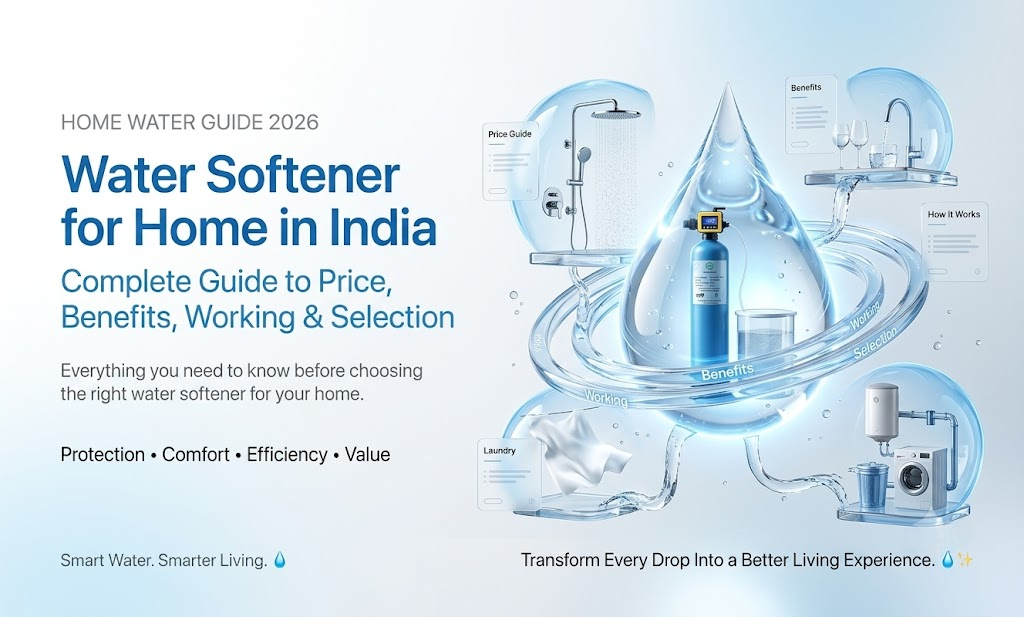
Introduction: Why Hard Water Is India's Silent Home Destroyer
If you've ever noticed chalky white deposits around your taps, dull and lifeless hair after a shower, or your geyser running less efficiently than it used to — you're not imagining it. You're dealing with hard water, and across India, it's one of the most common yet least talked-about household problems.
Hard water contains elevated levels of dissolved minerals, primarily calcium and magnesium. These minerals are picked up naturally as water travels through limestone and chalk rock formations. In India, over 60% of groundwater sources — including borewells and municipal supply lines in cities like Delhi, Jaipur, Ahmedabad, Bengaluru, Hyderabad, Pune, and Chennai — are classified as moderately to severely hard.
The damage is slow but cumulative. Scale builds up inside your water pipes, narrowing them year after year. Your washing machine, geyser, and dishwasher work harder and fail sooner. Your skin feels dry and rough. Your hair loses its shine. Bathroom tiles and fittings get permanently stained. Soap and shampoo barely lather. And your monthly utility bills creep upward — silently.
A water softener is the proven, reliable solution to all of this. Whether you live in a 2BHK apartment, an independent villa, or manage a large housing society, a water softener system can protect your plumbing, extend appliance life, and significantly improve your daily quality of life.
In this complete guide, we cover everything you need to know about water softeners in India — how they work, the benefits, pricing, types of resin and salt, installation options, and how to choose the right system for your specific needs.
Section 1: What Is a Water Softener?
A water softener is a water treatment device that removes calcium and magnesium ions from hard water through a process called ion exchange, converting hard water into soft water that is gentle on pipes, appliances, skin, and hair.
More specifically, a water softener is a filtration system that treats the entire water supply entering your home or building. Rather than filtering at a single point — like an RO purifier at your kitchen sink — a water softener works at the point of entry, ensuring that every tap, shower, appliance, and pipe in your home receives treated soft water.
The Science of Water Hardness
Water hardness is measured in milligrams per litre (mg/L) or parts per million (ppm) of calcium carbonate (CaCO?). The Bureau of Indian Standards (BIS) classifies water hardness as:
Hardness Level |
CaCO(mg/L) |
Classification |
0 – 75 |
Soft |
Ideal |
75 – 150 |
Moderately Hard |
Acceptable |
150 – 300 |
Hard |
Problematic |
300+ |
Very Hard |
Severe |
The Ion Exchange Process
A water softener system for home uses a technology called ion exchange. Inside the softener is a tank filled with thousands of small resin beads — typically made from sulfonated polystyrene. These beads carry a negative charge and are pre-loaded with sodium (Na?) ions.
When hard water passes through the resin bed:
This exchange happens continuously until the resin beads become saturated with calcium and magnesium. At that point, the system enters a regeneration cycle, where a salt (sodium chloride) solution washes the resin, flushing out the accumulated minerals and recharging the beads with fresh sodium ions — ready for the next cycle.
Section 2: How Does a Water Softener Work? (Step-by-Step)
Understanding the working mechanism helps you operate and maintain your system more effectively. Here's what happens inside a water softener:
Step 1 – Hard Water Entry Hard water from your borewell, municipal supply, or overhead tank enters the water softener system through the inlet valve. At this stage, it is carrying dissolved calcium and magnesium minerals that cause all the problems described above.
Step 2 – Resin Bed Treatment The water flows downward through a bed of ion exchange resin beads housed inside an FRP (Fibre-Reinforced Plastic) vessel or a stainless steel tank. These beads are the heart of the system — they do the actual softening work.
Step 3 – Calcium Removal As water contacts the resin, calcium ions (Ca²?) are pulled out of the water and bond to the resin beads, displacing sodium ions which enter the water stream instead.
Step 4 – Magnesium Removal Simultaneously, magnesium ions (Mg²?) undergo the same exchange process. Both calcium and magnesium are removed from the water in this single pass through the resin bed.
Step 5 – Soft Water Output The now-softened water exits through the outlet of the softener and flows to your bathroom taps, kitchen, geyser, washing machine, and all other water points in your home.
Step 6 – Regeneration Cycle Over time (typically every 3–7 days depending on water hardness and usage), the resin beads become fully loaded with calcium and magnesium and can no longer exchange ions effectively. The system automatically (or manually, in basic models) initiates a regeneration cycle:
This cycle typically takes 1–2 hours and is best scheduled at night to avoid interrupting household water supply.
Section 3: Benefits of Installing a Water Softener
Soft water transforms your home experience in ways you'll notice every single day. Here are the key benefits in detail:
Protects Plumbing Infrastructure
Hard water leaves calcium carbonate scale inside your pipes. Over months and years, this scale accumulates and narrows the internal diameter of your pipes, restricting water flow and increasing pressure. Eventually, pipes choke or burst. A water softener eliminates this problem entirely — soft water is non-scaling, so your plumbing stays clean, clear, and fully functional for decades.
Real example: In areas like Delhi NCR and Rajasthan where water hardness regularly exceeds 400 mg/L, homeowners report replacing corroded pipes within 5–8 years of construction. With a water softener, the same pipes can last 20–25 years or more.
Extends Appliance Life Significantly
Geysers, washing machines, dishwashers, and steam irons are all vulnerable to hard water damage. Scale coats the heating elements inside geysers, forcing them to consume 15–30% more electricity to heat the same amount of water. Scale-coated elements eventually burn out.
Soft water keeps heating elements clean. An electric geyser used with soft water can last 10–15 years versus just 4–6 years with hard water — representing significant savings on appliance replacement costs.
Better Bathing and Shower Experience
Hard water reacts with soap to form a sticky, insoluble scum instead of a rich lather. This scum doesn't rinse off completely, leaving a film on your skin that clogs pores and causes dryness. With soft water, soap lathers richly and rinses cleanly — your skin feels genuinely clean and moisturised after every shower.
Softer Skin and Healthier Hair
Dermatologists frequently link dry skin, eczema flare-ups, and brittle hair with hard water exposure. The calcium and magnesium ions in hard water disrupt the natural pH of skin and strip moisture from hair. Soft water preserves the natural oils in your skin and hair, leading to noticeably softer skin and shinier, more manageable hair within just a few weeks of installation.
Dramatically Reduced Soap and Detergent Consumption
With soft water, you'll use up to 50–70% less soap, shampoo, detergent, and cleaning products to achieve the same results. Soft water activates surfactants in cleaning products far more efficiently than hard water does. Over the course of a year, this reduction in product consumption represents real monetary savings that contribute toward recovering the cost of the softener itself.
Spot-Free Bathroom Fittings and Glassware
Those stubborn white spots and crusty deposits on your bathroom taps, shower glass, tiles, and stainless steel fixtures? They are calcium scale deposits left behind as hard water evaporates. Soft water doesn't leave these deposits, so your bathroom fittings stay gleaming and spot-free with minimal cleaning effort.
Energy Savings on Water Heating
As mentioned, scale on geyser heating elements forces the element to work harder and consume more electricity. Studies in the water treatment industry consistently show that removing scale from heating systems reduces energy consumption by 15–30%. Multiplied across the months and years of a geyser's operation, this is a meaningful reduction in electricity bills.
Improved Overall Water Quality for Household Use
Soft water makes laundry brighter (because detergent works better), dishware cleaner, and cooking utensils free of scale buildup. It also keeps swimming pools and water features cleaner and reduces chemical usage in these applications.
Section 4: Common Signs You Need a Water Softener
You likely need a water softener if you notice two or more of the following signs in your home.
If you're experiencing several of these, getting your water tested for hardness is the first step. A TDS (Total Dissolved Solids) meter gives a quick indication, but a proper hardness test using a titration kit or sending a water sample to a certified laboratory gives you exact CaCO? levels to guide your water softener selection.
Section 5: Water Softener for Home – Which Type Do You Need?
The right water softener for home depends on your home type, family size, daily water consumption, and the hardness level of your local water supply.
Apartments (2BHK / 3BHK)
For apartments receiving municipal supply with moderate hardness (150–300 mg/L), a compact 8–16 LPH (litres per hour) point-of-use softener or a 50–100 LPD (litres per day) softener installed at the overhead tank inlet is typically sufficient. These systems are small enough to fit in a utility area or balcony and require minimal plumbing modifications.
Independent Houses and Villas
Larger homes with multiple bathrooms, a garden, and appliances like a washing machine and dishwasher benefit from a whole-house softener with a capacity of 200–500 LPD. This ensures every water outlet in the home receives softened water.
Farmhouses
Farmhouses often rely on borewell water, which tends to be significantly harder than municipal supply (frequently 400–800 mg/L). They also have higher water usage — gardens, swimming pools, staff quarters. A larger system of 500–2000 LPD with higher resin volume is recommended, along with more frequent salt replenishment.
Selection Tip
To calculate the approximate softener capacity you need:
Example: A family of 4 needs approximately 4 × 150 = 600 litres/day. A system rated for 700–800 LPD would be appropriate.
Section 6: Water Softener for Home India – Understanding Indian Water Conditions
Indian water conditions vary significantly by region, water source, and season — making it essential to choose a water softener for home India specifically suited to Indian groundwater chemistry.
Borewell vs Municipal Water in India
Parameter |
Borewell Water |
Municipal Water |
Hardness |
Very high (300–800+ mg/L) |
Moderate to high (150–400 mg/L) |
TDS |
Often high (500–2000 ppm) |
Usually lower (200–600 ppm) |
Iron Content |
Sometimes present |
Rarely significant |
Seasonal Variation |
High |
Low to moderate |
Pre-treatment Needed |
Often yes |
Usually not |
TDS vs Hardness — An Important Distinction
Many homeowners confuse TDS (Total Dissolved Solids) with hardness. They are related but different:
A water softener removes hardness (calcium and magnesium) but does not significantly reduce TDS. In fact, because sodium replaces calcium and magnesium in ion exchange, the TDS may remain similar or increase slightly after softening.
If you have high TDS water (above 500 ppm), you may need a [Domestic RO System] in addition to a water softener — the softener protects your pipes and appliances, while the RO purifies drinking water. This combination is the gold standard for Indian homes with borewell water.
Section 7: Water Softener for Bathroom – A Targeted Solution
A water softener for bathroom is a compact, point-of-use installation that treats only the water supply to your bathroom, making it ideal for apartments or homes where a whole-house system isn't feasible.
Why Bathroom-Specific Softeners Make Sense
The bathroom is where hard water causes the most direct personal harm — dry skin, brittle hair, soap scum, and stained fixtures. A bathroom water softener addresses these specific concerns without requiring a complete overhaul of the home's water supply.
Installation Details
A bathroom water softener is typically installed on the cold water inlet pipe before it splits to the shower, bathtub, washbasin, and flush tank. The unit is small (roughly the size of a large water filter) and can be wall-mounted or installed under the wash basin.
Benefits of Bathroom-Specific Softening
Space and Cost Considerations
Bathroom-specific softeners require minimal space — most models have a footprint smaller than a standard water purifier. They are also more affordable than whole-house systems. However, they do not protect plumbing outside the bathroom or appliances like the washing machine or kitchen geyser.
Ideal for: Renters who cannot modify the main water supply, apartments where the overhead tank is inaccessible, or homeowners on a budget who want to start with a specific area.
Section 8: Frequently Asked Questions (FAQ)
What is a water softener?
A water softener is a water treatment system that removes dissolved calcium and magnesium minerals from hard water using ion exchange technology. It makes water "soft" — gentler on pipes, appliances, skin, and hair.
How much does a water softener cost in India?
Water softener price in India ranges from ?8,000–?18,000 for compact bathroom units, ?25,000–?80,000 for residential whole-house systems, and ?1,50,000–?10,00,000+ for housing society plants, depending on capacity and quality.
Which water softener is best for home in India?
The best system depends on your water hardness, family size, and water source. For most 4–5 person Indian households using borewell water, a 300–500 LPD water softener for home India with 8% DVB resin and a quality multiport valve is ideal.
Is a water softener worth buying in India?
Yes, especially for areas with hard water (most of India). The long-term savings from protected plumbing, longer appliance life, and reduced soap/detergent costs easily offset the purchase price within 2–4 years.
How long does water softener resin last?
Standard 4% DVB resin lasts 4–6 years. Premium 8% DVB water softener resin lasts 8–12 years. Resin life depends on water quality, regeneration frequency, and the presence of chlorine or iron in the water.
How much salt is required per month for a water softener?
For a family of 4–5 people in an area with high hardness water, expect to use 5–10 kg of water softener salt per month. At ?10–?15/kg for solar salt, that's approximately ?75–?150/month.
Section 9: Expert Buying Recommendations
Based on real-world installation experience across Indian homes and societies, here's what actually works:
For Small Apartments (2–3 People, Municipal Water, 150–300 mg/L Hardness)
A compact 100–150 LPD automatic water softener for home with standard 8% DVB resin installed at the overhead tank inlet is the most practical and cost-effective solution. Budget: ?20,000–?35,000. Focus on brand after-sales support over price.
For Larger Apartments / Families (4–5 People, Mixed Source)
A 300–400 LPD system with demand-based automatic regeneration, an FRP vessel, and quality multiport valve. Ensure the installer does a hardness test first. Budget: ?35,000–?60,000.
For Independent Houses (Borewell Water, 300–600 mg/L)
A 500–750 LPD twin-vessel system (so one vessel is always in service while the other regenerates) with 8% DVB iron-tolerant resin. Pair with an iron pre-filter if iron content is above 0.3 mg/L. Budget: ?60,000–?1,20,000.
For Villas with Swimming Pools and Gardens
A 1000–2000 LPD system that includes a pre-filter, main softener, and post-filter. The pre-filter protects resin from sediment (common in borewell water), extending resin life significantly. Budget: ?1,00,000–?2,00,000.
For Housing Societies
Work with a water treatment company that conducts a detailed site survey, water analysis, and provides a written proposal with technical specifications. A properly designed water softener for housing society delivers the highest ROI of any residential application. Insist on reference sites you can visit. Sign a 2-year AMC upfront. Budget is highly variable — get 3 competitive quotes and evaluate on specifications, not just price.
Key questions to ask any supplier:
Conclusion: Make the Smart Investment in Soft Water
Hard water is not a minor inconvenience. It's a slow, cumulative drain on your home infrastructure, your appliances, your utility bills, and even your personal health and comfort. Across India — from Delhi to Hyderabad, from Ahmedabad to Bengaluru — water softeners are transitioning from a luxury to a necessity as groundwater quality worsens and the true cost of hard water damage becomes increasingly apparent.
The benefits are clear and measurable: protected pipes, longer-lasting appliances, dramatically better bathing experience, softer skin and hair, reduced soap and detergent costs, spot-
Leave A Comment