Added to wishlist.

How to Maintain the Ideal Pool pH Level: The Complete Guide

20-Jul-2026

How to Maintain the Ideal Pool pH Level: The Complete Guide

Maintaining clear, sparkling, and safe swimming pool water relies on a foundational rule: mastering your water chemistry. Whether managing a backyard oasis, an Olympic-sized community facility, or a luxury resort pool, knowing how to maintain pool pH is essential. Unbalanced pH ruins swim sessions, damages expensive pump equipment, and neutralizes sanitizers like chlorine.

This comprehensive 2026 guide breaks down pool chemistry principles, detailing accurate testing methods, step-by-step chemical adjustments, and professional maintenance schedules—featuring trusted water treatment solutions like those from Pearl Water Technologies.


Quick Answer: What is the Ideal Pool pH?

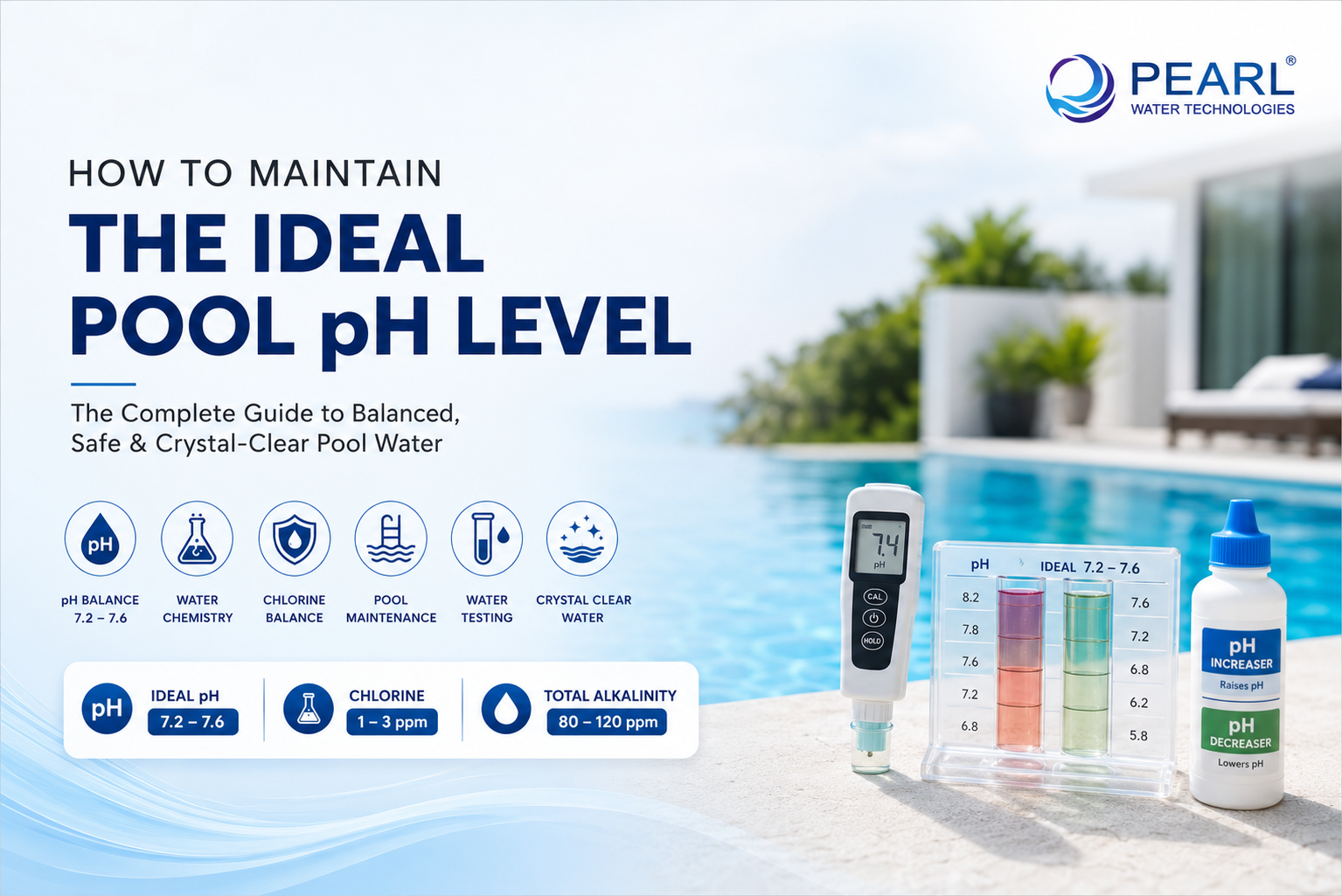
The ideal pool pH level is 7.2 to 7.6, with 7.4 representing the sweet spot. Keeping your pool within this range ensures maximum chlorine effectiveness, prevents eye and skin irritation, protects pool equipment from scale or corrosion, and preserves overall water clarity.


Ideal Water Chemistry Snapshot

Parameter

Ideal Range

Function

pH

7.2 – 7.6

Controls sanitizer efficiency & swimmer comfort

Free Chlorine

1.0 – 3.0 ppm

Sanitizes water, kills bacteria & algae

Total Alkalinity

80 – 120 ppm

Acts as a pH buffer to prevent drastic fluctuations

Calcium Hardness

200 – 400 ppm

Protects plaster walls & prevents scaling or etching

Cyanuric Acid (CYA)

30 – 50 ppm

Shields chlorine from sunlight degradation


What Is Pool pH?

The term pH stands for "potential Hydrogen." It measures how acidic or basic (alkaline) your pool water is on a logarithmic scale from 0 to 14:

  • 0.0 to 6.9: Acidic water

  • 7.0: Neutral (pure water)

  • 7.1 to 14.0: Basic / Alkaline water

Because the human body’s natural pH (tears and skin) sits between 7.35 and 7.45, pool water outside this threshold causes discomfort, skin irritation, and red eyes.

What Is the Ideal Pool pH Level?

The industry standard recommended by the Pool & Hot Tub Alliance (PHTA) and the Centers for Disease Control and Prevention (CDC) for pool pH is 7.2 to 7.6.

Maintaining this precise range delivers three main benefits:

  1. Chemical Efficiency: Free chlorine works best at a slightly basic pH.

  2. Swimmer Comfort: Matches natural human eye and skin pH levels.

  3. Asset Protection: Prevents chemical wear on liners, plaster, pumps, and heaters.


Why Maintaining Pool pH Is Important

Unbalanced pH creates severe operational and safety problems. Here is how High pH compares to Low pH:

High pH vs. Low pH Symptoms

Feature / Effect

Low pH (< 7.2) — Too Acidic

High pH (> 7.6) — Too Alkaline

Swimmer Impact

Stinging eyes, dry skin, itchy scalp

Burning eyes, dry itchy skin

Water Appearance

Clear, but deceptively corrosive

Cloudy, dull, or murky water

Chlorine Power

Dissolves too fast; overactive

Ineffective (up to 80% loss in efficiency)

Pool Surfaces

Etches plaster, dissolves grout, corrodes metal

Scale buildup, calcium deposits on tiles

Equipment Impact

Corrodes pump seals, heaters, and ladders

Clogs pipes, filters, and heat exchangers


How to Test Pool pH

To properly maintain pool pH, accurate testing is essential.

Recommended Testing Tools

  1. Liquid Test Kits (OTO/Phenol Red): The gold standard for residential and commercial accuracy. Phenol Red turns pink/red depending on the pH level.

  2. Digital Photometers & Automated Monitoring: Companies like Pearl Water Technologies provide high-grade digital sensors, online pH meters, and automated chemical dosing controllers that give exact, real-time numeric readings without color interpretation errors.

  3. Test Strips: Fast and convenient for everyday residential quick checks.

Best Testing Time: Early morning or evening (away from direct sunlight).

How to Lower High Pool pH

If your pool pH reads above 7.6, lower it promptly to prevent scaling and keep your chlorine active.


Common pH Reducers

  • Muriatic Acid (Liquid Hydrochloric Acid): Highly effective and budget-friendly.

  • Sodium Bisulfate (Dry Acid): Granular, safer to handle, ideal for smaller residential pools.


Step-by-Step Guide to Lowering pH Safely

  1. Calculate the Required Dose: Check your pool volume (gallons) and current pH level.

  2. Put on Safety Gear: Wear chemical-resistant gloves and safety goggles.

  3. Dilute (If Using Muriatic Acid): Pre-mix acid in a plastic bucket filled with pool water (always add acid to water, never water to acid).

  4. Add to the Deep End: With the pump running, pour the solution slowly near the return jets.

  5. Circulate: Allow the pump to run for 4 to 6 hours before retesting.


How to Raise Low Pool pH

If your water drops below 7.2, raise the pH to prevent equipment corrosion and swimmer discomfort.

Common pH Increasers

  • Sodium Carbonate (Soda Ash) / pH Boosters: High-grade chemical formulations from suppliers like Pearl Water Technologies raise pH quickly with a modest boost to Total Alkalinity.

  • Sodium Bicarbonate (Baking Soda): Primarily raises Total Alkalinity, with a smaller increase to pH.

Step-by-Step Guide to Raising pH Safely

  1. Measure Alkalinity First: If Total Alkalinity is low (< 80 ppm), fix it first; doing so often stabilizes pH.

  2. Dissolve Soda Ash: Measure the correct dose based on pool volume and dissolve it in a bucket of pool water.

  3. Broadly Broadcast: Pour the slurry slowly around the perimeter of the pool while the filtration system runs.

  4. Wait and Retest: Circulate for 4 hours before taking a fresh reading.

Factors That Affect Pool pH

Pool chemistry is dynamic. Several environmental and operational factors cause pH fluctuations:

  • Rainfall: Acid rain drops pool pH, while heavy rain dilutes chemicals and destabilizes alkalinity.

  • Bather Load: Sweat, skin oils, and sunscreen shift pH upward.

  • Sunlight & Heat: UV rays degrade sanitizers, driving up pH levels.

  • Water Features: Waterfalls, spillways, and aerators introduce oxygen, steadily driving pH up.

  • Chemical Additions: Saltwater chlorine generators naturally push pH up, while trichlor chlorine tabs drop pH down.


Common Pool pH Mistakes

  • Ignoring Total Alkalinity: Attempting to adjust pH without balancing alkalinity leads to unstable pH levels.

  • Adding Too Many Chemicals at Once: Dosing aggressively causes chemical rebound swings. Adjust incrementally.

  • Mixing Chemicals Directly: Never mix dry acid, liquid acid, or chlorine together in the same container. This releases toxic gases.

  • Retesting Too Quickly: Retesting before chemicals circulate leads to over-dosing. Wait at least 4 to 6 hours.


Weekly Pool pH Maintenance Checklist

Follow this schedule to maintain stable pool chemistry:

  •  Test pH and Free Chlorine: 2–3 times weekly (daily for commercial pools).

  •  Check Total Alkalinity: Once weekly.

  •  Inspect Pool Equipment: Check pump basket, skimmers, and pressure gauges weekly.

  •  Shock Pool (If Needed): Perform after heavy rain or intense use.

  •  Brush and Vacuum: Clean walls to clear organic debris before it impacts pH.


Professional Tips to Maintain Ideal Pool pH

Pro Tip 1: Master Total Alkalinity First

Always adjust Total Alkalinity (80–120 ppm) before attempting major pH corrections. Alkalinity acts as a buffer; if it is out of balance, your pH will fluctuate wildly.


Pro Tip 2: Implement Automated Dosing & Filtration Technologies

For commercial facilities, resorts, or busy homeowners, manually dosing chemicals can lead to human error. Utilizing automated water treatment systems, high-efficiency FRP sand filters, and chemical dosing pumps from specialists like Pearl Water Technologies ensures continuous water circulation and precise pH balancing, protecting infrastructure and significantly reducing chemical waste.


Pro Tip 3: Manage Saltwater Pools Proactively

Saltwater pools continuously generate sodium hydroxide as a byproduct of electrolysis, which pushes pH up. Keep muriatic acid on hand and inspect cell plates monthly.

mp to circulate added chemicals thoroughly before retesting and allowing swimmers back in.


Key Takeaways

  • Maintain pool pH strictly between 7.2 and 7.6 for healthy, clear water.

  • Balance Total Alkalinity (80–120 ppm) first to prevent erratic pH swings.

  • Use Soda Ash to raise pH and Muriatic Acid to lower it.

  • Leverage modern solutions from brands like Pearl Water Technologies for reliable water testing, chemical balancing, and industrial-grade filtration.

  • Follow basic chemical handling safety: Always add acid to water, never water to acid.


Frequently Asked Questions (FAQs)


What is the ideal pH for a swimming pool?

The ideal pH level for any swimming pool is 7.2 to 7.6. This range optimizes sanitation performance and prevents skin and equipment damage.

Can high pH make pool water cloudy?

Yes. High pH causes dissolved calcium to precipitate out of the water, leading to cloudy water and scale buildup along pool walls and plumbing.

How often should I check pool pH?

Check residential pool pH 2 to 3 times per week during active seasons. Winterized or covered pools require checks every 2 weeks.

Is pool pH different from alkalinity?

Yes. pH measures water acidity, while Total Alkalinity measures the water’s ability to resist pH changes (acting as a buffer).

What chemical lowers pool pH?

Muriatic acid (liquid) and sodium bisulfate (dry acid) are the primary chemicals used to lower high pool pH levels safely.

What chemical raises pool pH?

Sodium carbonate (soda ash) is the primary chemical used to raise pool pH rapidly without drastically increasing total alkalinity.

Can rain affect pool pH?

Yes. Rainwater is typically acidic and drops pool pH. Heavy storms can also dilute pool chemicals, destabilizing total alkalinity.

Does chlorine increase pool pH?

It depends on the chlorine type. Liquid chlorine and salt cell generators raise pool pH, whereas Trichlor floating tablets lower pool pH over time.

How long after adding chemicals can you swim?

Wait at least 30 to 60 minutes after adding pH adjusters, and ensure the pump has circulated the water thoroughly. After shocking with heavy chlorine, wait until levels fall below 3.0 ppm.

How do professionals maintain pool pH?

Professionals test water chemistry weekly, balance alkalinity first, use automated dosing systems and commercial filtration systems from industry providers like Pearl Water Technologies, and make calculated chemical adjustments based on exact gallon volumes.

Conclusion

Maintaining the ideal pool pH level is the single most effective step you can take toward clean, safe, and crystal-clear swimming water. By keeping your water balanced within the optimal 7.2 to 7.6 range, you protect swimmers from skin and eye irritation, ensure your sanitizer works at peak efficiency, and extend the lifespan of expensive pool liners, pumps, and heaters.

Proactive, consistent water chemistry management is key. By performing routine testing, adjusting Total Alkalinity first, and leveraging professional-grade solutions from trusted industry leaders like Pearl Water Technologies—such as high-precision test kits, balancing chemicals, and automated dosing equipment—you eliminate the guesswork from pool maintenance. With the right schedule and tools in place, keeping your pool balanced becomes effortless, leaving you with a inviting oasis all season long.


Share:

Leave A Comment

Thank You for subscribing our newsletter.