29-Oct-2026
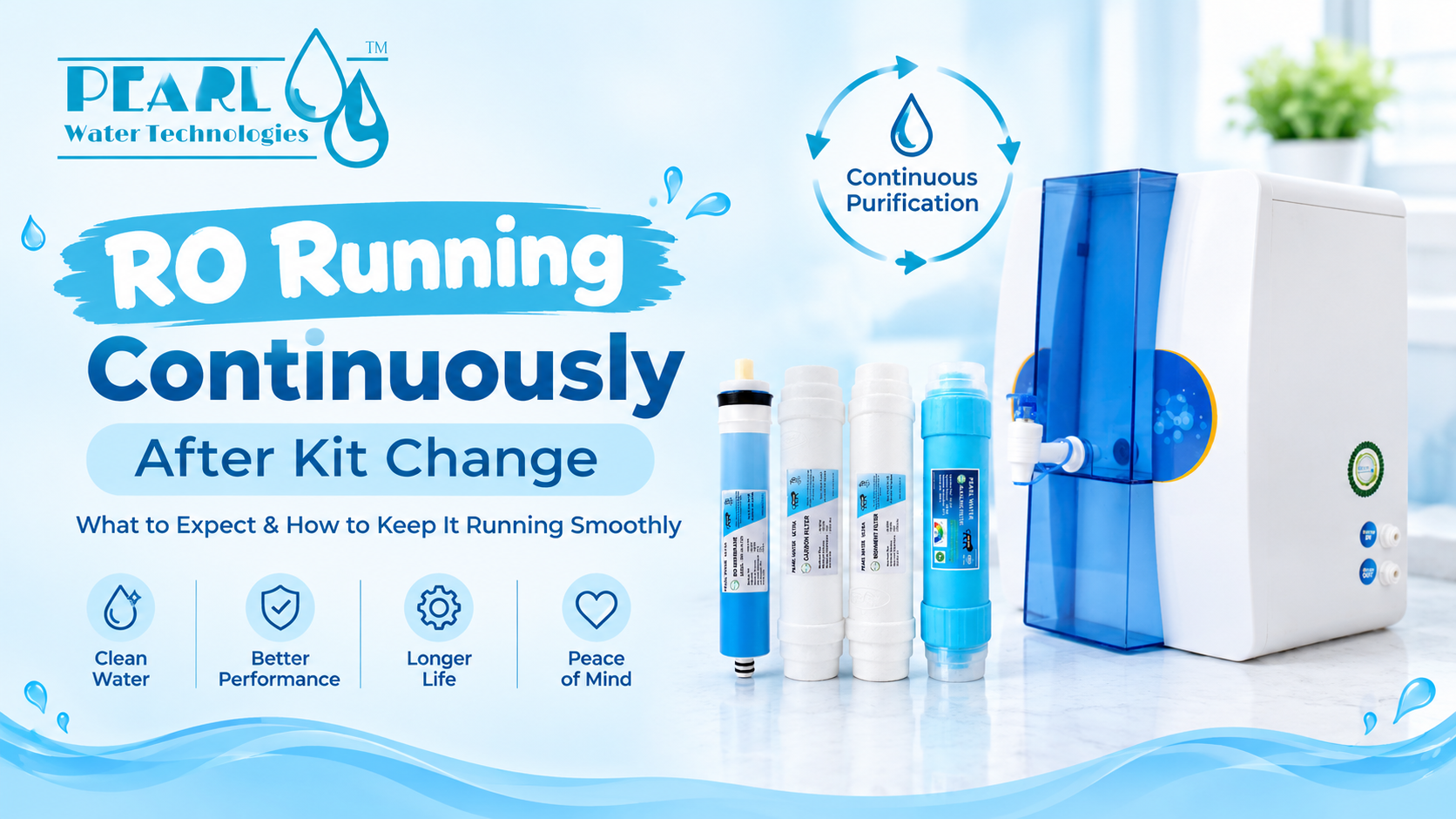
Why Is My RO Running Continuously After a Kit Change?
An RO purifier keeps running after a kit change for one of two reasons. Either it is normal, because the new filters and the empty tank need time to fill, or something is stopping the system from reaching shut-off pressure. The usual faults are air in the lines, a leak, a faulty auto shut-off (ASO) valve, low inlet pressure, a wrongly fitted tube or a wrong tank pre-charge.
A purifier that runs for a few hours after a kit change is usually fine. One that runs all day and all night, or keeps sending water to the drain, needs checking.
Yes, for a limited time. Right after you change the sediment filter, carbon filter or membrane:
Most domestic RO systems take 2 to 4 hours to fill an empty tank, and a little longer after a membrane change. If the purifier still does not shut off after about 6 hours, treat it as a fault.
Air in new cartridges and tubing lowers the pressure at the membrane and the tank. The system keeps trying to build pressure, so it does not shut off. Flushing the system (see below) solves it.
A loose fitting, a missing or twisted O-ring or a half-seated cartridge can leak water or draw in air. If the purifier cannot build pressure, the ASO valve never closes. Look for drips, wet spots and hissing sounds.
The ASO valve closes the inlet when the tank is full. If it was bumped, blocked or damaged during the kit change, the purifier keeps running and often keeps sending water to the drain.
The storage tank has an air chamber that pushes water out. If the air pressure is wrong with the tank empty, the tank may take far too long to fill, or never reach the pressure needed to trigger shut-off.
RO needs steady incoming pressure. Low pressure from the borewell, overhead tank or a partly closed valve delays the shut-off. The system can run for hours without getting a full tank.
If the flow restrictor was removed or replaced with a wrong rating, or if the tubes were connected to the wrong ports, the system loses pressure at the membrane and runs continuously.
A choked sediment filter or carbon filter (or one fitted in the wrong order) cuts the flow. The membrane gets less water and the tank fills very slowly, so the system seems never to stop.
Using matched, genuine parts avoids most of these problems. See the complete RO filter kit and the individual parts:
Situation |
Likely meaning |
|---|---|
Runs 2 to 4 hours after the change, then stops |
Normal tank refill |
Runs 4 to 6 hours, then stops |
Air or low pressure, usually fine |
Runs all day and night |
Leak, ASO fault or pressure problem |
Water flows to the drain nonstop |
ASO valve, flow restrictor or tube fault |
Tank stays nearly empty |
Tank pre-charge, choked filter or low pressure |
Hissing, dripping or sputtering |
Air or a loose fitting |
Get help if:
A continuously running RO wastes water, strains the pump and wears out the new membrane early. If your supply is hard or carries a lot of sediment, consider the RO water purifiers range or a water softener to protect the new kit.
More service guides are in the Pearl Water blog.
1. Why does my RO not stop after changing the filter?
The new filters and the empty tank need time to fill, and air in the lines slows the pressure build-up. If it continues beyond 6 hours, check for leaks, the ASO valve, the tank pre-charge and the inlet pressure.
2. How long should RO run after a kit change?
Usually 2 to 4 hours to fill an empty tank. After a membrane change it can take a little longer.
3. Why is my RO draining water continuously after the kit change?
The ASO valve may be stuck or damaged, the flow restrictor may be missing or wrong, or the tubes may be in the wrong ports.
4. Can low water pressure make RO run non-stop?
Yes. Low inlet pressure prevents the system from building the pressure it needs to shut off.
5. Is a continuously running RO harmful?
It wastes water, raises the electricity use and puts extra load on the pump and the membrane, so it should be fixed rather than ignored.
Action completed successfully.

Leave A Comment