


20-Jul-2026
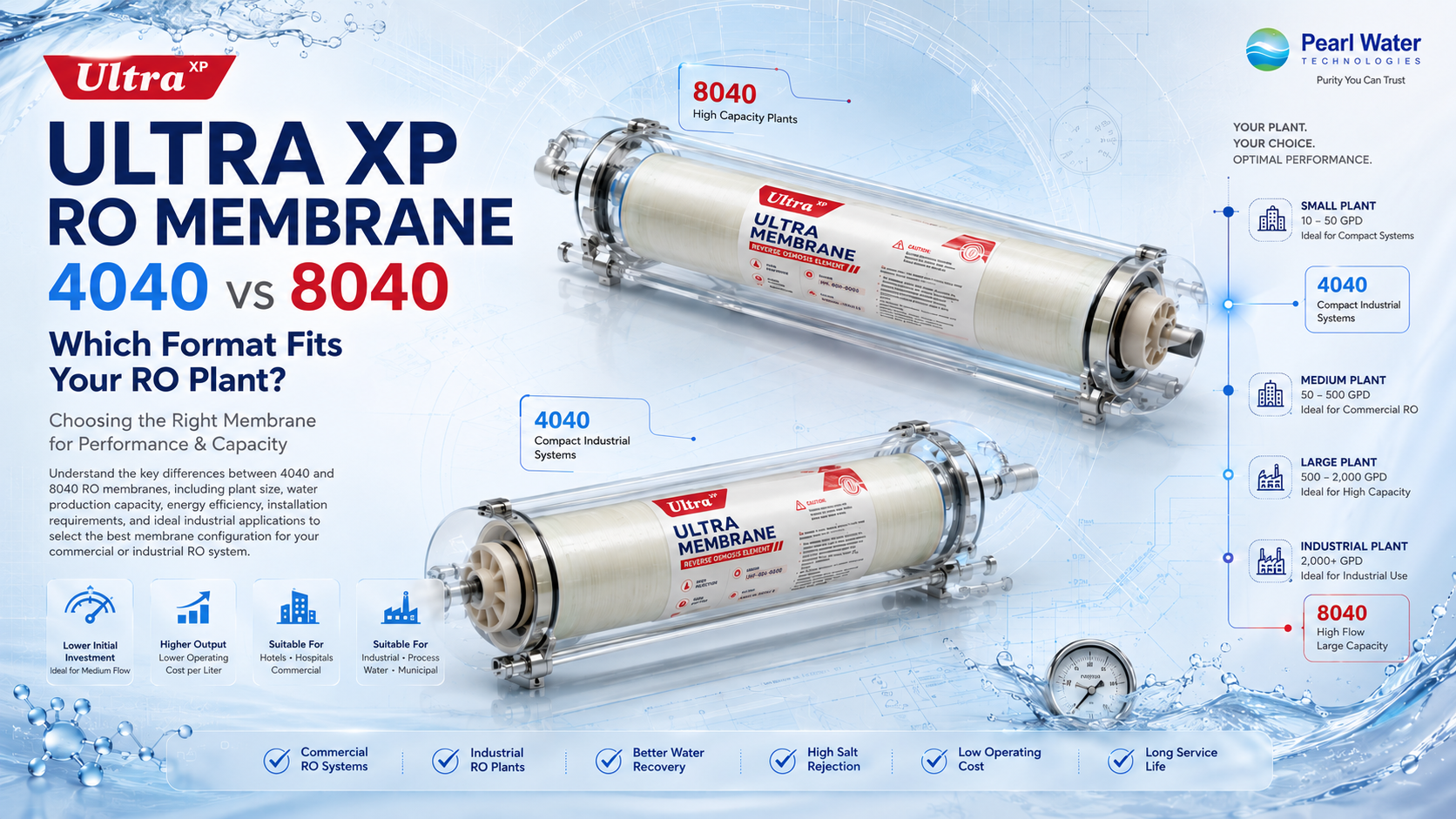
Every RO system, whether it's a single office unit or a full municipal treatment plant, comes down to one question: is the membrane element matched to the actual water demand, or is it oversized, undersized, or simply the wrong brand for the job? Pearl Water built the Ultra XP RO Membrane range to answer that question with data instead of guesswork — and we engineered it in two industry-standard formats, 4040 and 8040, so that scale is never the reason a system underperforms.
As a RO membrane manufacturer in India with over a decade of experience supplying industrial RO plants, spares, and membrane elements to commercial and municipal clients nationwide, we've seen the same mistake repeat across projects: a business assumes "bigger is always better" and installs an 8040 element where a 4040 would have done the job at a fraction of the housing footprint and cost — or the reverse, where a growing facility keeps limping along on undersized 4040 elements long after its demand has outgrown them. This guide exists to prevent both mistakes.
Quick answer: In RO membrane terminology, the numbers refer to physical size, not brand or performance tier. "4040" means a 4-inch diameter, 40-inch length element. "8040" means an 8-inch diameter, 40-inch length element. It's a universal sizing convention used across every major manufacturer — Dow Filmtec, Toray, Hydranautics, CSM, GE, and Pearl Water's own Ultra XP line — which is why a correctly rated 4040 or 8040 element fits any standard housing of that size, regardless of brand.
Size alone doesn't tell you performance, though — that comes down to flow capacity, salt rejection, and fouling resistance, which is where individual models like the Ultra XP RO-4040 and Ultra XP RO-8040 differentiate themselves.
Quick answer: GPD stands for Gallons Per Day — the maximum volume of purified water (permeate) a membrane element can produce in 24 hours under standard test conditions. It's the primary spec used to size an RO membrane against your facility's actual daily water demand. A membrane rated "up to 2,500 GPD," for example, is being sized for smaller-footprint or point-of-use systems, while a "9,500 GPD" rating is built for continuous, high-volume commercial or industrial output.
Two things worth knowing before you size a system off the GPD number alone:
Specification |
Ultra XP RO-4040 |
Ultra XP RO-8040 |
Diameter |
4 inch (101.6 mm) |
8 inch (201.6 mm) |
Length |
40 inch (1016 mm) |
40 inch (1016 mm) |
Flow capacity |
Up to 2,500 GPD (approx. 395 LPH) |
Up to 9,500 GPD (approx. 1,500 LPH) |
Salt rejection |
Up to 99.5% |
Up to 99.5% |
Membrane design |
Low-fouling, TFC spiral-wound |
Low-fouling, TFC spiral-wound |
Best suited for |
Small commercial RO membrane setups, point-of-use systems, space-constrained installations |
Large scale RO membrane requirements — high-volume commercial, industrial, and municipal systems |
Housing requirement |
Standard 4040 housing |
Standard 8040 housing |
Ideal feed water |
Standard commercial/industrial feed with proper pre-treatment |
Brackish water RO membrane applications and higher-TDS feed water where volume and rejection both matter |
Warranty |
1 Year |
1 Year |
Replacement window |
10 days |
10 days |
Both formats share the same TFC spiral-wound construction and up-to-99.5% salt rejection — the difference is purely one of scale, not quality. Choosing between them isn't about which is "better," it's about which matches your actual daily throughput and housing constraints.
The Ultra XP RO-4040 is the right call if:
The Ultra XP RO-8040 is the right call if:
Most membrane suppliers pick a lane. We didn't want to. A manufacturer that only offers high-capacity elements ends up upselling smaller clients into oversized systems; one that only offers compact elements can't serve industrial or municipal demand at all. Pearl Water has spent over a decade supplying industrial RO plants, spares, and membrane elements — including Dow, Toray, and HM membranes — to businesses across India, and that range of real-world deployments is exactly why the Ultra XP line launched with both the 4040 and 8040 format from day one, rather than adding the second size later as an afterthought.
As a RO membrane manufacturer and supplier in India, we publish exact flow capacity and rejection figures for both elements — 2,500 GPD / 99.5% for the 4040, 9,500 GPD / 99.5% for the 8040 — rather than vague marketing claims, because a membrane spec only matters if it's accurate enough to size a real system against.
Before ordering either format, run through this checklist:
What is the best RO membrane for a small business or office setup? For daily demand under roughly 2,500 GPD, the Ultra XP RO-4040 is generally the best RO membrane choice — it delivers the same 99.5% salt rejection as the larger format in a compact, cost-efficient 4-inch housing.
Is the 8040 membrane always better than the 4040? No. Both share identical salt rejection and low-fouling design; the 8040 simply offers nearly four times the flow capacity. Buying an 8040 for a system that needs 4040-level output means paying for and housing capacity you'll never use.
Can I use an Ultra XP membrane in place of a Dow, Toray, or Hydranautics element? Yes. Because 4040 and 8040 are universal industry sizing standards, an Ultra XP element fits any correctly rated standard housing of the same size, making it a direct replacement option.
What's the difference between a 4040 and 8040 membrane in terms of price? Price scales with capacity and materials — the 8040 costs more per unit than the 4040, but because a single 8040 element can replace roughly four 4040 elements in equivalent applications, the 8040 is often the more economical choice at higher volumes despite the higher unit price.
Where can I buy a 4040 or 8040 RO membrane in India? Pearl Water Technologies supplies both formats directly, with published specifications, a 1-year warranty, and a 10-day replacement window. Buy the Ultra XP RO-4040 or buy the Ultra XP RO-8040 directly from our product pages.
Does membrane size affect salt rejection? No. Salt rejection is a function of the membrane's material and construction (TFC spiral-wound technology, in this case), not its physical size. Both Ultra XP formats reject up to 99.5% of dissolved salts and TDS.
Pearl Water Technologies has supplied industrial RO plants, membrane elements, and water treatment spares to commercial and municipal clients across India for over a decade. All specifications published in this article reflect Pearl Water's own tested and published product data.
Leave A Comment