|
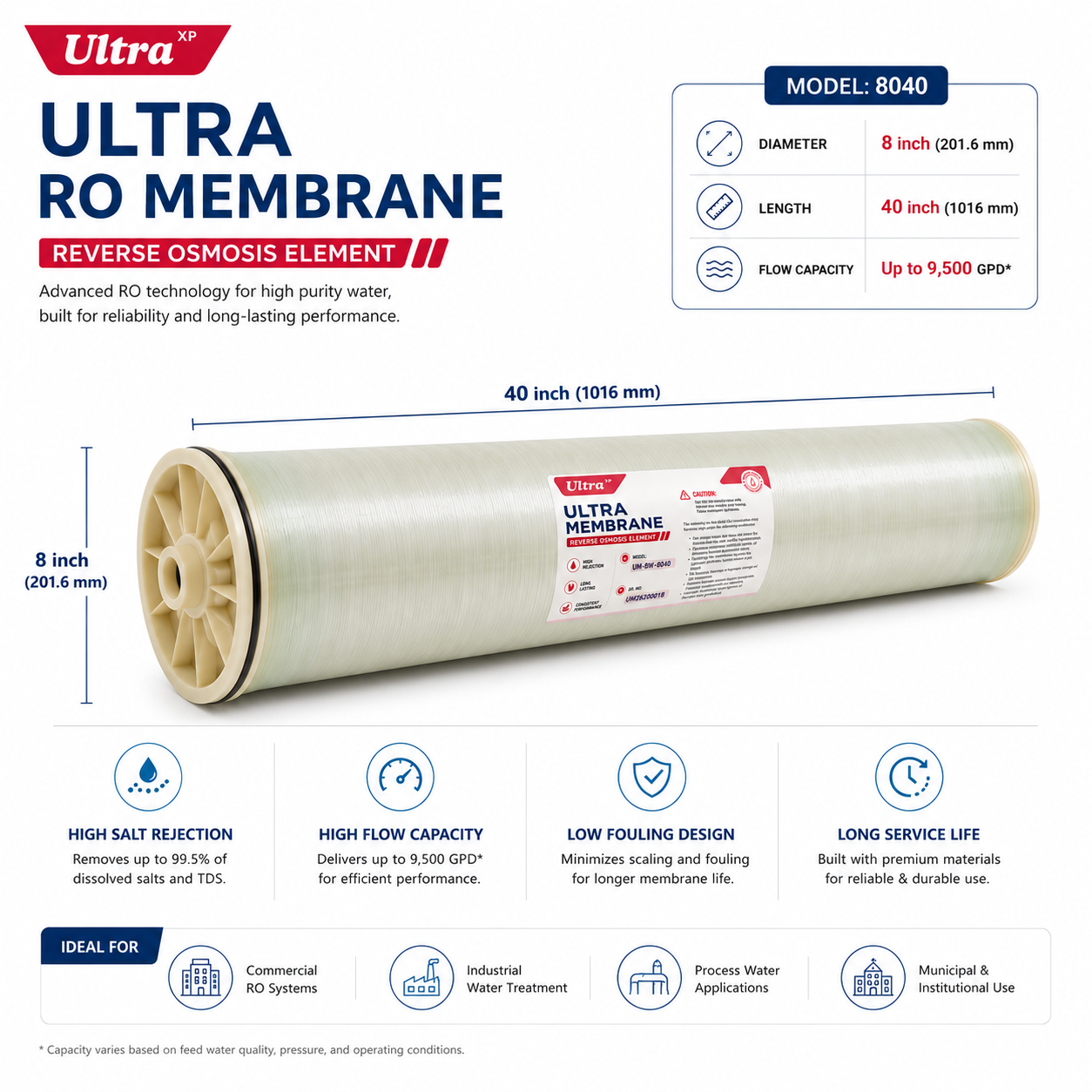
Model |
8040 |
|
Diameter |
8 inch (201.6 mm) |
|
Length |
40 inch (1016 mm) |
|
Flow capacity |
Up to 9,500 GPD (approx. 1,500 LPH) |
|
Salt rejection |
Up to 99.5% |
|
Design |
Low fouling, TFC spiral-wound |
|
Application |
Commercial, Industrial, Process, Municipal |
|
Warranty |
1 Year |
|
Replacement window |
10 days |


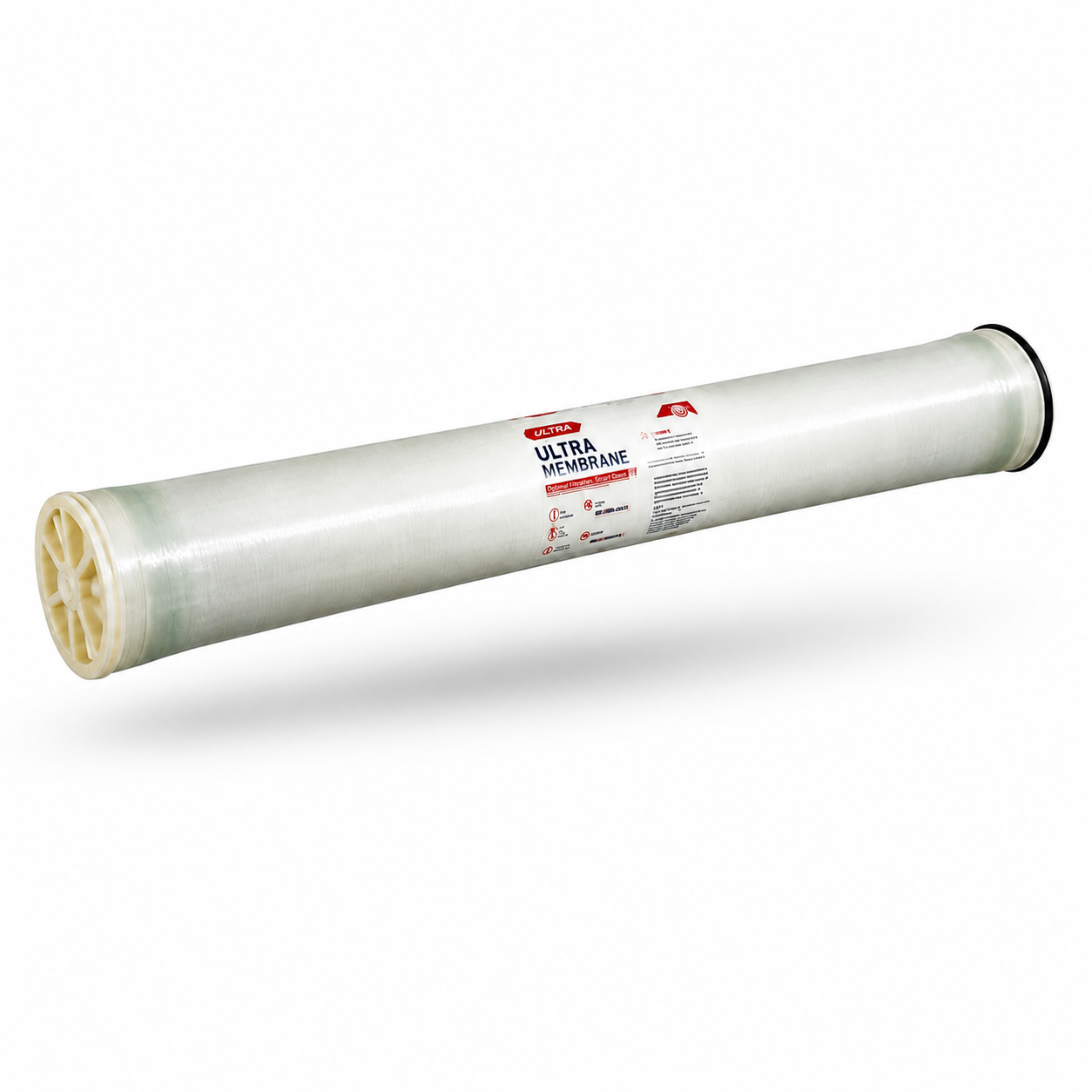
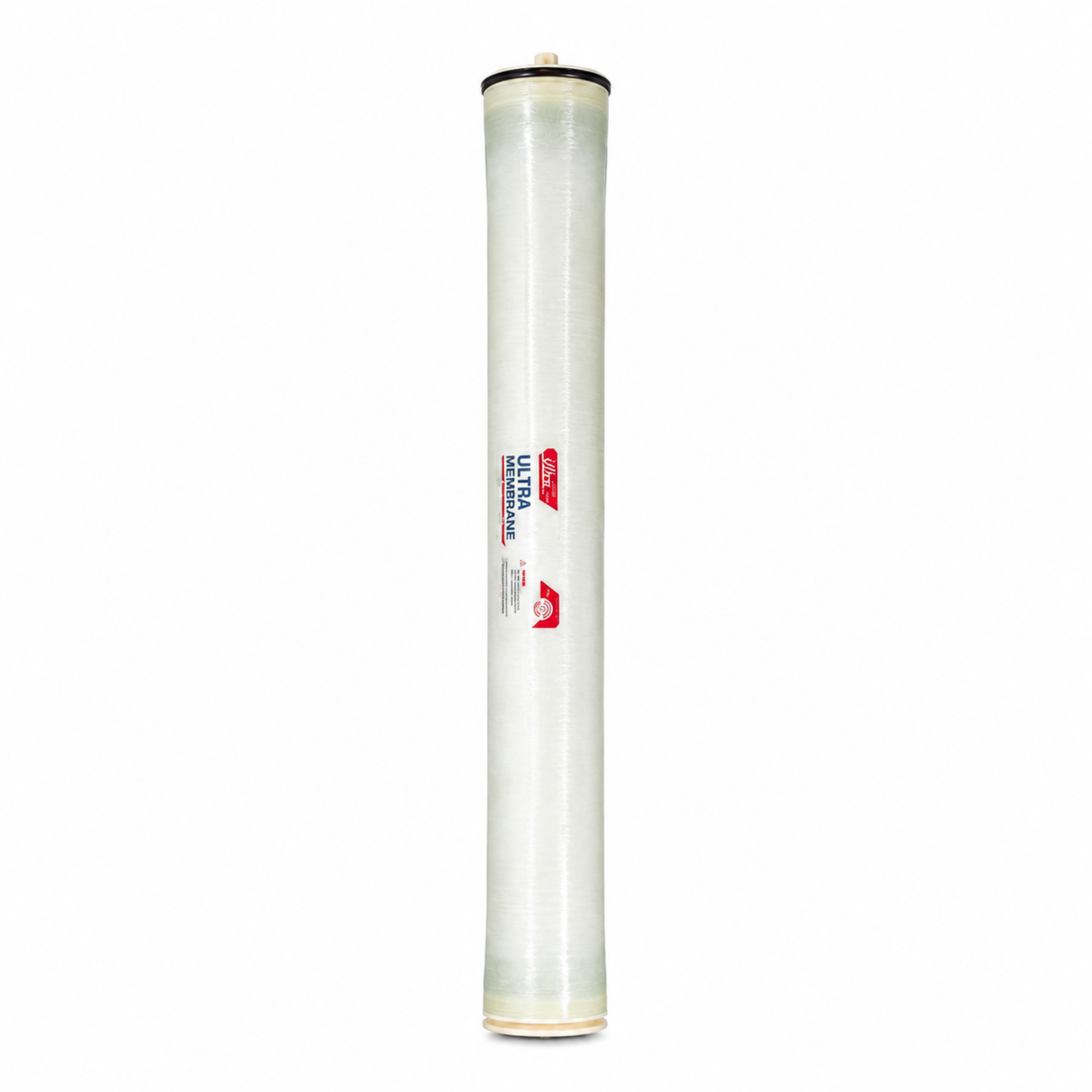
When a commercial or industrial RO system needs to move serious volume — thousands of gallons a day, not the few hundred a domestic purifier handles — the membrane element itself becomes the bottleneck if it isn't sized right. The Ultra XP RO-8040 is a TFC (thin-film composite) spiral-wound reverse osmosis membrane in the industry-standard 8 inch diameter, 40 inch length format, delivering up to 9,500 GPD (roughly 1,500 LPH) of flow capacity while rejecting up to 99.5% of dissolved salts and TDS. It's built with a low-fouling membrane surface designed to resist scaling and organic buildup over long duty cycles, which matters directly for anyone running continuous or near-continuous filtration in a commercial, industrial, process, or municipal water treatment setup. If you're specifying or replacing a membrane for a standard 8040 membrane housing and comparing it against other 8040 RO membrane options on price, flow rate, and salt rejection, this is a straightforward, purpose-built fit backed by Pearl Water's warranty and replacement support.
What Does "8040" Mean in an RO Membrane?
The number "8040" is standard industry shorthand for a membrane element's physical size: an 8 inch diameter and a 40 inch length. It's not a brand or a performance tier — it's a sizing convention used across virtually every commercial and industrial RO membrane manufacturer, including Dow Filmtec, Toray, Hydranautics, CSM, and GE, which is why an 8040 housing can typically accept any properly rated 8040-format membrane. Within that shared sizing, individual models like the Ultra XP RO-8040 differ on flow capacity, salt rejection rate, and fouling resistance — which is what actually determines performance in your system.
What Is the Ultra XP RO-8040 Membrane?
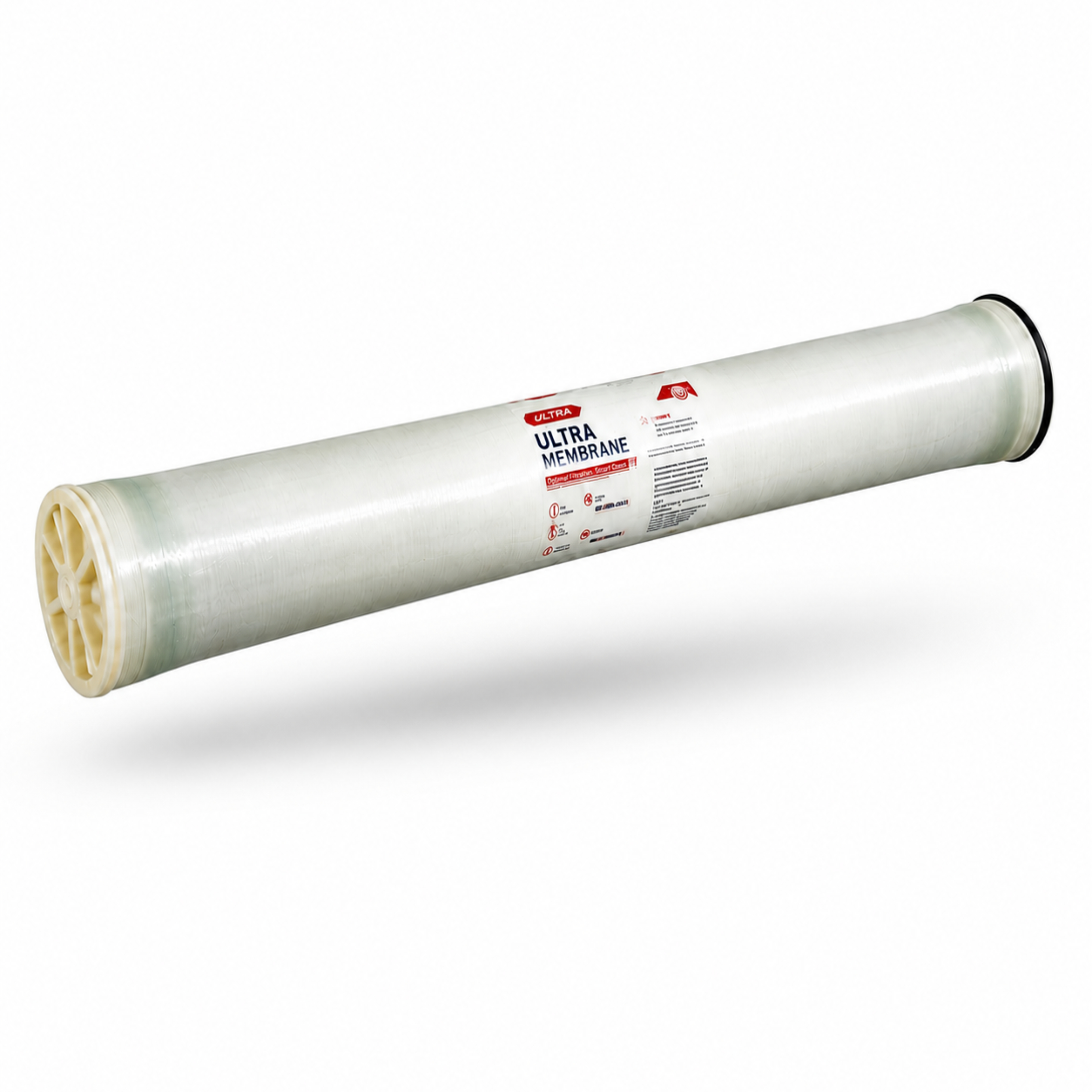
The Ultra XP RO-8040 is a spiral-wound reverse osmosis membrane element sized to the industry-standard 8040 format — 8 inches in diameter, 40 inches in length. This is the standard footprint used across commercial and industrial RO plant systems worldwide, meaning it's designed to drop into existing 8040 membrane housings without requiring custom fittings.
Reverse osmosis works by forcing feed water through a semi-permeable membrane under pressure, allowing water molecules through while rejecting dissolved salts, minerals, and other impurities. The membrane surface itself is the critical component — its material, pore structure, and surface treatment determine how much water it can process per day (flow capacity) and how effectively it blocks dissolved solids (salt rejection). The Ultra XP RO-8040 is built for the higher end of both: up to 9,500 GPD of throughput and up to 99.5% rejection, positioning it for facilities that can't compromise on either volume or purification quality.
Its low-fouling design is a deliberate engineering choice for commercial and industrial use, where feed water often carries more organic load, scaling potential, or variability than a controlled residential supply — this is also why proper pre-treatment with sediment and carbon filtration ahead of the membrane matters so much to its working life. A membrane that fouls quickly in these conditions means more frequent cleaning cycles, more downtime, and a shorter usable life — all of which this membrane is designed to reduce.
How Does It Work?
Pressurized feed water enters the membrane housing and flows across the surface of the spiral-wound membrane element.
Water molecules pass through the semi-permeable membrane under the applied pressure, while dissolved salts, minerals, and larger molecules are rejected.
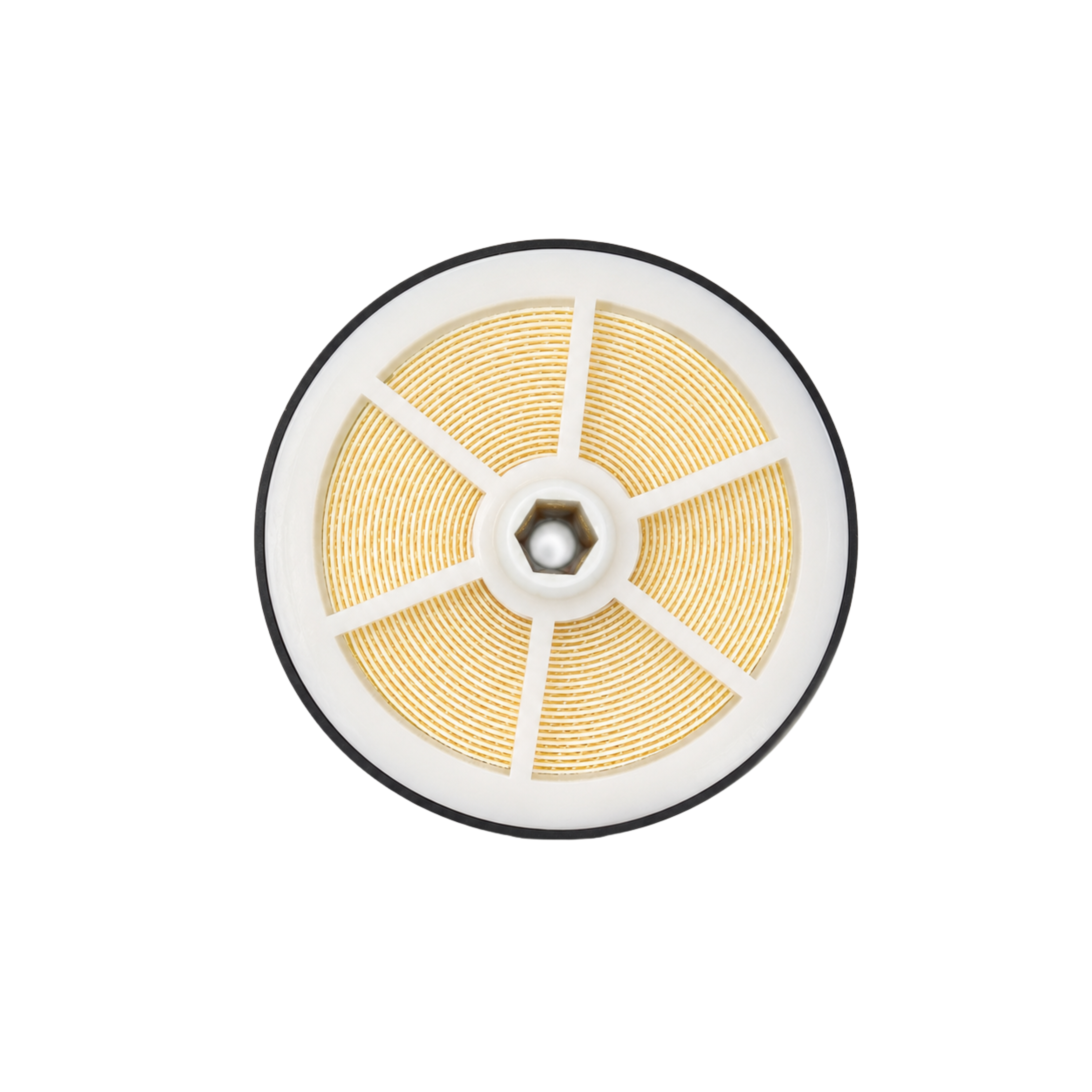
Purified water (permeate) is collected through the membrane's central tube and directed to the system's outlet.
Concentrated reject water (concentrate) carrying the rejected salts and impurities is flushed out separately, preventing buildup on the membrane surface.
The low-fouling surface design helps resist scale and organic deposits forming during this process, maintaining flow and rejection performance over a longer operating period between cleanings.
Because this happens continuously under pressure, feed water quality, pressure consistency, and pre-treatment (such as sediment and carbon filtration ahead of the membrane) all directly affect how well — and how long — the membrane performs.
Ultra XP RO-8040 vs Ultra XP RO-4040
|
Factor |
Ultra XP RO-4040 |
Ultra XP RO-8040 |
|
Diameter |
4 inch |
8 inch |
|
Flow capacity |
Up to 2,500 GPD |
Up to 9,500 GPD (nearly 4x) |
|
Salt rejection |
Comparable high-rejection performance |
Up to 99.5% |
|
Best suited for |
Smaller commercial systems, point-of-use setups |
Large-scale commercial, industrial, and municipal systems |
|
Housing requirement |
Standard 4040 housing |
Standard 8040 housing |
If your system's daily water demand is modest — a smaller office, a single commercial RO unit — the 4040 format may be the better fit. Once demand scales up toward higher-volume commercial or industrial output, the 8040's flow capacity becomes the more practical choice, since it can handle roughly four times the throughput of a single 4040 element.
Related Products
If your system's demand is lower or your housing is sized differently, the Ultra XP RO-4040 offers the same low-fouling design in a smaller 4 inch format, and the Industrial RO Membrane 4040 (up to 1200 TDS) is worth considering for moderate-TDS feed water. Browse the full Ultra RO Membrane range for other capacity options, or explore Dow RO Membranes, Toray RO Membranes, and LG Membranes for alternative brands within the same format. For a complete system setup, check Industrial Membrane Housings sized to match this element, or browse Industrial RO Spares for pre-treatment cartridges, housings, and other replacement parts.
Built for High-Volume Purification
When throughput and rejection quality both matter, the Ultra XP RO-8040 is engineered to deliver both without forcing a compromise. High flow capacity, dependable salt rejection, and a low-fouling design suited to demanding commercial and industrial conditions make it a straightforward choice for anyone specifying or replacing an 8040 membrane element. Order the Ultra XP RO-8040 today and keep your high-volume water treatment system running at the capacity it needs.
|
Model |
8040 |
|
Diameter |
8 inch (201.6 mm) |
|
Length |
40 inch (1016 mm) |
|
Flow capacity |
Up to 9,500 GPD (approx. 1,500 LPH) |
|
Salt rejection |
Up to 99.5% |
|
Design |
Low fouling, TFC spiral-wound |
|
Application |
Commercial, Industrial, Process, Municipal |
|
Warranty |
1 Year |
|
Replacement window |
10 days |
| Customer Rating | |
| Price |
₹28,999
|
| Availability |
100 in stock
|
Why Choose Pearl Water for Your 8040 Membrane?
Sourcing an industrial RO membrane isn't like buying a domestic filter — a wrong spec or a poor-quality element can mean a plant running below capacity or a rejection rate that fails to meet process requirements. Pearl Water has supplied industrial RO plants, spares, and membrane elements to commercial and municipal water treatment operations across India, backing every Ultra XP membrane with a clear, published specification — 9,500 GPD flow, 99.5% salt rejection — rather than vague performance claims that only get tested once the membrane is already installed.
Each element ships with a 1-year warranty and a 10-day replacement window, and Pearl Water's technical support team can help confirm whether the 8040 or a smaller format like the Ultra XP RO-4040 fits your system's actual daily demand before you order. For larger installations, Pearl Water also supplies matched industrial membrane housings and pre-treatment spares, so the membrane isn't sourced in isolation from the rest of the system it needs to work with.
Buying Guide: Choosing the Right Membrane
Match the membrane to your housing size. This element is built for standard 8040 housings (8 inch diameter, 40 inch length) — confirm your system uses this format before ordering.
Consider your daily water demand. If your facility's requirement approaches or exceeds a few thousand gallons per day, the 8040's higher flow capacity avoids running multiple smaller elements at their limit.
Factor in feed water quality. Systems with higher scaling potential or organic load benefit specifically from this membrane's low-fouling design, which is engineered with exactly those conditions in mind.
Check pre-treatment. A membrane performs best — and lasts longest — when properly pre-filtered water reaches it. Sediment and carbon pre-treatment stages ahead of this membrane protect it from particulate and chlorine-related damage.
Plan for replacement cycles. Even a low-fouling membrane has a finite service life; budgeting for periodic replacement, backed by the 1-year warranty here, keeps a commercial or industrial system running predictably.
Installation Guide
Shut down the RO system and relieve pressure in the membrane housing before opening it.
Remove the old membrane element from the housing, noting the orientation of the feed and concentrate ends.
Inspect the housing for scale buildup or damage before installing the new element.
Insert the Ultra XP RO-8040, ensuring correct orientation and that O-rings and seals are properly seated.
Reassemble the housing and reconnect feed, permeate, and concentrate lines securely.
Restore system pressure gradually, checking for leaks at all connection points.
Run an initial flush cycle before bringing the system into normal service, allowing the membrane to stabilize under operating pressure.
Monitor early performance — flow rate and permeate quality — to confirm the membrane is operating within expected parameters.
For commercial and industrial installations, this work is often best handled by a qualified RO service technician, particularly for larger multi-element housing arrays.
Required fields are marked *
Frequently Asked Questions
What is the flow capacity of the Ultra XP RO-8040? Up to 9,500 GPD (gallons per day), depending on feed water quality, applied pressure, and operating conditions. Actual throughput in any given system will vary based on these real-world factors.
What salt rejection rate does this membrane offer? Up to 99.5% removal of dissolved salts and TDS, making it suitable for applications where high purification quality is required alongside high flow volume.
Where can the Ultra XP RO-8040 be used? It's built for large-scale commercial RO systems, industrial water treatment, process water applications, and municipal or institutional use — anywhere higher-volume purification is needed.
What size housing does this membrane fit? Standard 8040 RO membrane housings, meaning 8 inch diameter and 40 inch length. It's a direct-fit replacement for any system already using this standard industrial format.
How does the 8040 differ from the 4040 model? The 8040 has a larger 8-inch diameter compared to the 4040's 4-inch diameter, and nearly four times the flow capacity — up to 9,500 GPD versus up to 2,500 GPD — making it suited for considerably higher-volume applications.
How long does this membrane typically last? Service life depends heavily on feed water quality, pre-treatment, and operating conditions, but the low-fouling design is specifically engineered to extend usable life between cleanings and replacements compared to standard membranes under similar commercial or industrial duty cycles.
Does this membrane require special pre-treatment? Like any RO membrane, performance and longevity improve significantly with proper upstream sediment and carbon pre-filtration, which protects the membrane surface from particulate fouling and chlorine damage.
Is this membrane suitable for municipal water treatment applications? Yes, its flow capacity and rejection rate are positioned for municipal and institutional-scale use, in addition to commercial and industrial applications.
Can this membrane be installed without professional help? For smaller commercial setups, installation can be done by someone comfortable with RO system maintenance, but for larger industrial arrays with multiple membrane elements, professional installation is generally recommended to ensure correct setup and system balancing.
What happens if feed water quality is inconsistent? Inconsistent feed water — variable turbidity, hardness, or organic content — can accelerate fouling even on a low-fouling membrane. Consistent pre-treatment and periodic water quality monitoring help maintain expected performance.
Is there a warranty on this membrane? Yes, it comes with a 1-year warranty along with a 10-day replacement window, covering standard manufacturing and performance assurance.
How do I know if I need a 4040 or 8040 membrane for my system? This comes down to daily water demand and housing size. Smaller commercial systems or lower-volume needs typically use a 4040 element, while facilities requiring several thousand gallons per day or more are better served by the higher-capacity 8040.