Added to wishlist.

Sand Filter for Home Water – Benefits, Working & When to Use

19-Jul-2025

Sand Filter for Home Water – Benefits, Working & When to Use

Table of Contents

  • Introduction
     
  • What Is a Sand Filter?
     
  • How Does a Sand Filter Work?
     
  • Types of Sand Filters: Electrical vs Non-Electrical
     
  • Key Benefits of Using a Sand Filter
     
  • Common Applications in Homes
     
  • Maintenance Tips
     
  • Is a Sand Filter Right for You?
     
  • Conclusion
     
  • FAQs


 Introduction

Clean water is essential for every household, but with increasing sediment, dust, and turbidity in our water supply, having an effective filtration system has become a necessity. One of the most reliable and affordable solutions for removing suspended particles is the sand filter.

In this blog, we’ll explore what a sand filter is, how it works, its advantages, the different types available (electric and non-electric), and why it might be the right choice for your home.


 What Is a Sand Filter?

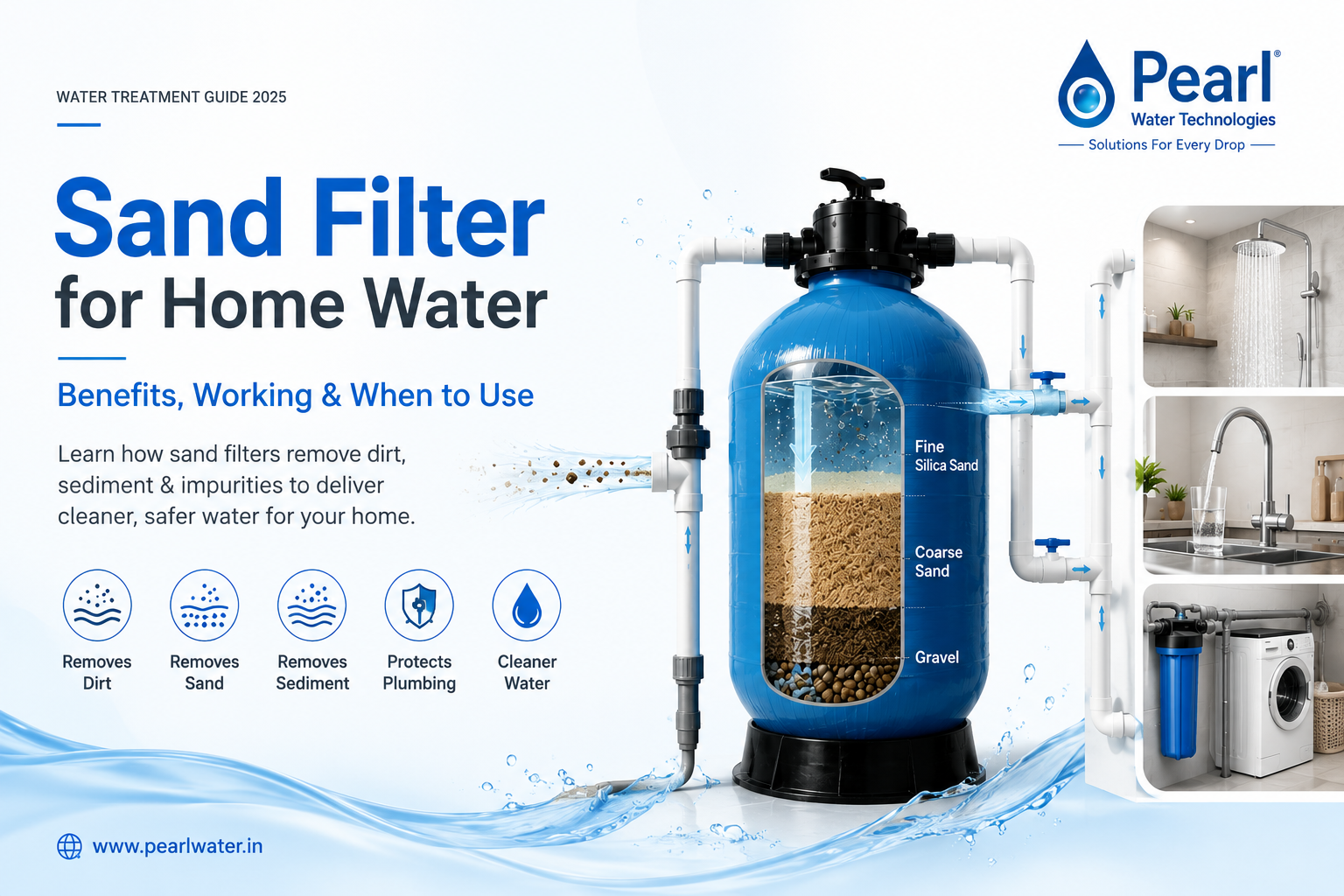
A sand filter is a water purification device that uses layers of sand—usually a combination of fine sand, silex, and gravel—to remove dirt, debris, and suspended solids from water. It’s a physical filtration method commonly used in residential, industrial, and municipal applications.

Sand filters come in two main types:

  • Non-Electrical Sand Filters – Operate on inlet pressure or gravity, ideal for areas with good water pressure.
     
  • Electrical Sand Filters – Equipped with a motor or booster pump, suitable for homes with low pressure or borewell water.
     

They are often used as whole-house filtration units or as pre-treatment before RO/UV systems.


 How Does a Sand Filter Work?

The filtration process begins when raw water enters the top of the sand filter tank. It passes through multiple layers of sand media arranged from fine to coarse:

  • Fine sand layer – Traps smaller particles like clay, silt, and organic matter.
     
  • Silex sand – Catches medium-sized particles.
     
  • Gravel layer – Provides support and facilitates even water flow.
     

Once the water passes through these layers, the result is clear, sediment-free water, ready for household use such as cleaning, bathing, or further filtration.


 Types of Sand Filters: Electrical vs Non-Electrical

Feature

Non-Electrical Sand Filter

Electrical Sand Filter

Power Requirement

No electricity needed

Requires electricity for motor or pump

Operation

Based on gravity or inlet pressure

Uses a pump to generate pressure

Best Suited For

Homes with good water pressure

Homes with low pressure or borewell systems

Maintenance

Minimal

Slightly more due to motor parts

Cost

Budget-friendly

Higher initial cost


 Key Benefits of Using a Sand Filter

Here’s why more households are switching to sand filters:

  •  Non-Electric or Electric Options
    Available in both variants for different water pressure conditions.
     
  •  Whole-House Compatibility
    Ideal for villas, apartments, and homes needing central filtration.
     
  •  Low Maintenance
    Requires only periodic backwashing and sand replacement every few years.
     
  •  Cost-Effective
    Budget-friendly solution compared to advanced filtration systems.
     
  •  Eco-Friendly
    No chemicals or disposable filter cartridges involved—just natural sand media.


 Common Applications in Homes

Sand filters are commonly used in:

  • Homes using borewell or well water
     
  • Areas with visible turbidity or muddy water
     
  • As pre-treatment before UV or RO water purifiers
     
  • Independent villas or bungalows
     
  • Apartments with centralized water supply systems


 Maintenance Tips

To ensure your sand filter runs efficiently:

  •  Backwash every 2–4 weeks (depending on water quality)
     
  •  Replace sand media every 3–5 years
     
  •  Install the filter near the main water inlet
     
  •  Monitor flow rate and pressure drop for signs of clogging
     

Pearl Water Technologies provides complete support for installation and maintenance.


 Is a Sand Filter Right for You?

If your water appears muddy, cloudy, or has floating particles, a sand filter can be your first line of defense.

Choose based on your water supply:

  •  Good pressure from municipal supply? → Go for non-electric sand filter
     
  •  Using overhead tank or borewell with low pressure? → Opt for an electric model with a pump
     

Important Note: Sand filters remove physical impurities only. They do not remove dissolved salts, bacteria, or heavy metals. For safe drinking water, combine it with RO or UV systems.


 Conclusion

A sand filter is a smart, affordable, and eco-friendly solution for homes dealing with sediment, dust, and turbidity. With options in both non-electric and electric models, they offer flexibility based on your water pressure and needs.

At Pearl Water Technologies, we offer premium-quality sand filters designed for Indian water conditions. Our filters are easy to install, durable, and require minimal maintenance.

 Visit: https://pearlwater.in


 FAQs

Q1. Does a sand filter make water safe to drink?
No. Sand filters remove physical impurities only. Use them as pre-treatment before RO or UV systems.

Q2. How long does the sand media last?
Usually 3 to 5 years depending on water quality and usage.

Q3. Do sand filters work with borewell water?
Yes, especially when water has high turbidity or suspended particles.

Q4. Is electricity required for a sand filter?
Not always. Non-electric models work with inlet pressure, while electric models need power for the pump.

Q5. Can I install it myself?
Basic units may be DIY-friendly, but professional installation is recommended for best performance.

Q6. What’s the difference between electric and non-electric sand filters?
Electric models use a pump to push water through the filter, ideal for low-pressure areas. Non-electric models rely on gravity or inlet pressure.

Share:

Leave A Comment

Thank You for subscribing our newsletter.