


16-Jun-2026
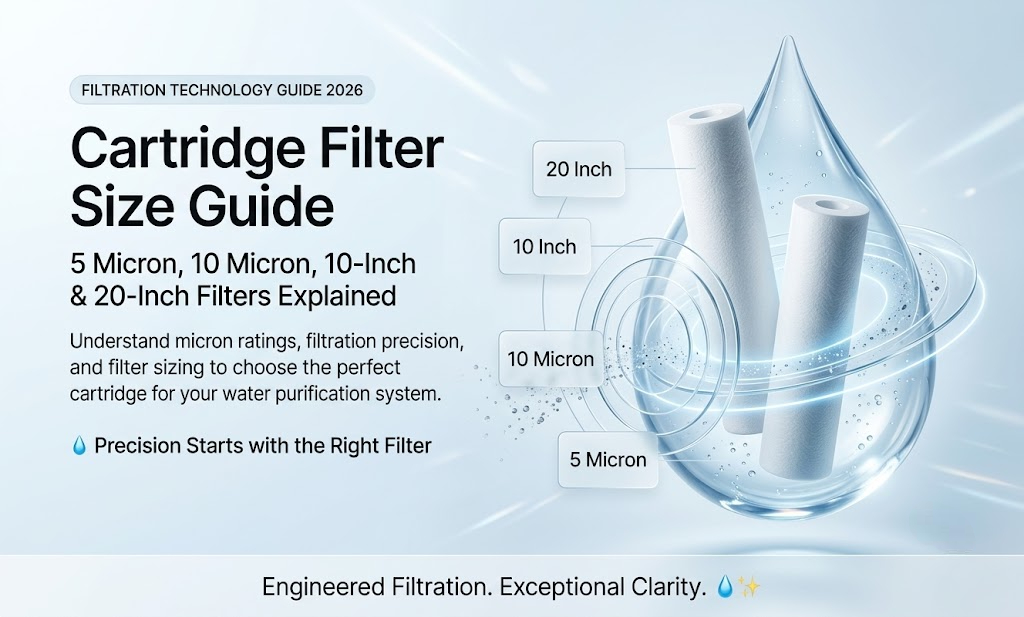
Cartridge Filter Size Guide: 5 Micron, 10 Micron, 10-Inch & 20-Inch Filters Explained (2026)
By Pearl Water Technologies | Updated June 2026 | Water Treatment Expert Guide
If you own an RO water purifier, you already depend on a cartridge filter every single day. These small cylindrical filters are the first line of defence for your RO membrane. They trap dust, dirt, rust, sand, and microscopic particles before the water ever reaches the sensitive membrane inside your purifier.
Choosing the right cartridge filter micron size is one of the most important decisions you can make for your water purifier. Get it wrong and you risk clogged membranes, poor water quality, and costly repairs. Get it right and your purifier runs efficiently for years.
In this complete guide, Pearl Water Technologies — a leading supplier of RO spare parts and filtration solutions across India — explains everything you need to know about 5 micron filters, 10 micron filters, 10-inch and 20-inch cartridge sizes, pre-filter cartridges, prices in India, and how to choose the best option for your water source.
Quick SummaryA cartridge filter removes sediment and particles from water before it enters the RO membrane. The micron rating tells you the smallest particle size it traps. A 5 micron filter catches finer particles; a 10 micron filter allows slightly larger particles but offers faster water flow. Most home RO systems use a 5 micron pre-filter cartridge as the first stage. |
What is a Cartridge Filter?
A cartridge filter is a cylindrical filtration element placed inside a filter housing. Water flows through the outer surface of the cartridge and exits through the hollow centre, leaving suspended particles trapped in the filter material.
In an RO water purifier, cartridge filters are installed as pre-filters — they protect the RO membrane by removing sediment before it can clog or damage the membrane. Without them, the membrane would fail within weeks.
The most common materials are polypropylene (PP) spun fibre and activated carbon block. PP cartridges remove physical sediment; carbon cartridges additionally remove chlorine, odour, and organic compounds.
Understanding Cartridge Filter Micron Size
A micron (also called a micrometre) is one-millionth of a metre. The micron rating of a cartridge filter tells you the size of the smallest particle it can reliably trap. The lower the micron number, the finer the filtration.
For reference: a human hair is about 70 microns wide. Bacteria range from 1 to 10 microns. Dust particles typically fall between 1 and 100 microns.
Most domestic RO purifiers use a 5 micron filter as the first or second stage pre-filter, followed by an activated carbon cartridge to remove chlorine and odour.
5 Micron Filter Explained
DefinitionA 5 micron filter traps any particle larger than 5 microns in diameter, including fine sand, silt, rust flakes, sediment, and some larger bacteria. |
The 5 micron cartridge filter is the most widely used pre-filter cartridge for domestic RO systems across India. It strikes the ideal balance between fine filtration and adequate water flow for household use.
Benefits of a 5 Micron Filter
Best Use Cases
10 Micron Filter Explained
DefinitionA 10 micron filter traps particles larger than 10 microns. It filters out sand, coarse silt, and rust but allows finer particles to pass through compared to a 5 micron cartridge. |
The 10 micron cartridge filter is the preferred choice when water is relatively clean and the priority is maintaining a high flow rate. It is less restrictive than a 5 micron filter, so water passes through faster, which matters for high-volume applications.
Benefits of a 10 Micron Filter
Best Use Cases
5 Micron Filter vs 10 Micron Filter: Complete Comparison
Expert RecommendationFor most Indian homes — especially those on borewell water or areas with rust and silt — a 5 micron PP spun filter cartridge is the correct choice as the primary pre-filter. For very clean municipal water, a 10 micron filter can be used as a first stage with a 5 micron stage following it. |
Cartridge Filter Sizes Explained
Cartridge filters come in standard sizes designed to fit universal filter housings. The two most common sizes in India are the 10-inch and 20-inch cartridges.
10 Inch Cartridge Filter
The 10-inch cartridge filter is the most common size used in domestic RO water purifiers across India. It fits the standard slim-line filter housing found in most wall-mounted RO units. The actual length is approximately 9.75 inches (24.8 cm) to allow easy insertion and removal.
20 Inch Filter Cartridge
The 20-inch filter cartridge is used in commercial RO systems, industrial water treatment plants, and high-flow domestic setups. It offers twice the filtration surface area of a 10-inch cartridge, which means longer service life and higher flow capacity. It fits the standard big-blue housing used in most commercial pre-filtration systems.
Standard Dimensions
Size |
Outer Diameter (OD) |
Length |
Fitting |
Typical Use |
10 Inch (Slim) |
~2.5 inch (63.5 mm) |
9.75 inch (~24.8 cm) |
Standard slim housing |
Domestic RO purifiers |
10 Inch (Big Blue) |
~4.5 inch (114 mm) |
9.75 inch (~24.8 cm) |
Big blue housing |
Commercial / semi-commercial |
20 Inch (Slim) |
~2.5 inch (63.5 mm) |
19.75 inch (~50 cm) |
Standard slim housing |
High-flow domestic |
20 Inch (Big Blue) |
~4.5 inch (114 mm) |
19.75 inch (~50 cm) |
Big blue housing |
Commercial / industrial RO |
Pre Filter Cartridge for RO Water Purifiers
A pre-filter cartridge is any filter placed before the RO membrane in the water flow path. Its sole job is to protect the RO membrane from physical damage and chemical fouling.
Why Pre-Filtration Matters
The RO membrane is the most expensive component of any water purifier. It operates by forcing water through microscopic pores — pores so small that even dissolved salts are blocked. These pores are extremely vulnerable to physical particles, chlorine, and biological fouling.
Standard Pre-Filtration Setup in Indian RO Systems
Micron Cartridge Filter Price in India (2026)
Filter Type |
Size |
Micron |
Price Range (INR) |
PP Spun Sediment Filter |
10 inch |
5 micron |
Rs. 40 – Rs. 100 |
PP Spun Sediment Filter |
10 inch |
10 micron |
Rs. 35 – Rs. 90 |
PP Spun Sediment Filter |
20 inch |
5 micron |
Rs. 80 – Rs. 180 |
PP Spun Sediment Filter |
20 inch |
10 micron |
Rs. 70 – Rs. 150 |
Carbon Block Filter |
10 inch |
5 micron |
Rs. 100 – Rs. 250 |
Carbon Block Filter |
20 inch |
5 micron |
Rs. 200 – Rs. 400 |
Big Blue PP Spun |
10 inch |
5/10 micron |
Rs. 150 – Rs. 300 |
Big Blue PP Spun |
20 inch |
5/10 micron |
Rs. 250 – Rs. 500 |
Disclaimer: Prices listed above are approximate market estimates for 2026 and may vary based on brand, material quality, micron rating, quantity purchased, and supplier. Contact Pearl Water Technologies for current pricing and bulk discounts.
How to Choose the Right Cartridge Filter
Use this decision guide based on your water source and quality:
Your Water Source / Condition |
Recommended Filter |
Muddy or visibly turbid water (heavy silt) |
20 micron PP Spun (Stage 1) + 5 micron PP Spun (Stage 2) |
Borewell water with rust and sand |
5 micron PP Spun pre-filter — replace every 3 months |
Municipal corporation water supply |
10 micron PP Spun + 5 micron Carbon Block |
Hard water with high TDS |
5 micron PP Spun + Carbon Block + Antiscalant dosing |
Commercial RO system (>100 LPH) |
20-inch Big Blue 10 micron (Stage 1) + 5 micron (Stage 2) |
Water with chlorine smell |
5 micron Carbon Block as pre-filter before RO membrane |
Well water with biological contamination |
1 micron filter + UV post-treatment |
How Often Should You Replace a Cartridge Filter?
Cartridge filter lifespan depends on your water quality and usage volume. As a general rule:
Signs Your Cartridge Filter Needs Replacement
Maintenance Tips
Frequently Asked Questions (FAQs)
Q1. What is a 5 micron filter?
A 5 micron filter is a cartridge filter that traps all particles larger than 5 microns in diameter, including fine sand, silt, rust, and sediment. It is the most commonly used pre-filter in domestic RO water purifiers in India.
Q2. Is 5 micron better than 10 micron for RO purifiers?
Yes, for most Indian homes a 5 micron filter provides better membrane protection by catching finer particles. A 10 micron filter is suitable for cleaner water sources or as a first-stage pre-filter before the 5 micron stage.
Q3. What size cartridge filter do I need for my RO purifier?
Most domestic wall-mounted RO purifiers use the standard 10-inch (slim) cartridge. Check your existing cartridge or filter housing dimensions before purchasing. Commercial systems typically use 20-inch cartridges.
Q4. How long does a cartridge filter last?
A PP spun sediment cartridge lasts 3 to 6 months under normal use. Carbon block cartridges last 6 to 12 months. If your water has high sediment, replace more frequently — every 2 to 3 months.
Q5. What is the price of a 10-inch cartridge filter in India?
A 10-inch PP spun sediment filter cartridge costs approximately Rs. 35 to Rs. 100 in India, depending on brand and micron rating. Carbon block variants range from Rs. 100 to Rs. 250.
Q6. What is the difference between a sediment filter and a carbon filter cartridge?
A sediment filter (PP spun) removes physical particles like sand, rust, and silt. A carbon filter removes chemical contaminants including chlorine, taste, odour, and volatile organic compounds (VOCs). Both are used as pre-filters in RO systems.
Expert Recommendation from Pearl Water Technologies
Based on over a decade of supplying RO spare parts and filtration solutions across India, here is our expert guidance:
Water Source |
Recommended Pre-Filter Setup |
Replacement Interval |
Municipal Corp. Water |
10 micron PP Spun + 5 micron Carbon Block |
Every 5–6 months |
Borewell / Tanker Water |
5 micron PP Spun (Stage 1 & 2) |
Every 2–3 months |
Overhead Tank / Stored Water |
5 micron PP Spun + Carbon Block |
Every 3–4 months |
Hard / High TDS Water |
5 micron PP Spun + Carbon Block + Antiscalant |
Every 3 months |
Commercial (>100 LPH) |
20-inch Big Blue 10 micron + 5 micron |
Every 4–6 months |
Industrial (>500 LPH) |
Multi-stage 20-inch Big Blue banks |
Every 3 months or by pressure gauge |
Always buy cartridge filters from a reliable supplier to ensure consistent micron rating accuracy, correct dimensions, and food-grade polypropylene material. Sub-standard filters may be labelled 5 micron but provide only 20–30 micron actual filtration — rendering your entire pre-filtration stage ineffective.
Conclusion
Choosing the right cartridge filter is not complicated once you understand what micron ratings mean and what your water quality demands. A 5 micron filter is the go-to choice for most Indian homes, offering reliable fine sediment removal and excellent RO membrane protection. A 10 micron filter works well for cleaner water sources or as a first-stage coarse pre-filter. For system sizing, the 10-inch cartridge handles domestic needs while the 20-inch cartridge serves commercial applications.
Key points to remember:
Leave A Comment