


20-Jun-2026
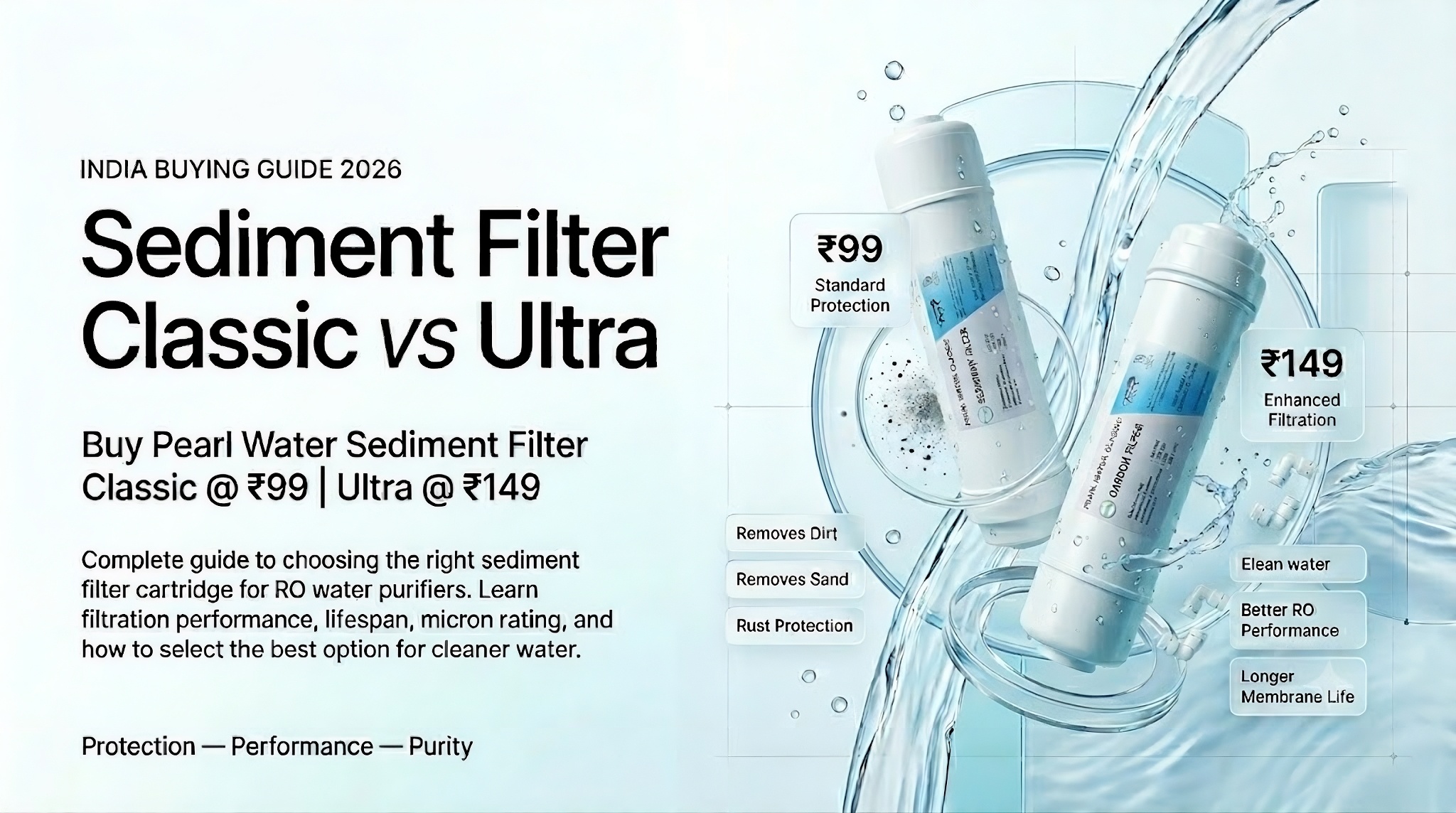
Sediment Filter: Complete Guide for Water Purification Systems
What is a sediment filter? A sediment filter is a mechanical pre-filtration device that removes suspended particles like sand, silt, rust, and dust from water before it reaches downstream components such as the carbon filter or RO membrane. It is the first line of defense in any water purification system.
Introduction
If your RO purifier loses pressure, clogs frequently, or needs repeated servicing, the sediment filter may be the hidden reason. This guide explains how sediment filters work, when to replace them, and how to choose the right micron rating.
Whether you run a domestic RO purifier in your kitchen or manage an industrial water treatment plant, a sediment filter is the unsung component that keeps every other stage of purification working efficiently. Without it, even a high-end RO membrane or UV chamber can fail prematurely.
What is a Sediment Filter?
A sediment filter is a physical filtration cartridge designed to trap suspended solids before water moves to finer purification stages. It works purely through mechanical straining — there are no chemical or biological processes involved.
Most sediment filters are made from spun or melt-blown polypropylene, wound into a cylindrical cartridge with a graded pore structure. Water passes through layers of fiber that progressively trap particles such as:
Micron ratings define filtration precision. A 1-micron filter captures finer particles than a 50-micron filter, but at the cost of flow rate. Most domestic RO systems use a 5 to 10 micron sediment filter, balancing particle removal with adequate water flow.
How Does a Sediment Filter Work?
The filtration process follows a simple, four-step mechanical sequence:
This depth-filtration design means the cartridge has a measurable dirt-holding capacity. Once that capacity is reached, flow rate drops and replacement is needed.
Benefits of Using a Sediment Filter
Domestic vs Industrial Sediment Filter
Feature |
Domestic Sediment Filter |
Industrial Sediment Filter |
Capacity |
Low to moderate (suited for household consumption) |
High capacity for continuous, large-volume use |
Flow Rate |
Typically 1–2 LPM for point-of-use systems |
50+ LPM, scalable with multi-cartridge housings |
Micron Rating |
5–10 microns (general use) |
1–50 microns, application-specific |
Applications |
Kitchen RO purifiers, borewell-fed homes |
Manufacturing plants, commercial RO, cooling towers |
Size |
Compact, single cartridge (typically 10 inch) |
Larger housings, multi-cartridge banks (20–40 inch) |
Maintenance |
Replaced every 3–6 months |
Monitored via pressure differential, replaced as needed |
Cost |
Lower upfront and replacement cost |
Higher cost due to volume and housing infrastructure |
Technical Specifications of Pearl Water Sediment Filter
Specification |
Details |
Material |
High-quality polypropylene (PP) spun media |
Micron Rating |
5 micron (standard); other ratings available |
Filtration Efficiency |
High dirt-holding capacity with consistent particle capture |
Flow Rate |
Optimized for standard domestic RO inlet pressure |
Operating Pressure |
Designed for typical municipal and borewell supply pressure |
Temperature Range |
Suitable for standard cold-water domestic and commercial use |
Compatibility |
Fits standard 10-inch housing used across major RO brands |
Lifespan |
Recommended replacement every 3–6 months depending on water quality |
Pearl Water uses high-quality polypropylene sediment cartridges designed for maximum dirt-holding capacity and superior filtration performance, ensuring consistent protection for every stage of your RO system.
Why Choose Pearl Water Technologies Sediment Filters?
Quality Advantages-
Customer Benefits-
Compatible:
Pearl Water Technologies sediment filters are designed to fit standard housing dimensions, making them compatible with major RO brands and models. Since some brands use a mix of standard and brand-specific cartridge formats, use the guide below to confirm fit before ordering.
Brand |
Common Cartridge Format |
Typically Compatible Models / Series |
Kent |
10-inch standard housing |
Grand Plus, Grand Star, Supreme, Prime, Prime Plus, Ace Plus, Pearl, Elegant |
Livpure |
10-inch standard housing; some models use 9-inch threaded candle cartridges |
Glo, Glo Pro, Pep Pro, Zinger, and other models using a standard pre-filter housing |
Aquaguard (Eureka Forbes) |
Mostly 9-inch threaded candle-type cartridges in a dedicated pre-filter housing; some newer models (Reviva, Enhance, Compact) use sealed, brand-specific cartridges |
Classic, Marvel, and other models using a separate candle-type pre-filter housing |
Pureit (HUL) |
Predominantly sealed, brand-specific cartridge units rather than standard 10-inch housings |
Models with a dedicated Pureit pre-filter mount; verify cartridge type before purchase |
V-Guard |
10-inch standard housing on most RO models |
Zenora, Zenith, and other models using a standard pre-filter housing |
AO Smith |
10-inch standard housing on most RO models |
Z series, X series, and other models using a standard pre-filter housing |
Important: Cartridge length (9-inch candle, 9.5–10-inch, 11-inch, or 12-inch) and housing type vary even within a single brand's model lineup. Always check your existing cartridge's length and thread type — or your purifier's model number — against the product listing before ordering a replacement.
When Should You Replace a Sediment Filter?
Recommended replacement interval: Every 3 to 6 months for domestic use, though this varies based on input water quality. Borewell water or visibly turbid municipal supply may require more frequent replacement.
Warning signs that replacement is overdue:
Expert recommendation: Don't wait for a visible problem. Set a calendar reminder for sediment filter replacement, since particulate fouling damage to the RO membrane is often irreversible and far more expensive to fix than a routine cartridge swap.
Common Questions About Sediment Filters
1. Can a sediment filter remove bacteria? No. Sediment filters remove physical particles like sand and silt, not microorganisms. Bacteria removal requires UV treatment, UF membranes, or RO membranes with appropriately small pore sizes.
2. What micron size is best? For most domestic RO systems, a 5 to 10 micron rating offers the best balance between filtration precision and flow rate. Industrial applications may require finer or coarser ratings depending on water source.
3. How long does a sediment filter last? Typically 3 to 6 months, depending on input water quality. Heavily turbid or borewell water shortens this lifespan considerably.
4. Can it improve water taste? Indirectly, yes. By removing particulate matter and protecting the carbon filter, a sediment filter helps maintain the carbon stage's ability to address taste and odor effectively.
5. Does every RO need a sediment filter? Yes. Virtually all RO systems include a sediment filter as the first pre-treatment stage, since RO membranes are highly vulnerable to physical fouling without it.
Frequently Asked Questions
Q1: How often should I replace my sediment filter? A: Every 3 to 6 months, depending on water source quality. Borewell or visibly turbid water may need replacement every 2 to 3 months.
Q2: Can I clean and reuse a sediment filter cartridge? A: Spun polypropylene cartridges are generally designed for single use; cleaning rarely restores full filtration efficiency and risks bacterial growth.
Q3: What happens if I don't replace a clogged sediment filter? A: Reduced water flow, increased strain on the RO pump, and accelerated fouling of the carbon filter and RO membrane.
Q4: Is a sediment filter necessary for municipal water supply? A: Yes. Even treated municipal water can carry pipeline rust and sediment, especially after maintenance work or low-pressure periods.
Q5: Are sediment filters different for borewell water applications? A: Borewell water often carries higher silt and sand content, so a robust, higher dirt-holding capacity cartridge with possibly a coarser pre-stage is recommended.
Q6: Can a sediment filter handle hard water? A: A sediment filter removes particulate matter but does not soften water or remove dissolved minerals; hard water treatment requires a separate softening or RO stage.
Q9: Does a sediment filter reduce RO membrane replacement frequency? A: Yes. By preventing particulate fouling, it significantly extends the operational life of the RO membrane.
Q10: Can a sediment filter be used in commercial filtration setups? A: Yes, with larger housing and higher-capacity cartridges designed for continuous, high-volume industrial filtration applications.
Conclusion
A sediment filter may be the simplest component in your water purification system, but its role is foundational. By trapping sand, silt, rust, and dust before they reach your RO membrane, carbon filter, or UV chamber, it directly extends component life, reduces maintenance costs, and ensures consistent water quality — whether for a household kitchen RO unit or a large-scale industrial filtration plant.
Pearl Water Technologies sediment filters combine premium polypropylene construction with high dirt-holding capacity and broad compatibility across leading RO brands, making them a dependable choice for both domestic and industrial water treatment needs.
Ready to protect your RO system? Explore Pearl Water Technologies' range of sediment filters and replacement parts designed for reliable, long-lasting water purification performance.
Protect your RO system from the inside out.
Choose Pearl Water Technologies sediment filters — engineered with premium polypropylene media, high dirt-holding capacity, and broad compatibility with leading RO brands.
Browse the full range of Pearl Water Technologies sediment filters and spare parts today to keep your water purifier running efficiently for years to come.
Visit Now - https://pearlwater.in/domestic-sediment-filter
Leave A Comment