


12-Sep-2026
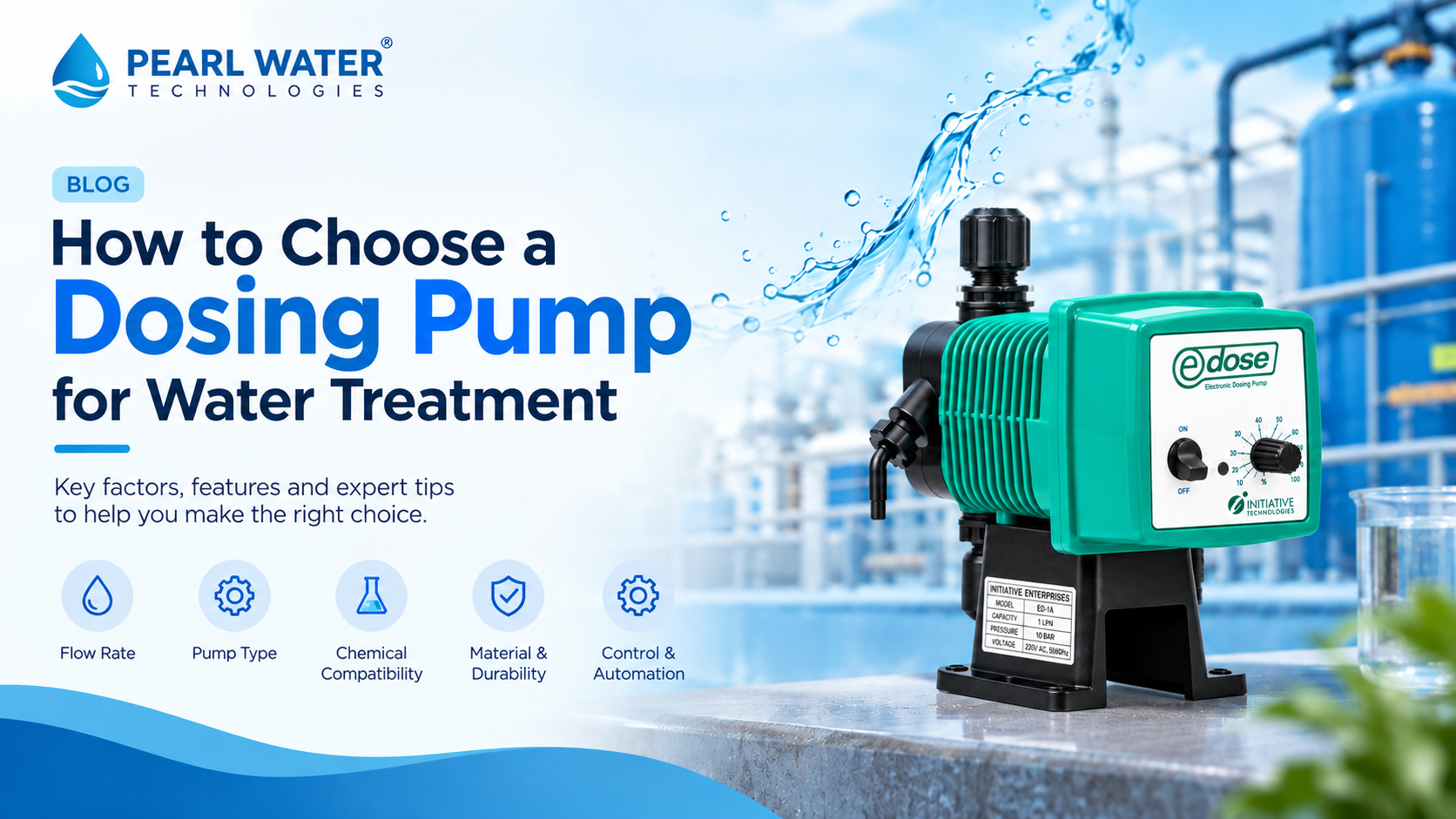
Already know what you need and just want the pump? Check out the E-Dose Chemical Dosing Pump — PTFE diaphragm, adjustable up to 400 SPM, priced at ?5,079.
If you've ever stood in front of a water treatment skid trying to figure out why your RO membrane is scaling faster than it should, there's a decent chance the answer isn't the membrane at all — it's the dosing pump feeding it antiscalant. Get the dosing wrong, even slightly, and every other part of the system pays for it eventually.
Picking a chemical dosing pump looks simple on paper. It's a small, unglamorous piece of equipment compared to an RO plant or a membrane housing, so people often buy it last and think about it least. That's usually a mistake. This guide walks through what a dosing pump actually does, the questions worth asking before you buy one, and where people commonly go wrong.
A chemical dosing pump (also called a metering pump) is a small positive-displacement pump that injects a liquid — usually a chemical — into a system at a controlled rate. Instead of someone manually pouring antiscalant or hypochlorite into a tank (which is imprecise and, with some chemicals, genuinely dangerous), the pump does it automatically, in fixed, repeatable amounts.
Most dosing pumps used in water treatment today are solenoid-driven diaphragm pumps. An electronic circuit pulses a solenoid, which drives a diaphragm back and forth. Each stroke draws in a small, fixed volume of chemical and pushes it out on the next stroke. Adjust the stroke rate, and you adjust the dose. It's a straightforward mechanism, which is part of why these pumps are so reliable when sized and specified correctly.
You'll find dosing pumps doing this job across RO plants, ETP and STP systems, UF plants, cooling towers, and even outside water treatment entirely — dairy processing, bottling lines, and agricultural fertigation all use the same basic technology.
It's tempting to treat a dosing pump as a commodity item — pick whichever one's in stock, plug it in, move on. But under-dosing and over-dosing both cause real problems, just on different timelines.
Under-dose your antiscalant, and your RO membrane starts scaling. You won't notice it the first week. You'll notice it three months later when your permeate flow has dropped and your feed pressure has crept up, and by then you're looking at membrane cleaning or replacement instead of a pump adjustment.
Over-dose chlorine or hypochlorite, and you're wasting chemical every single day — a cost that adds up fast across a year of continuous operation — and in some cases pushing residual chlorine levels higher than they should be downstream.
A pump that's correctly matched to your chemical, your flow rate, and your system pressure removes this guesswork entirely. That's really the whole value proposition.
This is the first filter, and it's non-negotiable. Every dosing pump has "wetted parts" — the diaphragm, pump head, valves, and seals that actually touch the chemical — and these need to be compatible with what you're dosing.
If you're not sure whether a pump's wetted parts suit your chemical, it's worth checking the spec sheet or asking the supplier directly before ordering — this is the one area where guessing is expensive.
Your dosing rate needs to match your system's flow rate and the chemical concentration you're working with, not just be "big enough." A pump rated for 6 LPH at a given pressure is suited to small-to-mid-size RO plants and general water treatment dosing — larger industrial systems often need multiple pumps or a higher-capacity unit instead of pushing one pump past its comfortable range.
It also helps to look at the turndown ratio — how well the pump performs at lower output, not just at maximum. A pump with poor turndown might dose accurately at 100% output but drift at 20%, which matters if your system's demand varies through the day.
Check the pressure the pump needs to inject against — this is usually tied to where in your system the chemical enters. Dosing into a high-pressure RO feed line needs a pump rated for that pressure; dosing into an open tank at atmospheric pressure doesn't. Mismatching this is a common reason pumps "don't dose properly" even though nothing is actually broken — they're just fighting pressure they weren't built for.
You want a pump where you can actually fine-tune the stroke rate — ideally with a simple manual knob rather than something that requires recalibration or a technician visit every time your dosing needs shift. Systems rarely run at one constant demand forever; feed water quality changes, flow rates change, and your dosing pump needs to keep up without a fuss.
A few features are worth prioritizing even if they add a small amount to the upfront cost:
Most dosing pumps run continuously, so power draw matters more than it looks like on a spec sheet. A pump consuming 30W versus one consuming significantly more adds up meaningfully over a year of 24/7 operation — worth factoring into total cost of ownership, not just the sticker price.
Dosing pumps are mechanical devices with moving parts exposed to corrosive chemicals — they will eventually need service or replacement parts. A 1-year warranty plus a genuine replacement window, backed by a supplier with actual local presence (not just a phone number), makes a real difference when something does go wrong.
Pump Type |
Best For |
Watch Out For |
Solenoid diaphragm |
Most water treatment applications — RO, ETP, STP, UF |
Match diaphragm/seal material to your chemical |
Motor-driven diaphragm |
Higher flow, more continuous heavy-duty dosing |
Higher upfront cost |
Peristaltic |
Viscous or shear-sensitive chemicals, easy tube replacement |
Tubing wears out and needs periodic replacement |
For the vast majority of RO, ETP, STP, and UF applications, a solenoid-driven diaphragm pump like our E-Dose Chemical Dosing Pump covers the requirement well — it's the type this guide focuses on, and the type most water treatment plants in India actually run.
A dosing pump rarely works alone — it's one part of a larger system, and it's worth thinking about the whole setup rather than the pump in isolation:
Before you place an order, confirm:
What's the difference between a dosing pump and a regular water pump? A regular pump moves water in bulk. A dosing pump injects a small, precisely controlled volume of chemical at a set rate — accuracy matters far more than flow volume.
Can one dosing pump handle multiple chemicals? Not safely, and not usually recommended. Different chemicals need dedicated pumps with compatible wetted parts — mixing chemicals in the same line risks reactions and cross-contamination.
How do I know what dosing rate I actually need? It depends on your flow rate, the chemical's concentration, and the manufacturer's dosing recommendation for your application (for example, antiscalant dosing is usually specified in ppm relative to feed water flow). When in doubt, ask your chemical supplier or the pump manufacturer to help calculate it.
Is a level switch interlock really necessary? It's not mandatory, but it's cheap protection against dry-running damage, especially for unattended or lightly supervised installations where nobody's checking the tank level daily.
How often should a dosing pump be serviced? There's no fixed interval that applies everywhere — it depends on the chemical, duty cycle, and pump quality — but periodic checks of tubing, seals, and calibration (every few months for continuous-duty systems) catch most issues before they become failures.
Is a higher-priced dosing pump always better? Not necessarily — it's better if the extra cost buys you the right wetted materials, a genuine warranty, and support you can rely on. A higher price with no material or feature difference for your specific chemical isn't worth paying for.
Looking for a dosing pump that ticks these boxes for your RO, ETP, STP, or UF setup? Check out the E-Dose Chemical Dosing Pump — PTFE diaphragm, adjustable up to 400 SPM, and priced at ?5,079, with 1-year warranty and nationwide delivery.
Leave A Comment