


24-Jul-2026
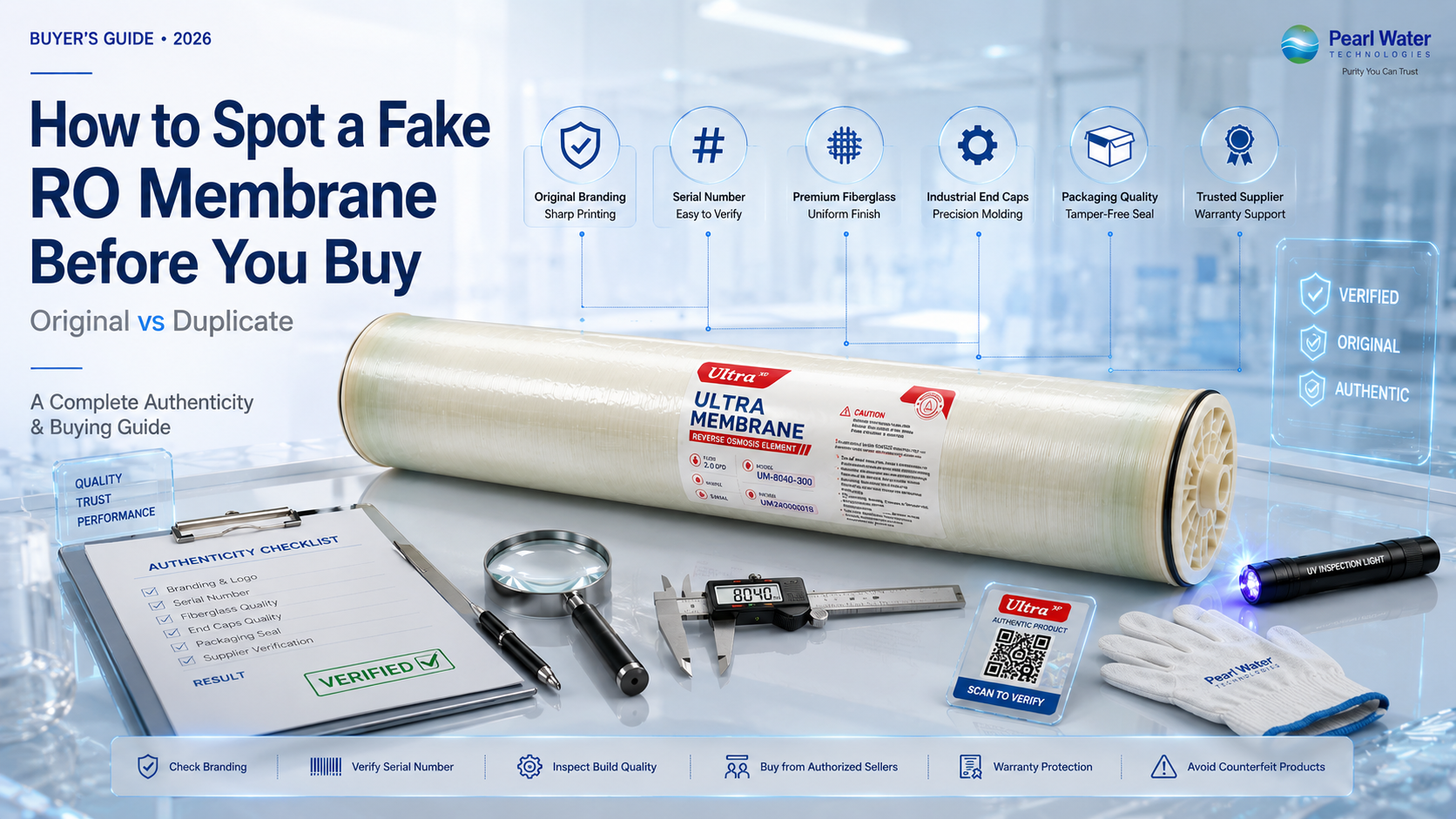
A plant manager running an industrial RO plant in Faridabad once called us three weeks after installing a "genuine" imported membrane he'd bought from a local vendor at a price that seemed too good to pass up. Flow was fine for the first ten days. Then salt rejection dropped from a promised 99% to somewhere around 92%, and it kept sliding. When we finally got the old element back to inspect, the housing markings didn't match the batch code format that brand actually uses, and the epoxy seal at the end cap had been redone by hand — badly. He'd bought a duplicate, repackaged to look like the real thing.
This happens more often than most buyers realize, and it's rarely obvious at the point of sale. Here's what actually separates a genuine RO membrane from a counterfeit one, and how to check before you hand over payment — not after your rejection rate starts falling.
RO membranes sit in a strange spot for counterfeiters: they're expensive enough to be worth faking, technical enough that most buyers can't verify quality by looking at them, and sold through a long chain of resellers and distributors where an original box can get swapped or refilled somewhere along the way. Add in the fact that India's industrial RO market runs heavily on price-based purchasing through marketplaces and local dealers, and you get exactly the conditions counterfeiters look for.
The financial damage isn't limited to the membrane's price tag either. A fake element that fails early takes your whole RO system's output down with it — production delays, emergency procurement, and in food, pharma, or process-water applications, potential quality failures downstream that cost far more than the membrane ever did.
Every legitimate manufacturer uses a consistent, structured format for serial and batch numbers — a specific number of digits, a predictable prefix pattern, or a date-code embedded in a particular position. Counterfeiters often get close but not exact: an extra digit, a missing letter prefix, or a format that doesn't match what you find when you search that manufacturer's official batch-numbering convention. If you're buying from Pearl Water, for instance, every Ultra XP element carries a serial number in the format printed directly on its product page — cross-check it before installation, not after.
This sounds unusual, but it's one of the more reliable checks. Genuine spiral-wound membrane elements have a consistent weight range for their size, because the number of membrane leaves, the fiberglass outer wrap thickness, and the core tube material are all standardized. A counterfeit that's noticeably lighter has likely cut corners on the number of wound leaves inside — which directly reduces both flow capacity and salt rejection, even though the outside looks identical.
Look closely at where the outer wrap meets the end cap. On a genuine element, this seam is factory-sealed — smooth, uniform, machine-applied. A hand-resealed end cap, visible epoxy drips, or a brine seal (the ring near the feed end) that looks like it's been swapped or reused is a strong red flag that the housing has been opened and repacked. This is also a good moment to confirm your membrane housing itself is properly rated and sealed — a mismatched or worn housing can cause symptoms that look like a bad membrane even when the element inside is genuine.
Genuine product labels list exact figures — GPD flow rating, salt rejection percentage, active membrane area, maximum operating pressure — that match the manufacturer's published specification sheet down to the decimal. Vague labels ("high flow," "premium rejection") without hard numbers, or numbers that don't match what the brand publishes on its own website, are a warning sign. Before buying, pull up the actual spec sheet — Ultra XP's 4040 and 8040 pages list flow capacity and rejection percentage explicitly for exactly this reason — and hold the physical label up against it.
Legitimate manufacturers can confirm a serial number against their own records, either through a phone call, email, or in some cases an online lookup tool. If a seller resists connecting you with the manufacturer directly, or claims verification "isn't possible," treat that as a serious red flag rather than a minor inconvenience.
A price that sits dramatically below every other quote you've gathered for the same brand and model is the single most common tell — and also the one buyers ignore most often, because it's the reason they were interested in the first place. Genuine membranes have a real manufacturing cost floor. If a deal looks too good, get the batch code and verify it before you commit, not after.
The most reliable protection isn't a forensic check at all — it's sourcing from the manufacturer directly or from a dealer they've explicitly authorized. This removes most of the opportunities for a swap to happen anywhere in the supply chain.
Beyond the obvious performance drop, a counterfeit membrane typically fails in ways that are expensive to diagnose. Salt rejection declines gradually rather than failing outright, so plant operators often spend weeks chasing pre-treatment or pressure issues — check our guide on signs your RO membrane needs replacement if you're seeing a similar gradual decline — before realizing the membrane itself is the problem. By the time it's replaced, you've usually paid for wasted chemicals, lost production time, and — in some cases — off-spec product downstream, on top of the membrane's original cost. Pairing a genuine membrane with matched pre-treatment spares from the same trusted source reduces the chances of this happening in the first place.
How can I verify if an RO membrane is genuine before installing it? Check the batch/serial number format against the manufacturer's published convention, compare the printed spec sheet figures (GPD, salt rejection %) against the manufacturer's official website, and where possible, contact the manufacturer directly to verify the serial number before installation.
Does a lower price always mean a fake RO membrane? Not always, but a price significantly below every other quote for the same brand and model is the most common warning sign reported by buyers who later discovered a counterfeit. Verify the batch code before assuming a low price is simply a good deal.
Can a counterfeit RO membrane look completely identical to a genuine one on the outside? Yes — outer packaging and casing can be closely replicated. The more reliable checks are the batch/serial number format, element weight, end-cap seal quality, and direct verification with the manufacturer, rather than visual inspection alone.
Where can I buy a verified, genuine RO membrane in India? Buying directly from the manufacturer or an authorized dealer is the most reliable way to avoid counterfeits. Pearl Water Technologies sells its Ultra XP 4040 and 8040 membrane elements directly, with verifiable serial numbers and published specification sheets for every unit.
Pearl Water Technologies has supplied industrial RO plants, membrane elements, and water treatment spares to commercial and municipal clients across India for over a decade. The verification steps in this article reflect checks our own technical team applies when inspecting returned or disputed membrane elements.
Leave A Comment