|
Flow Rate |
50 Litres Per Hour |
|
Operation |
Fully Automatic |
|
Recovery Rate |
50% |
|
Input TDS Handled |
Up to 1,500 ppm (tested to 2,000 ppm) |
|
Typical Daily Output |
300–400 litres (6–8 hrs/day) |
|
Warranty |
1 Year |
|
Installation |
Free, PAN-India |


Introduction
Searching for a 50 LPH RO plant price in India usually means one thing: you've got a small office, clinic, school, or shop that needs clean drinking water on tap, and you don't want to keep refilling cans or hauling bottles. That's exactly the gap this plant fills, and if you're still weighing why an industrial RO plant is required in the first place, that's worth a quick read before you decide on capacity.
LPH just means litres per hour — how much clean water the unit puts out for every hour it runs. A 50 LPH plant, run for a normal working day, gives you somewhere around 300–400 litres, which covers drinking and kitchen needs for roughly 10 to 20 people without much thought after installation.
Pearl Water has been building industrial RO plants since 2010, with manufacturing and service teams in Gurgaon, Bengaluru, and Lucknow. This particular unit is ISO certified and built for the kind of water Indian offices actually deal with — borewell, tanker-fed, or municipal supply that swings in TDS depending on the season.
Product Overview
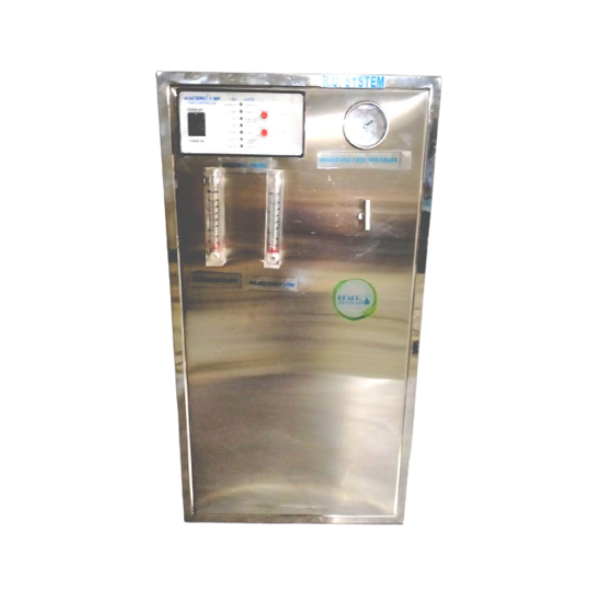
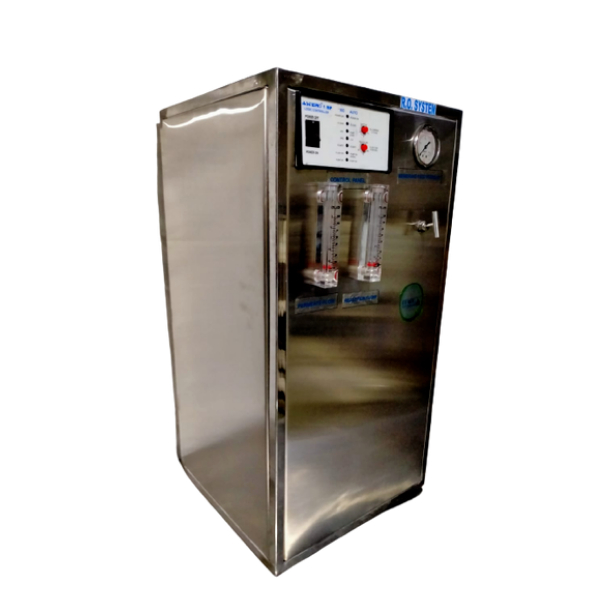
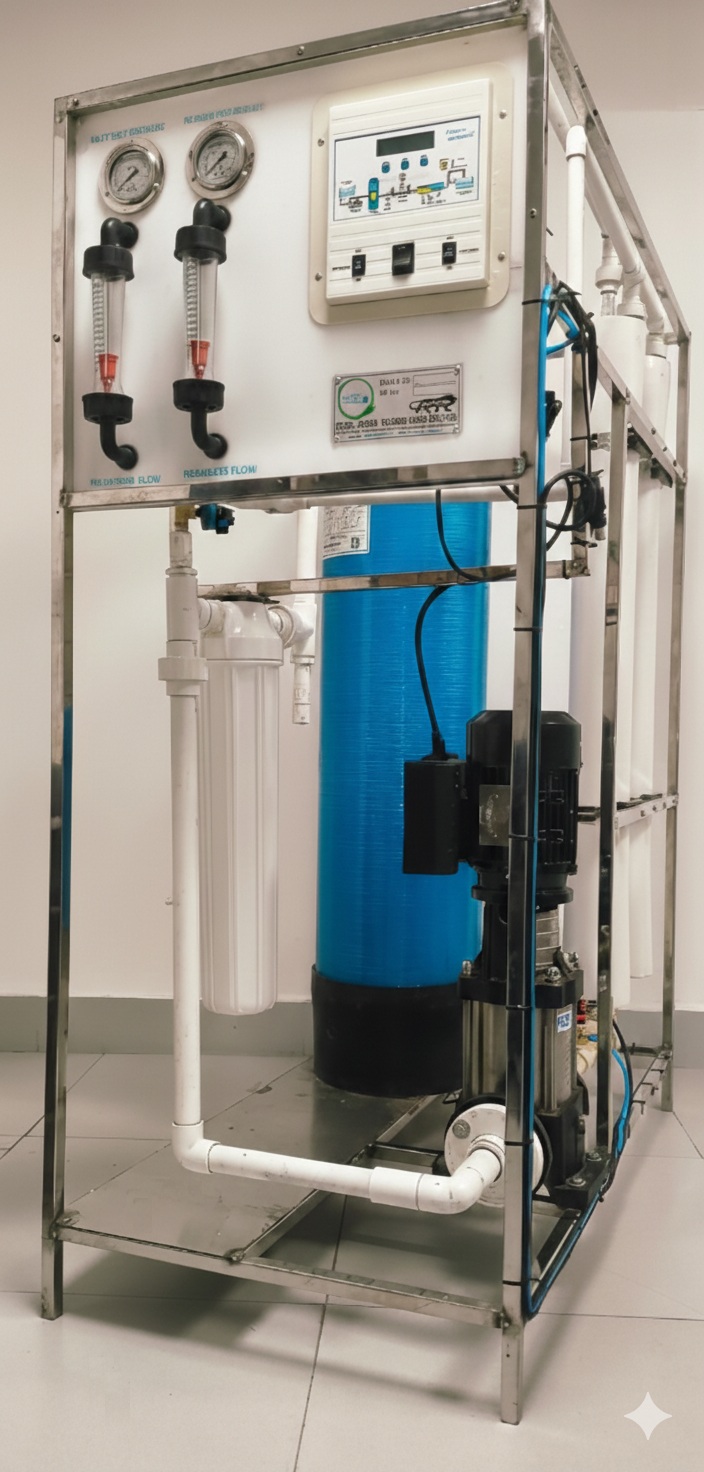
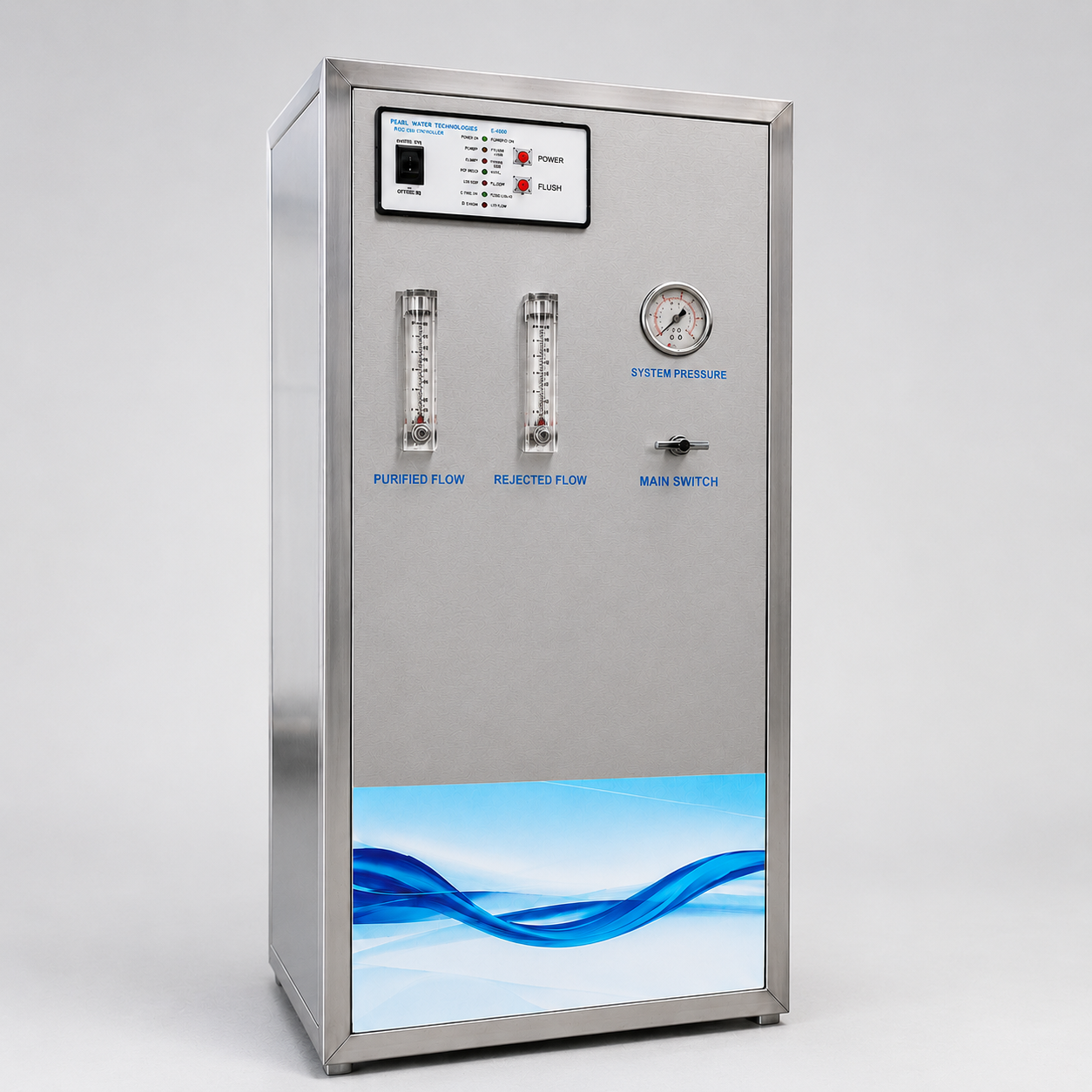
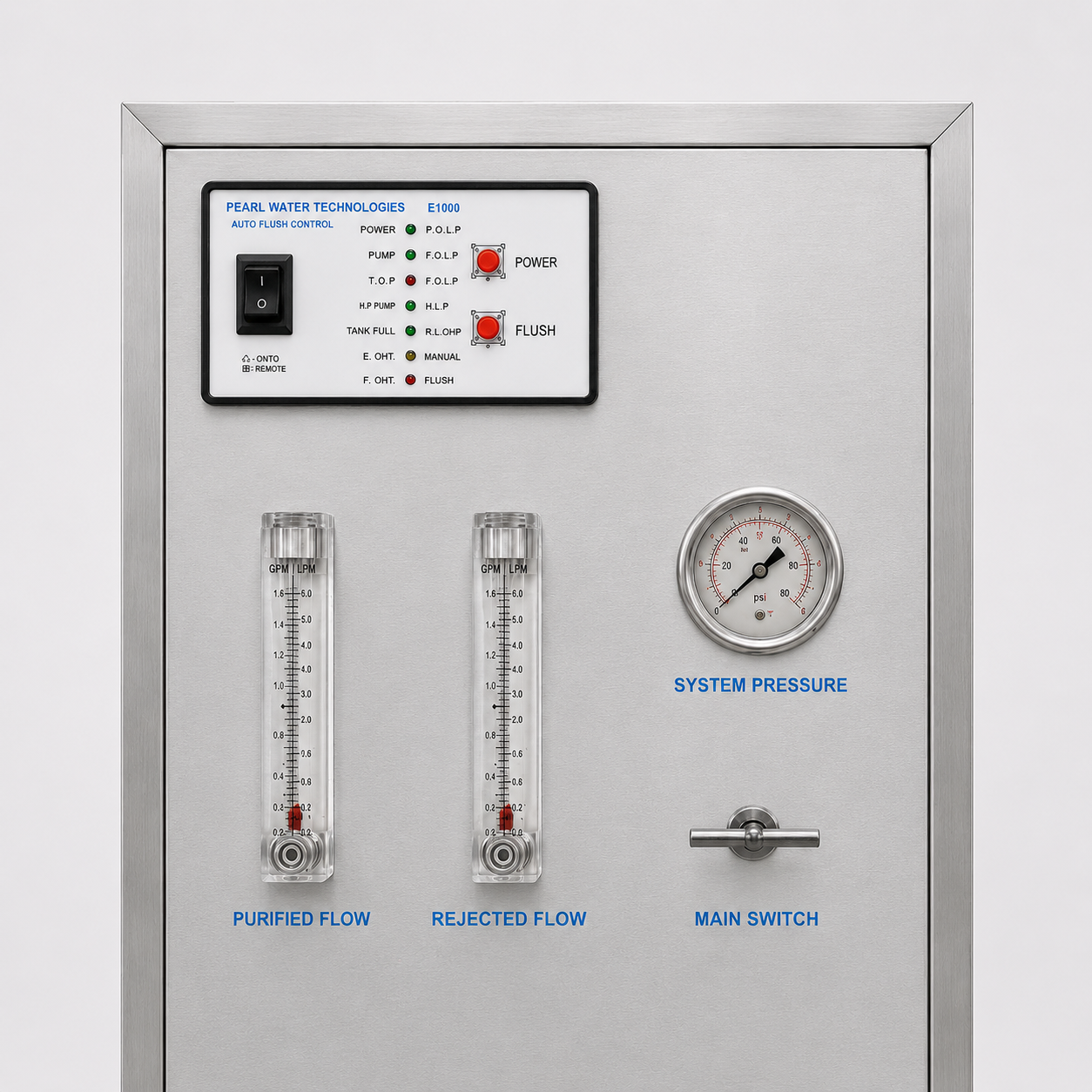
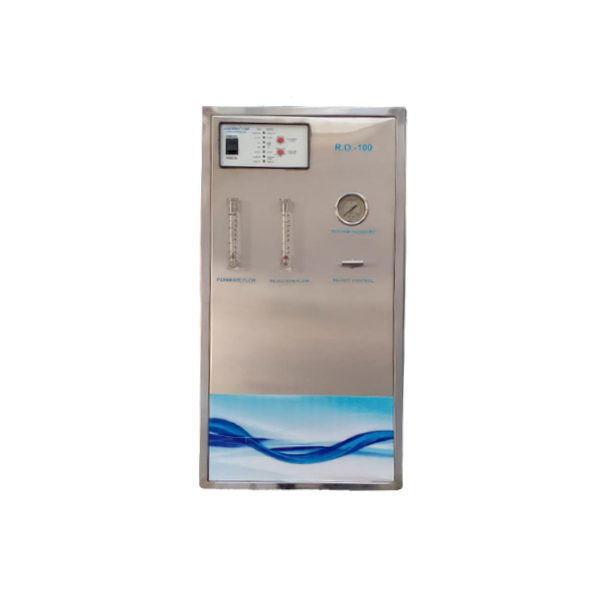
This is a fully automatic, skid-mounted RO system rated at 50 litres per hour. "Fully automatic" isn't just a spec sheet line — it means nobody on your staff needs to open valves, watch pressure gauges, or manage a flushing cycle by hand. You plug it in, connect the water line, and it runs. If you're comparing this against other types of industrial RO plants Pearl Water manufactures, this is our entry point for small-scale commercial use.
At a glance:
Output: 50 litres per hour
Mode: Fully automatic, self-flushing
Recovery rate: 50%
Handles TDS up to: 1,500 ppm (tested against sources up to 2,000 ppm)
Purification: 6 stages, from particulate filtration through to post-carbon polishing
Certification: ISO certified build process
Warranty: 1 year
Installation: Included, free, anywhere in India
Not sure this is the right size? The 100 LPH RO plant is the next step up if your headcount or usage is closer to 20–40 people. And if you'd rather test the waters before committing to a purchase, renting an RO plant is also an option through Pearl Water.
Buying Guide: Is the 50 LPH Plant Right for You?
A few honest questions before you buy:
How many people are actually drinking this water daily? Ten to twenty people, typical office usage — this plant fits. Above 25–30 regular users, look at the 100 LPH model instead; don't undersize and end up running the unit longer than it's rated for.
What's your raw water TDS? Get it tested if you don't already know. Under 1,500 ppm, you're fine here — our guide on the recommended TDS level for RO water explains what different ranges actually mean for drinking water. Above 2,000–3,000 ppm, common in some borewell-heavy regions, talk to us about a higher-capacity or pre-treatment configuration.
Do you actually want fully automatic? It costs a bit more than semi-automatic, but it removes the need for someone to manually operate valves during each cycle. For an office without a dedicated maintenance person, that trade-off is usually worth it.
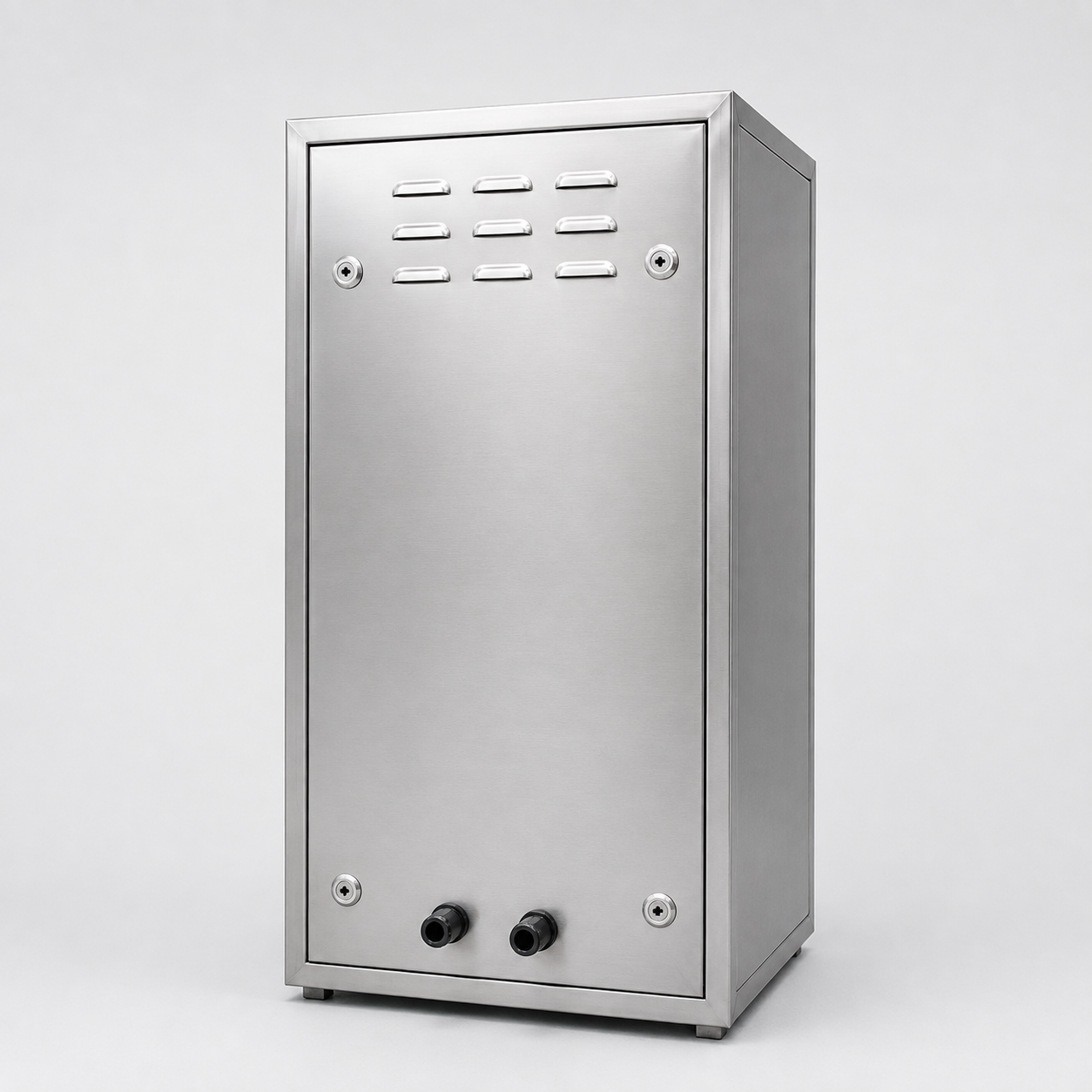
Where's it going physically? This is a compact, indoor-installable unit — a utility room, pantry corner, or under-counter space works. Just confirm you've got a drain point and a power socket nearby before installation day.
What will it cost you after the purchase? The unit price isn't the whole story. Budget for filter changes every 3–6 months and a membrane swap every 12–24 months — see Time to Replace Your RO Membrane for the actual warning signs to watch for. And when you do replace parts, it's worth knowing how to spot a fake or duplicate RO membrane before buying from an unfamiliar seller. Ask about an AMC (Annual Maintenance Contract) at purchase — it's usually cheaper than paying for callouts individually.
Installation & Maintenance
Installation is free and handled on-site by Pearl Water technicians — not shipped to you as a self-install kit. Someone comes out, checks your water source, plumbing, and power points, and commissions the unit properly before handing it over.
What maintenance actually looks like:
Pre-filters (particulate, sediment, carbon) — swap every 3–6 months, depending on how rough your raw water is. Genuine replacement parts are available in our industrial RO spares section.
RO membrane — every 12–24 months
Self-flushing — handled automatically by the system, no manual step needed
Annual check-up — worth doing even if nothing's obviously wrong; our guide on how often an industrial RO plant should be serviced covers the recommended schedule in detail
If you'd rather not track this yourself, ask about an AMC plan at the time of purchase — Pearl Water's service teams in Gurgaon, Bengaluru, and Lucknow (plus authorized partners elsewhere) can handle it on a schedule.
You Might Also Like
|
Flow Rate |
50 Litres Per Hour |
|
Operation |
Fully Automatic |
|
Recovery Rate |
50% |
|
Input TDS Handled |
Up to 1,500 ppm (tested to 2,000 ppm) |
|
Typical Daily Output |
300–400 litres (6–8 hrs/day) |
|
Warranty |
1 Year |
|
Installation |
Free, PAN-India |
| Customer Rating | |
| Price |
₹29,999
|
| Availability |
3 in stock
|
Industries Served
Anyone with a daily water need in the 300–400 litre range fits this plant. We've covered the broader case for this in Importance of Commercial RO Plant, but in practice, it's usually:
Small and mid-sized offices, roughly 10–20 people
Clinics, dental practices, diagnostic labs
Schools and coaching centres
Salons and small spas
Shops, showrooms, and retail counters
Cafes, small restaurants, cloud kitchens
Villas, farmhouses, and smaller residential communities on shared supply
Small workshops and light manufacturing units
Places of worship, community halls
It works on borewell water, sump-fed supply, overhead tanks, and municipal lines — you're not locked into one water source.
Working Principle
Reverse osmosis pushes raw water through a membrane fine enough to block dissolved salts, bacteria, and heavy metals, while letting purified water molecules through. If you want the full mechanics, we've broken it down separately in How Reverse Osmosis Actually Works. For this specific unit, the process runs across six stages:
Particulate filter — catches sand, rust, and larger suspended debris right at intake.
Membrane life enhancer — conditions the water to cut down on scaling, so the membrane itself lasts longer.
Sediment filter — picks up the finer particles the first stage missed.
Pre-carbon filter — strips chlorine and organic compounds that would otherwise damage the membrane.
RO membrane — the main event. This is where dissolved salts, heavy metals, and bacteria get rejected and TDS drops to drinking-safe levels.
Post-carbon filter — a final polish for taste before the water reaches your tap or tank.
Because it's automatic, the system also self-flushes on a schedule, and the multiport valve handles the backwash cycle without manual input — one less thing for your facility team to remember.
Why Choose Pearl Water
Since 2010 — this isn't a first product; it's over a decade of building water treatment systems for Indian conditions specifically.
ISO certified manufacturing — the build process is certified, not just the finished unit badge-stamped.
Three service hubs, not one — Gurgaon, Bengaluru, and Lucknow, so support isn't a single point of failure hours away.
Free installation, already priced in — some competitors quote a lower base price then add installation separately; ours doesn't.
A real warranty, not a marketing line — 1 year, backed by an active service team you can actually reach.
Already running in the field — clinics, schools, and offices are using this exact model today, not a prototype.
Export-ready quality — Pearl Water also supplies internationally, which is a decent proxy for consistency across units, not just the one that ships to you.
If you're comparing manufacturers, it's worth a look at why buyers choose Indian industrial RO equipment generally, not just our pitch for it.
Required fields are marked *
What does LPH mean in an RO plant?
LPH stands for litres per hour — it's how much purified water the plant produces for every hour it runs.
How much water does a 50 LPH RO plant give per day?
Around 300–400 litres a day, assuming it runs 6–8 hours, which is typical for an office setup.
What's the price of a 50 LPH RO plant in India?
Pearl Water's fully automatic 50 LPH plant is ?29,999 excluding tax, or ?35,399 including tax — installation is included, not billed separately.
How many people can a 50 LPH RO plant supply?
Comfortably 10 to 20 people for daily drinking and kitchen use. Beyond that, a 100 LPH unit is a better fit.
What TDS level can this plant treat?
Up to 1,500 ppm as standard, tested effectively up to 2,000 ppm. See our TDS guide for what these numbers mean in practice.
Is it really fully automatic, or does it need manual operation?
Fully automatic — no manual valve handling for normal day-to-day use.
Does the quoted price include installation?
Yes. Installation is free and included across India, not an add-on cost.
How often does the membrane need changing?
Typically every 12 to 24 months, depending on your raw water quality and how many hours a day it runs. If output feels lower than expected right after a replacement, this is worth a read: Why Does My New RO Membrane Produce Less Water Than Rated GPD?
Can it treat borewell water?
Yes — borewell, sump, overhead tank, and municipal supply are all fine, provided TDS is within the plant's rated range.