


31-Jul-2026
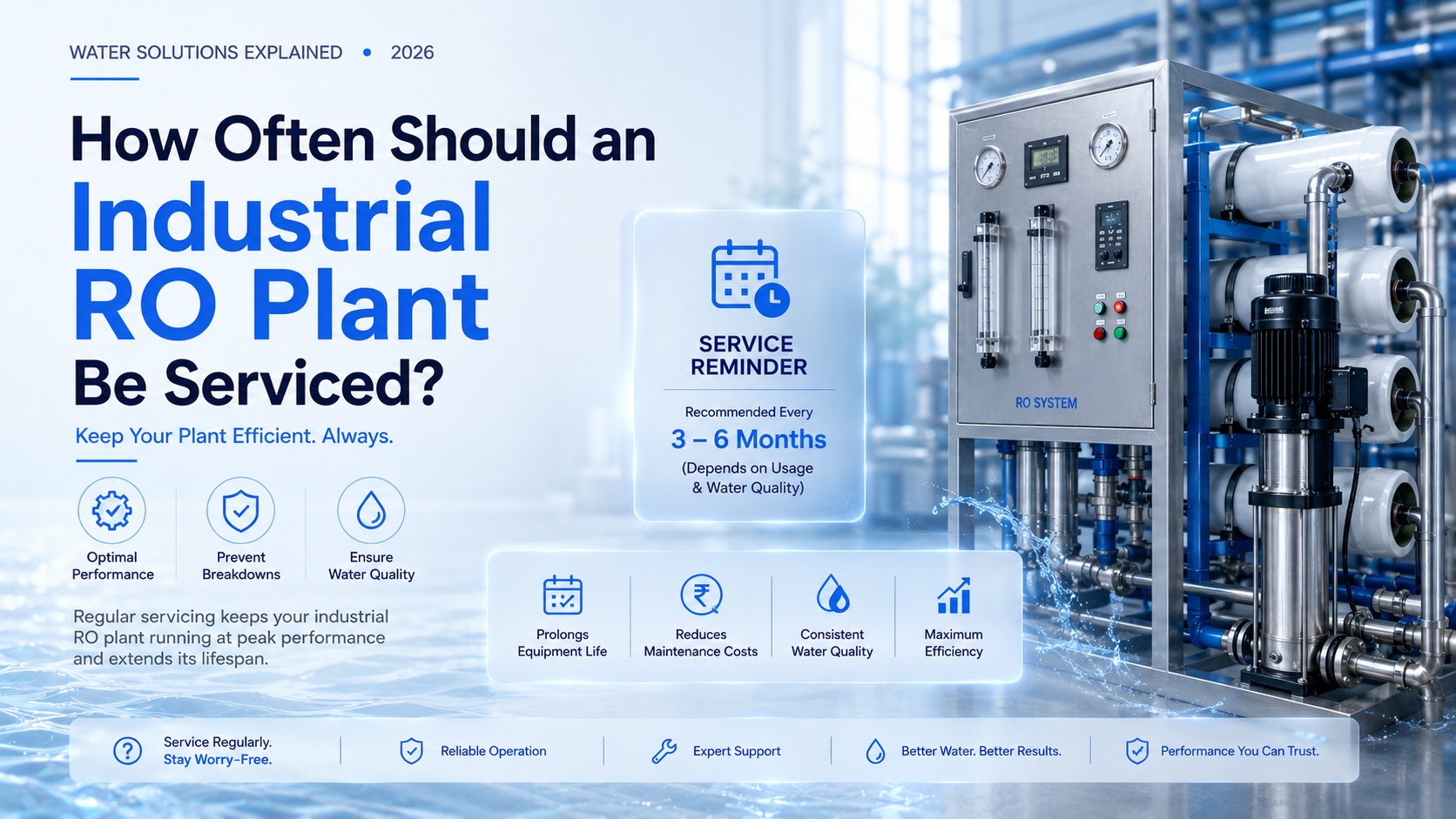
Most industrial RO plants need a full service every 3 months (quarterly), with lighter checks done weekly and cartridge filters/pre-filters replaced monthly. The RO membrane itself typically lasts 2–3 years before replacement, depending on feed water quality. Plants running on hard borewell water or operating 16+ hours a day need more frequent servicing than plants on soft municipal water running standard shifts.
There's no single number that fits every plant — the right frequency depends on your feed water TDS, daily run hours, and plant capacity. Below is the exact breakdown by component, the factors that shift the schedule, and the warning signs that mean you need service right now, not on the next scheduled visit.
An industrial RO plant is a system of several wear-and-tear components working together — cartridge filters, an RO membrane, a multiport valve or automation valve, a dosing pump, pressure gauges, and a high-pressure pump. Each part has its own lifespan, and that lifespan changes based on three things:
This is why an AMC (Annual Maintenance Contract) schedule should be tailored to your specific feed water report and usage pattern, not copy-pasted from a generic manual.
| Frequency | Component | What Gets Done |
|---|---|---|
| Daily | Pressure gauges, rotameter | Visual check of inlet/outlet pressure and flow rate against normal range |
| Weekly | Sand filter / multiport valve | Backwash cycle check; verify valve is rotating and sealing correctly |
| Weekly | TDS meter | Spot-check permeate (output) TDS against baseline |
| Monthly | Sediment / cartridge filter (5–10 micron) | Inspect and replace if pressure drop across the housing exceeds normal range |
| Monthly | Dosing pump & antiscalant | Check chemical tank level, calibrate dosing rate |
| Quarterly (every 3 months) | Full plant service | Complete inspection: pumps, valves, membrane performance test, pressure switches, electrical connections |
| Every 6–12 months | Activated carbon (CTO) filter | Replace — carbon loses adsorption capacity even if it looks physically fine |
| Every 12–18 months | Membrane cleaning (CIP) | Chemical cleaning-in-place if recovery rate or salt rejection has dropped |
| Every 2–3 years | RO membrane | Full replacement, sooner if feed water TDS is consistently high or fouling is frequent |
| Every 3–5 years | High-pressure pump | Bearing/seal inspection and overhaul, even if it hasn't failed |
This schedule assumes a standard single-shift industrial setup on moderately hard water. If your plant runs on very hard borewell water or 24×7 shifts, tighten every interval above by roughly 30–40%.
Don't wait for the next quarterly visit if you notice any of these:
If you're seeing any of the above, treat it as urgent rather than routine — most of these issues get significantly more expensive to fix the longer they're left running.
Two common ways industrial RO plant owners in India handle servicing:
As a rule of thumb: if your plant runs daily production for a business (not occasional/backup use), an AMC almost always costs less over a year than reactive call-based servicing — both in service fees and in avoided downtime.
If you'd rather not carry any maintenance responsibility at all — for a short-term project, a construction site, or while evaluating capacity needs — an industrial RO plant on rent typically bundles servicing into the rental cost, so this becomes a non-issue entirely.
Q: How often should an industrial RO plant be serviced overall? A: A full service is generally recommended every 3 months (quarterly), with lighter checks weekly and cartridge filter replacement monthly. Plants on hard borewell water or running 24×7 need more frequent attention.
Q: How long does an industrial RO membrane actually last? A: Typically 2–3 years under normal conditions. High-TDS feed water, poor pre-treatment, or inadequate antiscalant dosing can shorten this significantly, sometimes to under a year.
Q: What's the first sign that an industrial RO plant needs servicing? A: A noticeable drop in water output or a rise in output TDS are usually the earliest and clearest signs, often appearing before any visible fault or noise.
Q: Is an AMC worth it for a small industrial RO plant? A: For any plant used in daily production (not just backup/occasional use), an AMC usually costs less overall than reactive, pay-per-visit servicing, because it catches problems early instead of after a breakdown.
Q: Does the source of feed water (borewell vs municipal) change the service schedule? A: Yes, significantly. Hard, high-TDS borewell water fouls membranes and clogs cartridge filters much faster than treated municipal water, so plants on borewell feed typically need tighter service intervals.
Pearl Water Technologies is an ISO-certified manufacturer of industrial RO plants, spares, and components, with facilities in Gurgaon, Bangalore, and Lucknow. This guide reflects standard industry maintenance practices for industrial-scale RO systems in India; for a maintenance schedule specific to your plant's capacity and feed water report, get in touch with our service team.
Leave A Comment