


09-Jul-2026
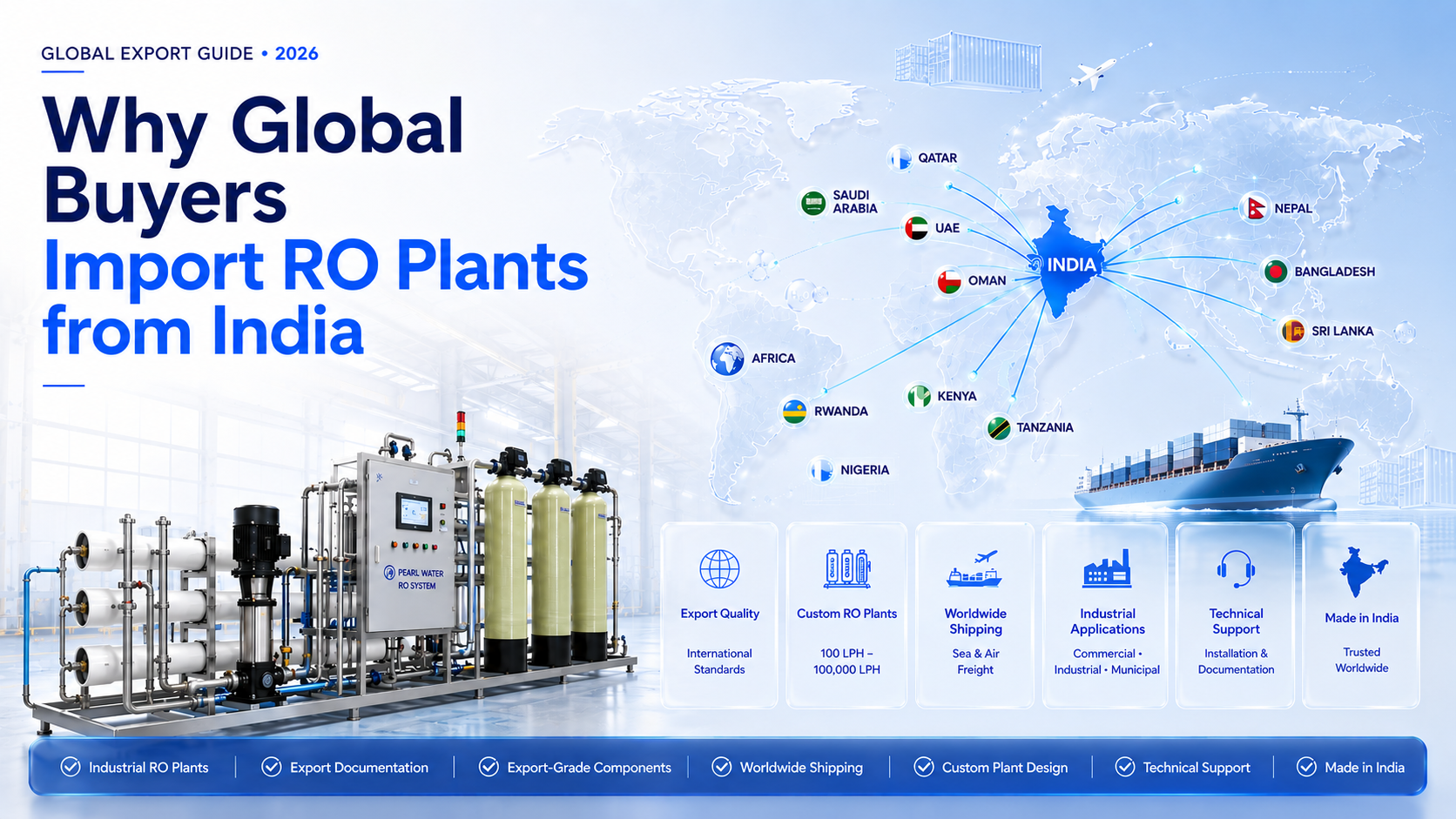
International buyers — including EPC contractors, distributors, and government agencies in Saudi Arabia, the UAE, Nigeria, Kenya, Bangladesh, and 25+ other countries — source Industrial RO Plants and water treatment equipment from India because Indian manufacturers combine engineering-grade design, global-brand components, competitive pricing, and a mature export ecosystem (GST/IEC-compliant, English-speaking, port-ready) that few other manufacturing regions match at the same cost. This guide explains the reasons, the buying process, and what to verify before placing an order.
Clean, reliable industrial water is no longer a convenience — it's a survival requirement for factories, hospitals, hotels, and food plants. As freshwater resources shrink and industrial demand grows, procurement teams worldwide are asking: where can we source dependable, cost-effective, engineering-grade water treatment equipment at scale?
For a growing number of importers, distributors, EPC contractors, and government agencies, the answer is India — specifically manufacturers like Pearl Water Technologies Pvt. Ltd., who combine engineering depth with export-ready manufacturing discipline.
Water stress has moved from a long-term sustainability topic to an immediate operational risk. The Middle East, Africa, South Asia, and parts of Southeast Asia already face limited freshwater access, falling groundwater tables, and unpredictable rainfall. Even where water quantity is sufficient, quality often isn't — high-TDS groundwater, seawater in coastal zones, and inconsistent municipal supply all require dedicated treatment before entering a production line.
A factory that cannot guarantee its water input cannot guarantee its output. Pharmaceutical plants need Water-for-Injection grade purity; food and beverage companies need contaminant-free water for taste and shelf-life; textile units need soft, mineral-free water to protect fabric quality and machinery. A poorly designed or undersized system leads to membrane fouling, high replacement costs, and unplanned downtime — which is why buyers now weigh engineering quality as heavily as price when choosing a supplier.
Add to this the growing push for wastewater recycling (ETPs, STPs, Zero Liquid Discharge) driven by regulation and corporate ESG commitments, and it's clear: industrial water treatment demand will only keep rising as population growth, urbanization, and climate variability continue over the next decade. Buyers making sourcing decisions today aren't just solving a current problem — they're choosing a long-term technology and supply partner.
International buyers typically compare India against China, Europe, and regional fabricators. India consistently wins consideration for several reasons:
Benefit |
What It Means for the Buyer |
Better Price-to-Quality Ratio |
Global components + Indian fabrication at competitive cost |
Long Product Life |
Robust SS304/SS316/FRP construction for industrial duty |
Cost Savings |
Lower fabrication/labor cost = lower landed cost |
Reliable Technical Support |
Pre-sales consultation, post-sales troubleshooting |
Export Documentation Handled |
Manufacturer manages invoices, packing lists, COO |
Faster Delivery |
Streamlined production scheduling |
Strong Export Packaging |
Fumigated crating, corrosion protection for sea transit |
Warranty & Spare Parts |
Long-term availability of membranes, cartridges, wear parts |
Remote Installation Support |
Video-based commissioning for sites without a resident engineer |
Pearl Water Technologies is an India-based manufacturer of industrial and commercial water treatment systems, serving food processing, pharmaceutical, hospitality, healthcare, textile, and infrastructure clients globally. The company works as an engineering-first manufacturer — every system starts from feed water chemistry and end-use requirements, not a fixed catalog.
Product |
Key Application |
Selection Tip |
Industrial RO Plants |
Boiler feed, process water, high-TDS borewell treatment |
Size against actual water analysis, not assumptions |
Commercial RO Systems |
Hotels, restaurants, small hospitals |
Base capacity on peak-hour demand |
Water Softeners |
Boiler protection, textile dyeing, cooling towers |
Size resin volume to water hardness and flow |
UF Systems |
Pre-treatment before RO, turbidity/microbial reduction |
Match pore size to source water turbidity |
Sand & Carbon Filters |
Turbidity, chlorine, odor removal |
Size for contact time and flow rate |
FRP Pressure Vessels |
Housing for filters/softeners |
Confirm pressure rating vs. operating pressure |
RO Membranes & Cartridges |
Core purification / pre-filtration |
Choose brackish vs. seawater membranes by TDS |
DM Plants |
Boiler feed, power plants, electronics |
Choose two-bed/mixed-bed based on purity needs |
A typical export shipment involves: GST registration (tax compliance), IEC (mandatory export code), LUT (tax-free shipping), AD Code, commercial invoice, packing list, certificate of origin, bill of lading/air waybill, transit insurance, and Incoterms (FOB, CIF, EXW) that define who bears cost and risk at each stage. Payment is usually structured as advance + balance against documents, Letter of Credit, or milestone payments for larger projects. Reputable manufacturers also offer pre-shipment inspection and export-grade packaging (ISPM-15 fumigated wooden crates, corrosion protection) to protect equipment during long sea transit.
Food processing, pharmaceuticals, hospitals, hotels, textiles, chemicals, mining, agriculture, automobile manufacturing, power plants, electronics, beverages, commercial buildings, infrastructure, and government projects — each with specific water quality and compliance needs that Pearl Water Technologies engineers systems around.
Before finalizing any order, buyers should confirm: documented QA/QC processes, pre-shipment inspection options, unit-specific performance test data, ISPM-15 packaging compliance, correct export documentation, clear warranty terms, post-delivery technical support, and whether operator training and remote commissioning assistance are included. A manufacturer's ability to support repeat orders and spare parts long-term matters as much as the initial price.
This guide is compiled and reviewed by the engineering and export documentation team at Pearl Water Technologies Pvt. Ltd., based on hands-on manufacturing, export, and project execution experience serving industrial buyers across the Middle East, Africa, and South/Southeast Asia. Figures on export documentation (GST, IEC, LUT, Incoterms) reflect standard Indian export procedure as of 2026; buyers should confirm current requirements with their customs broker, as regulations can change.
If you're an international importer, distributor, EPC contractor, or industrial buyer evaluating suppliers for Industrial RO Plants, Water Softeners, or complete Water Treatment Solutions, Pearl Water Technologies Pvt. Ltd. is ready to discuss your project requirements — from custom quotations and OEM partnerships to export documentation and long-term supply agreements.
Leave A Comment