


01-Aug-2026
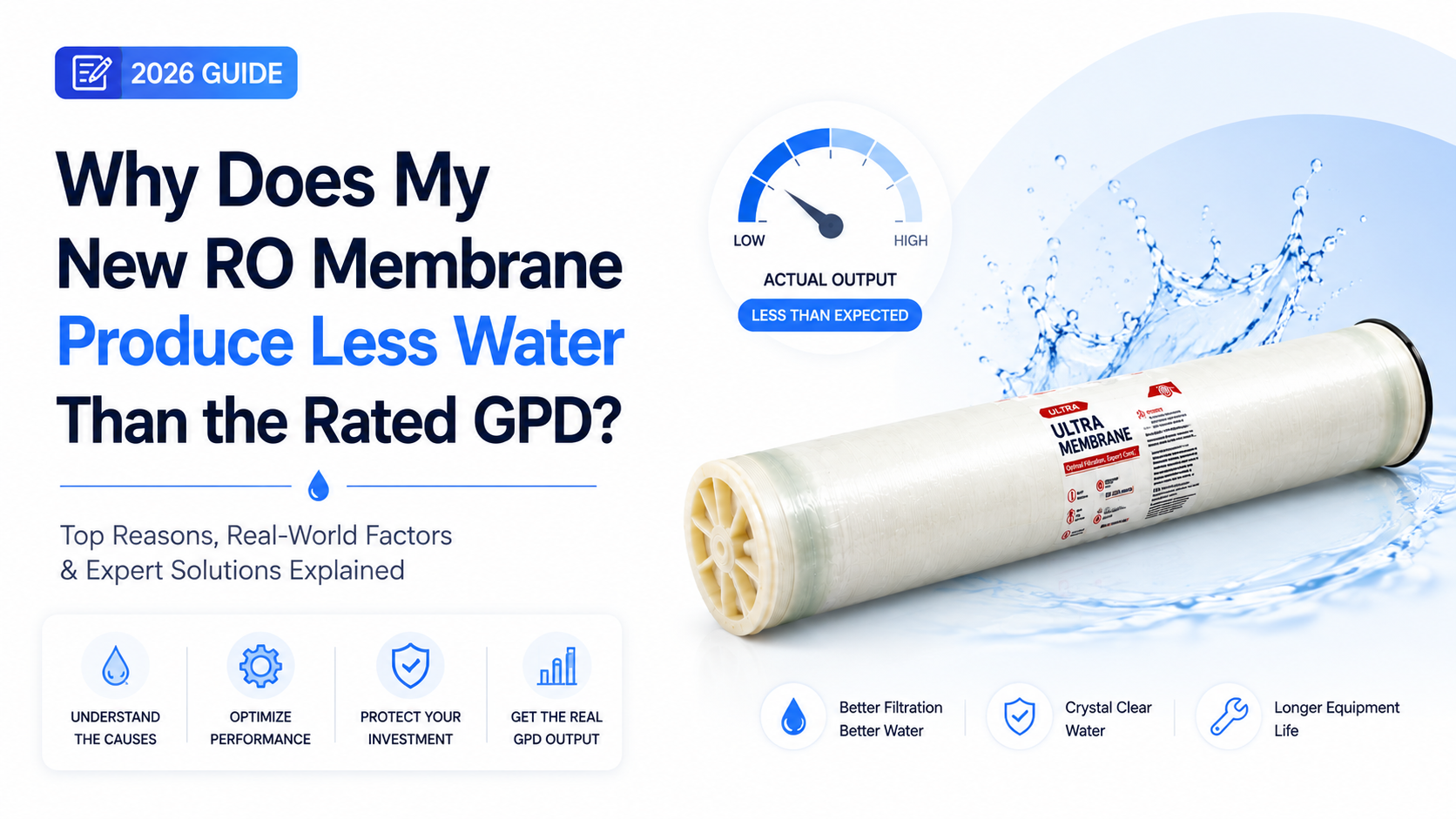
Got a call last month from a facility manager in Bengaluru. He'd just installed a brand-new 8040 element rated for 9,500 GPD, and two days in, the system was putting out closer to 6,800 GPD. He was already drafting a return request — which, honestly, is a pretty reasonable reaction. A new membrane falling that far short of spec on day two looks defective.
Turned out it wasn't. When our technical team walked through his setup with him over the phone, the membrane wasn't the issue at all. His feed pressure gauge was reading about 12% below what the element needed to hit its rated output — nobody had adjusted the pump after swapping his old 4040 out for the bigger 8040. Same housing, very different pressure requirements.
This is probably the most common support call we get on new installations, and nine times out of ten, it's not the membrane. Below is what's usually actually going on, roughly in order of how often we see each one.
If your new membrane isn't hitting its rated GPD, it's almost always one of four things: feed pressure that's a bit low, feed water that's colder than the standard test temperature, pre-treatment that isn't fully protecting the membrane yet, or a system that wasn't rebalanced for this specific element. Actual manufacturing defects are rare — most of the gap comes from the fact that "rated GPD" is measured under lab conditions your real system probably isn't matching on day one.
Every membrane's GPD figure — Ultra XP's 2,500 GPD and 9,500 GPD ratings for the 4040 and 8040 included — comes from a specific test setup: a defined feed pressure, water at 25°C, a set feed TDS, and clean, properly treated water going in. Shift any one of those and the real output shifts too. This isn't some fine-print trick manufacturers hide behind, by the way — it's just how the whole industry measures membranes, which is exactly why these same four checks apply no matter whose element you bought.
This one causes more of these calls than everything else combined. RO membranes are pressure-driven, so flow rises and falls with pressure in a fairly predictable curve. If you recently moved up from a smaller element to a bigger one — 4040 to 8040, say — your pump may not have been resized or even just re-adjusted for the new element's performance curve. It'll physically fit the same housing. That doesn't mean the pressure is right for it.
Check it by comparing your actual gauge reading against the operating pressure on the spec sheet. Even a 10-15% shortfall shows up directly as lower flow.
Water gets more viscous as it cools, and that slows how fast it moves through the membrane's pores. Manufacturers rate GPD at 25°C. Run the same element on feed water at 15-18°C — pretty normal for early morning startups or cooler regions — and you'll see a real drop in output. Nothing wrong with the membrane; the water's just colder than the test standard.
Most spec sheets include a temperature correction factor for exactly this reason. Apply it before comparing your numbers to the rating — you might find you're actually right on spec once temperature's accounted for.
A brand-new membrane can start fouling within days if the pre-treatment ahead of it isn't set up properly — sediment filters installed but not quite right, carbon filtration undersized for your actual chlorine or organic load, or a system that got started before pre-treatment was fully commissioned. From the flow meter's point of view, this looks exactly like a bad membrane. It isn't. It's a system problem wearing a membrane problem's clothes.
Go check your sediment and carbon stage directly. If those cartridges are already discolored or showing higher pressure drop than expected within the first week, that's your answer — the membrane's fouling from stuff that should never have reached it.
Less common, but it happens: the membrane gets dropped into a system that was really designed around a different element's flow characteristics. This matters especially in multi-element arrays, where feed distribution needs to be balanced across all the elements. Add a new one without rebalancing, and it can end up starved relative to what it's actually rated for.
If this was a replacement in a multi-element housing, confirm someone actually rebalanced the array afterward — don't assume the new element just slots into the old flow pattern and behaves the same way.
Start with pressure and temperature. Those two resolve most cases the same day, and you don't even need to touch the membrane. If both come back within spec and output's still meaningfully low, move to pre-treatment next. Only once all three check out clean is it worth pursuing a genuine defect claim with the manufacturer — and at that point, most reputable suppliers, Pearl Water included on both the 4040 and 8040, will have a warranty process built for exactly this.
Worth also double-checking whether the original sizing was even right to begin with — our 4040 vs 8040 sizing guide is a good place to start. A system that was undersized for its actual demand from the outset can look a lot like a flow problem too, even after pressure and temperature check out fine.
Is it normal for a new RO membrane to produce less water than its rated GPD? To some degree, yes. Rated GPD comes from standard lab conditions — 25°C, a set pressure, a set feed TDS — that most real systems aren't matching exactly straight out of the box. A small gap is normal. A large or ongoing one usually points to pressure, temperature, or pre-treatment rather than a bad membrane.
How far below rated GPD is still considered acceptable? There's no hard number everyone agrees on, but output within roughly 10% of rating, once you've corrected for temperature, is generally considered normal variance. Anything well beyond that is worth investigating before assuming the worst.
Can cold feed water really cause a noticeable drop in output? Yes — it's one of the more overlooked causes. Colder water is more viscous and moves through the membrane more slowly. Since manufacturers rate GPD at 25°C, feed water running several degrees below that will show real, measurable underperformance on an otherwise perfectly good membrane, unless you apply a temperature correction.
Should I replace a brand-new membrane right away if it's underperforming? Not immediately. Check feed pressure, water temperature, and pre-treatment first — together they explain most underperformance cases on new installs. If all three are fine and the membrane still isn't hitting spec, that's when it's worth contacting the manufacturer about a warranty replacement.
Pearl Water Technologies has supplied industrial RO plants, membrane elements, and water treatment spares to commercial and municipal clients across India for over a decade. The checks in this article are the same ones our technical support team walks through on real customer calls — this isn't theory, it's what actually gets asked and answered most weeks.
Leave A Comment