Added to wishlist.

What Is a Carbon Filter? How It Works and Why You Need One

30-Jul-2026

What Is a Carbon Filter? How It Works and Why You Need One

If you've ever shopped for a water pitcher, an air purifier, or a range hood, you've probably seen the phrase "activated carbon filter" on the box. But what does that actually mean — and does it matter for your home?

In this guide, we'll break down exactly what a carbon filter is, how it removes contaminants at a molecular level, the different types you'll encounter, and how to know when it's time to replace one. Whether you're researching a water filtration system, shopping for a carbon filter for your RO water purifier, or comparing air purifiers, understanding carbon filtration will help you make a smarter buying decision.


What Is a Carbon Filter?

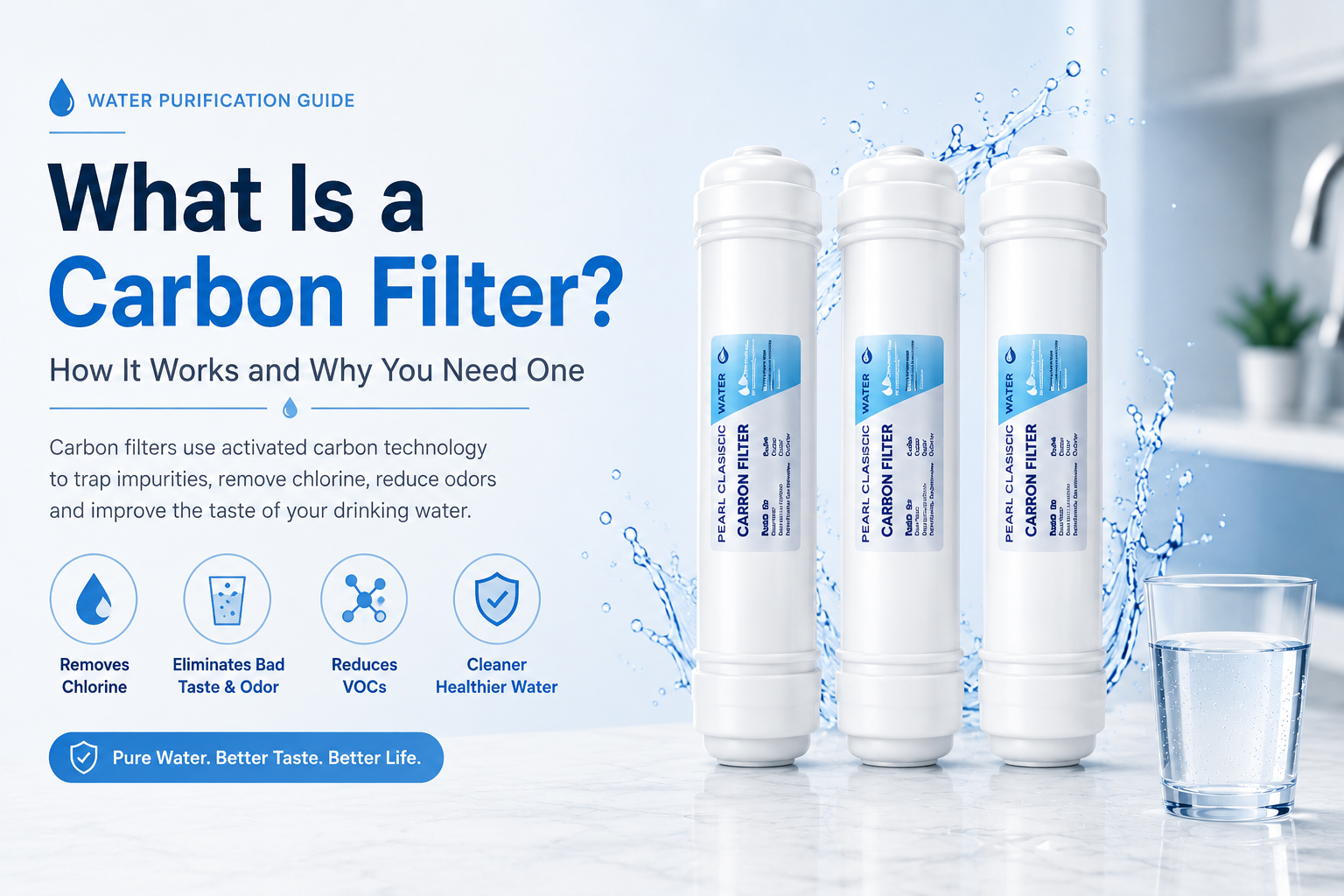
A carbon filter is a filtration device that uses activated carbon (also called activated charcoal) to remove impurities, odors, and certain chemicals from air or water as it passes through. Activated carbon is a form of carbon that has been processed to be extremely porous, giving it an enormous internal surface area — a single gram of activated carbon can have a surface area of 500 to 1,500 square meters, roughly the size of several tennis courts, all packed inside particles you could hold in your hand.

That porous structure is what makes carbon filters so effective. As air or water flows through the filter, contaminant molecules get trapped in the countless microscopic pores rather than passing through with the flow.

Carbon filters are used in a wide range of everyday products, including:

  • Home water filter pitchers, faucet filters, and under-sink systems

  • Whole-house water filtration units

  • Air purifiers and HVAC filters

  • Range hood and kitchen exhaust filters

  • Aquarium filters

  • Gas masks and industrial respirators

  • Refrigerator water and ice dispensers


How Does a Carbon Filter Work?

Carbon filters work primarily through a process called adsorption — not to be confused with absorption. Here's the distinction, and it matters:

  • Absorption is when one substance is taken into another, like a sponge soaking up water.

  • Adsorption is when molecules stick to the surface of a material, similar to how dust clings to tape.


The Adsorption Process, Step by Step

  1. Activation: Raw carbon (often derived from coconut shells, wood, or coal) is "activated" using heat and steam or chemicals. This process burns away impurities and creates millions of tiny pores.

  2. Surface exposure: As water or air passes through the carbon, contaminant molecules — like chlorine, volatile organic compounds (VOCs), pesticides, or odor-causing compounds — come into contact with the carbon's surface.

  3. Chemical bonding: These molecules are attracted to and trapped by the carbon through weak electrostatic forces called van der Waals forces, effectively locking them in place.

  4. Clean output: The filtered air or water continues on, now free of the trapped contaminants.

This is why activated carbon is especially effective at removing chlorine taste and odor, volatile organic compounds (VOCs), certain pesticides, and the compounds responsible for musty or "off" smells — but it is generally not effective at removing dissolved minerals, heavy metals, salts, or microorganisms like bacteria and viruses. For those, you typically need an additional filtration stage such as reverse osmosis or UV treatment.


Types of Carbon Filters

Not all carbon filters are built the same way. The three most common formats are:

1. Granular Activated Carbon (GAC)

GAC filters use loose granules of activated carbon. Water or air flows around these granules, giving reasonably good contact time. GAC is inexpensive and widely used in pitcher filters and basic under-sink systems, but it can allow "channeling," where water finds a path of least resistance through the granules and bypasses some of the carbon. Most RO purifiers use GAC at two separate stages — see our complete guide to pre-carbon and post-carbon GAC filters to understand the difference between the two.

2. Carbon Block Filters

Carbon block filters compress powdered activated carbon into a solid, dense block. This design forces water through the entire block rather than around it, resulting in more thorough contact and generally better contaminant reduction than loose GAC. Carbon block filters are common in higher-end pitcher filters, faucet filters, and whole-house systems.

3. Catalytic Carbon Filters

Catalytic carbon is a specially treated form of activated carbon designed to target chloramine (a chlorine-ammonia compound increasingly used by municipal water suppliers) and hydrogen sulfide odors. It's often used in shower filters and whole-house systems in areas where chloramine disinfection is common.


Why You Need a Carbon Filter

For Water

  • Better taste and smell: Removes chlorine taste and odor, the single most common complaint about tap water.

  • Reduces VOCs and certain pesticides: Helps lower exposure to industrial solvents and agricultural runoff chemicals that can enter municipal or well water.

  • Protects other equipment: Chlorine can degrade rubber seals and reverse osmosis membranes, so a carbon pre-filter often extends the life of downstream filtration components in a multi-stage filtration system.

For Air

  • Neutralizes odors: Cooking smells, pet odors, smoke, and off-gassing from furniture or paint are absorbed rather than just masked.

  • Reduces VOCs: Household products like cleaners, paints, and adhesives release VOCs that carbon filters can help capture.

  • Complements HEPA filtration: HEPA filters excel at trapping particles like dust and allergens but don't address gases or odors — pairing HEPA with carbon gives more complete coverage, which is why many HEPA air purifiers include a carbon pre-filter layer.


Carbon Filters vs. Other Filtration Types

Filter Type

Best At Removing

Not Effective Against

Activated Carbon

Chlorine, VOCs, odors, some

pesticides

Minerals, heavy metals, bacteria,

viruses

Reverse Osmosis

Dissolved solids, heavy metals,

most contaminants

Some gases and VOCs

(needs carbon pre/post-filter)

HEPA (air)

Dust, pollen, pet dander, particulates

Odors, gases, VOCs

UV Filtration

Bacteria, viruses, microorganisms

Chemicals, particulates, odors


This is why many effective systems combine carbon with another technology — for example, an RO water purifier fitted with pre- and post-carbon filters addresses both dissolved contaminants and taste/odor in one unit.


How Long Do Carbon Filters Last?

Carbon filters have a finite capacity — once every pore is occupied by trapped molecules, the filter becomes "exhausted" and stops adsorbing new contaminants effectively. Replacement timelines vary by product, but general guidelines are:

  • Pitcher filters: Every 2–3 months, or after filtering 40–100 gallons

  • Under-sink and faucet filters: Every 6–12 months

  • Whole-house carbon tanks: Every 3–5 years, depending on water usage and quality

  • Air purifier carbon filters: Every 3–6 months, sooner in high-odor or high-pollution environments

Always check the manufacturer's recommended replacement schedule — using a carbon filter well past its capacity means water or air may pass through with little to no additional treatment. Browse our carbon filters for RO water purifiers to find the right replacement for your system, and check our 2026 carbon filter price guide to compare costs before you buy.


Frequently Asked Questions

Does a carbon filter remove bacteria or viruses?

No. Standard activated carbon filters are not certified to remove bacteria, viruses, or other microorganisms. For microbial protection, look for a system that includes UV treatment or a sub-micron/reverse osmosis membrane in addition to carbon.

Is activated carbon the same as charcoal?

They come from a similar base material, but activated carbon undergoes a special processing step (activation) that dramatically increases its porosity and surface area, making it far more effective at adsorption than regular charcoal, such as briquettes used for grilling.

Can a carbon filter remove fluoride?

Standard activated carbon is generally not effective at removing fluoride. Specialized filters using activated alumina or bone char carbon are typically required for fluoride reduction.

How do I know when my carbon filter needs replacing?

Common signs include reduced water flow, the return of chlorine taste or odor, or simply reaching the manufacturer's recommended usage period or gallon capacity — whichever comes first.

Are carbon filters safe and eco-friendly?

Yes. Activated carbon is a natural, non-toxic material, and many carbon filters are made from renewable sources like coconut shells. Proper disposal or recycling (where available) helps minimize environmental impact.


Conclusion

A carbon filter is one of the simplest yet most effective filtration technologies available, relying on the science of adsorption to trap odors, chlorine, and organic chemicals as air or water passes through its porous structure. While it isn't a complete solution on its own — especially for microorganisms or dissolved minerals — it's often the backbone of a well-rounded filtration system.

If you're ready to improve your home's water quality, shop carbon filters for RO water purifiers online, or read our complete carbon filter price guide for 2026 to compare pre-carbon, post-carbon, and GAC options before you buy.

Share:

Leave A Comment

Thank You for subscribing our newsletter.