Added to wishlist.

Which Chlorine Tablets Should I Buy?

17-Aug-2026

Which Chlorine Tablets Should I Buy?

Quick Answer

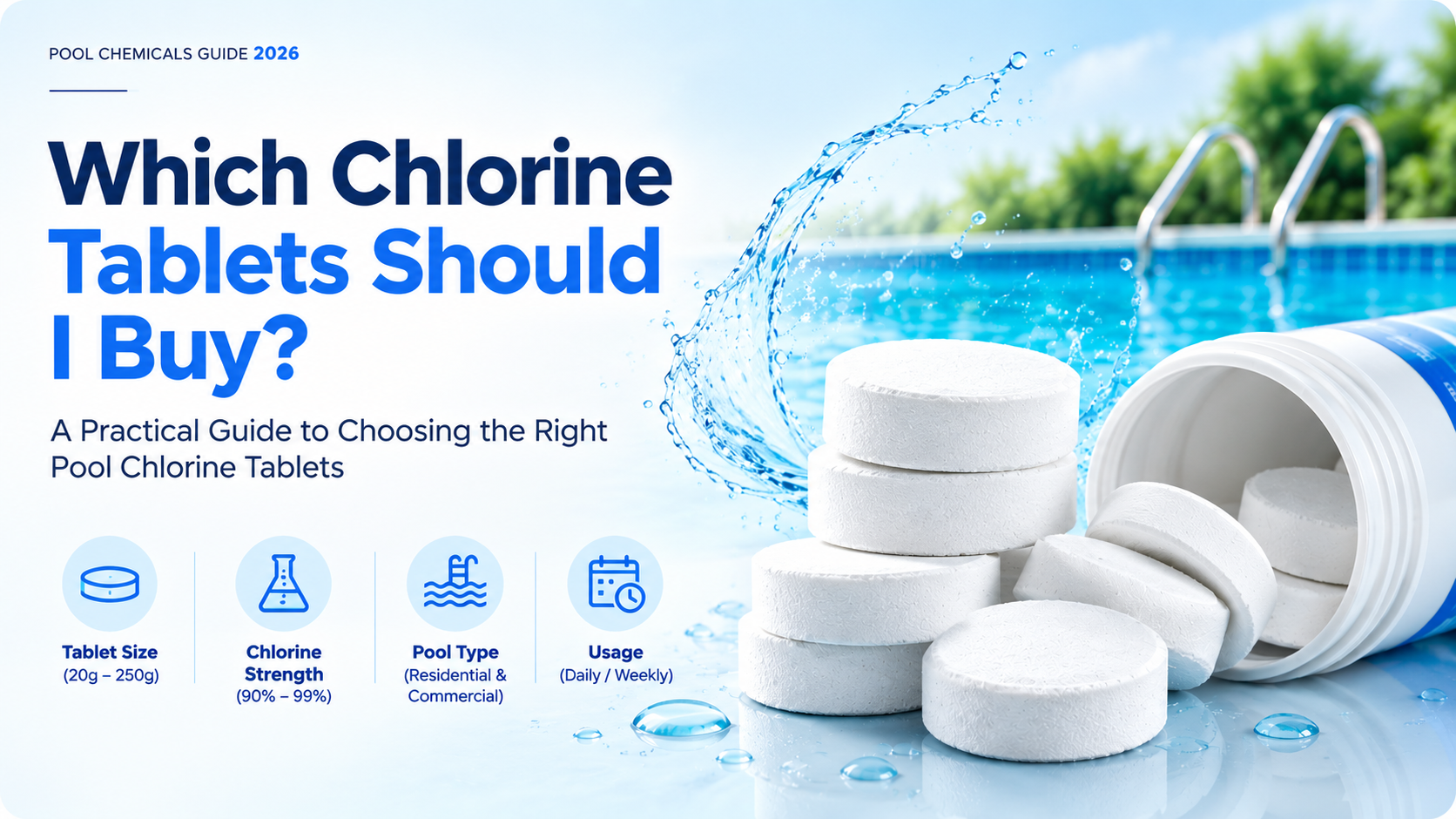
For most residential pools, 90% available-chlorine trichlor (TCCA 90) tablets in the standard 3-inch size are the right choice — they're stabilized against sun breakdown, dissolve steadily over 5–7 days in a floater or chlorinator, and cover the vast majority of pool situations. The exceptions: very small pools and spas need 1-inch tablets, and pools already running high stabilizer levels may need an unstabilized alternative instead. Find your exact situation below.


Find Your Situation

"I have a standard residential in-ground or above-ground pool." → 3-inch TCCA 90 tablets in a floating dispenser or automatic chlorinator. This covers most homes and is the standard, lowest-effort setup. See What Is a TCCA 90 Chlorine Tablet? Complete Guide for the chemistry and dosage guidelines behind this product.

"I have a spa, hot tub, or a very small above-ground pool." → 1-inch tablets (pucks), sized for smaller dispensers and lower water volume. A 3-inch tablet in a small feeder can dissolve unevenly or overshoot chlorine levels in that little water.

"I don't have a floater or chlorinator yet — what do I need?" → Buy tablets AND a floating dispenser or automatic chlorinator together. Tablets should never be added directly to pool water or dropped in the skimmer basket long-term — see the equipment guidance in our complete buying guide.

"My pool is large, or I run it commercially (club, gym, housing society)." → Buy in bulk (10 kg or larger packs) rather than small retail sizes, and prioritize a supplier who states available chlorine percentage consistently batch to batch. Larger volumes justify the cost savings of bulk packaging.

"I already use tablets, but my chlorine won't hold steady even though I keep dosing." → This usually isn't a tablet-buying problem — check cyanuric acid (stabilizer) buildup and water flow first. See the "Ignoring Cyanuric Acid Levels" section of What Is a TCCA 90 Chlorine Tablet? Complete Guide, and if a specific tablet physically isn't dissolving, see Why Won't My Chlorine Tablet Dissolve?

"I need something for a fast correction or an algae problem right now." → Tablets are the wrong tool for this — they're built for slow, steady release, not a rapid dose. Use fast-dissolving chlorine granules instead, then switch back to tablets for routine maintenance once the water's under control.

"I want the cheapest option." → Compare by available chlorine percentage per kg, not price per kg alone — a lower-purity product priced cheaper can cost more per unit of actual sanitizing chlorine. 90% is the standard high-purity benchmark; see What Is a TCCA 90 Chlorine Tablet? Complete Guide for why that number matters.


Quick Comparison

Situation

Tablet Size

Format

Key Consideration

Standard residential pool

3-inch

Floater or chlorinator

Most common, lowest effort

Spa / hot tub / very small pool

1-inch

Small floater or feeder

Match feeder capacity

Large / commercial pool

3-inch, bulk packs

Automatic chlorinator

Prioritize consistent purity, bulk pricing

Fast correction / algae outbreak

N/A — use granules instead

Broadcast dosing

Tablets are too slow for this job


Frequently Asked Questions

Are more expensive chlorine tablets actually better?

Not necessarily — price doesn't always track purity. Check the stated available chlorine percentage first; a well-priced 90% product is a better buy than an expensive product that doesn't clearly state its purity at all.

Can I just buy one size and use it for everything?

Mostly yes if you have a standard residential pool — 3-inch tablets cover routine maintenance for the vast majority of pools. The main exception is a spa or very small water volume, which needs the smaller 1-inch size to avoid overdosing.

Do I need both tablets and granules, or just one?

Most pool owners benefit from having both: tablets for everyday steady dosing, granules on hand for the occasional fast correction or algae shock that tablets aren't built to handle.

How do I know if a tablet product is good quality before buying?

Check for a clearly stated available chlorine percentage (90% is the standard high-purity benchmark), consistent packaging, and willingness from the seller to provide a Safety Data Sheet on request.

Share:

Leave A Comment

Thank You for subscribing our newsletter.