Added to wishlist.

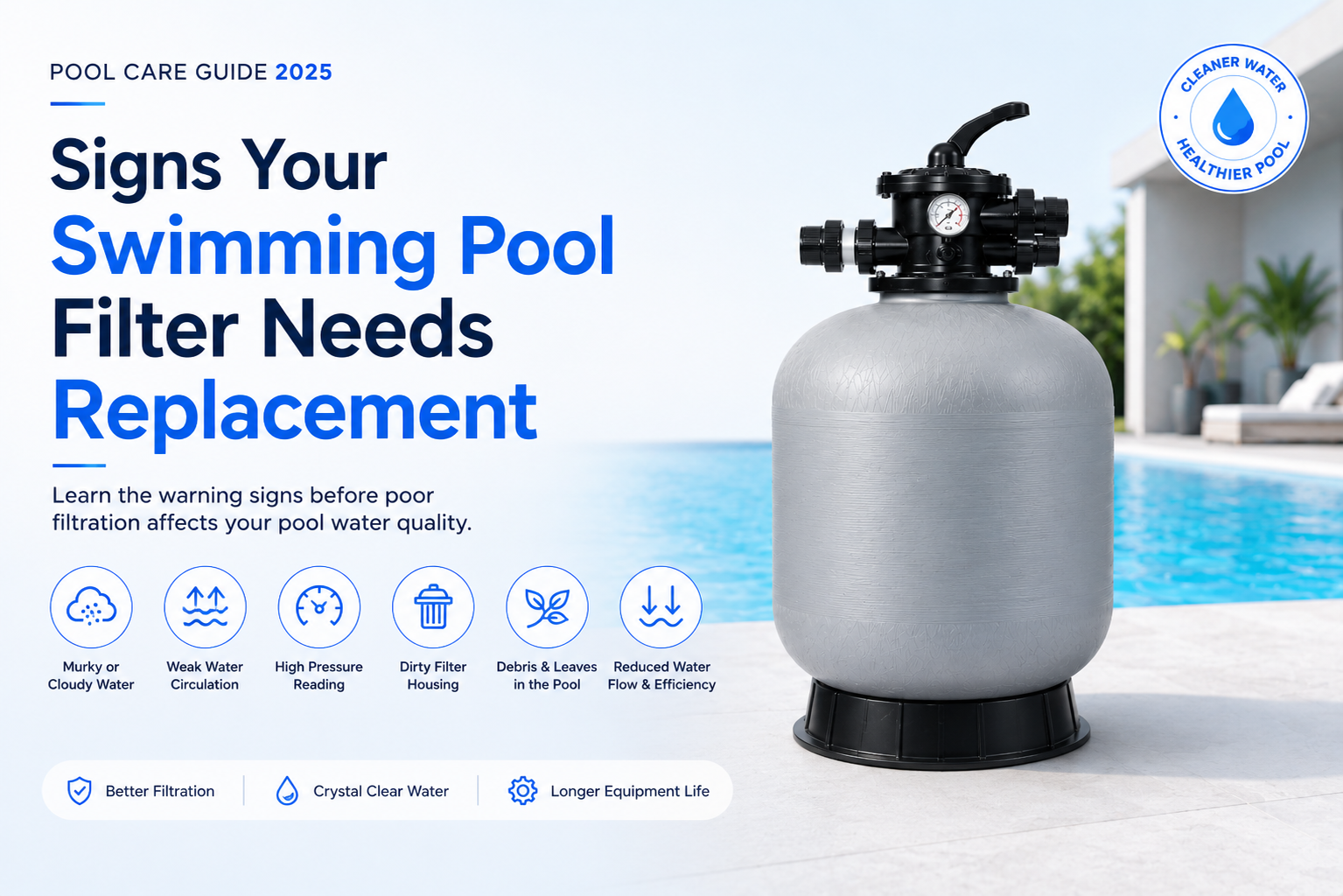
Signs Your Swimming Pool Filter Needs Replacement

27-Jun-2026

Signs Your Swimming Pool Filter Needs Replacement


Signs Your Swimming Pool Filter Needs Replacement

Nothing beats the sight of crystal-clear, shimmering water inviting you to take a refreshing dip. Behind that pristine water clarity lies an unsung hero: your pool filtration system. It works tirelessly day and night to trap organic matter, debris, and microorganisms. However, like any mechanical equipment, a pool filter has a finite lifespan.

Recognizing when your pool filter has reached the end of its functional life is crucial for proper pool maintenance. Operating a degraded or structurally compromised system leads to poor water sanitation, toxic algae blooms, rapid chemical depletion, and expensive damage to your pool pump.

How do I know my pool filter needs replacement?

You know your filter needs replacement when you observe chronic water cloudiness, structural cracks in the filtration tank, sand leaking into the pool, or a pressure gauge that remains stubbornly high even after an extensive backwashing cycle.

In this comprehensive guide, we will break down exactly how these filtration units function, highlight ten critical warning signs that indicate it is time for an upgrade, and help you select the ideal high-efficiency FRP pool filter from Pearl Water Technologies to restore your pool's health.


How Does a Swimming Pool Filter Work?

To understand why a system fails, it helps to understand how it operates. A standard swimming pool filtration system relies on a continuous loop driven by a pool pump. The pump pulls water from the skimmers and main drains, pushing it directly into a heavy-duty pressure vessel containing a specialized filter media, most commonly high-grade silica sand.


[Pool Water] > [Pool Pump] > [Multiport Valve] > [Silica Sand Media] > [Clean Water Back to Pool]


As water forces its way through the dense layers of sand inside the filtration tank, suspended particles, dirt, oils, debris, and micro-algae become trapped in the microscopic crevices of the media. The clean water then travels through internal laterals at the bottom of the tank and returns to the pool. Over time, as the media fills with trapped waste, a multiport valve allows you to run a process called backwashing—reversing the water flow to flush out the collected dirt. However, as the components age, structural fatigue and media calcification will eventually demand a total system replacement.


10 Warning Signs Your Pool Filter Needs Replacement

1. Chronic, Persistent Cloudy Water

If your pool water remains murky, dull, or milky despite running the pump for extended cycles and balancing your pool sanitation chemistry, your pool water filter is failing. This indicates the media or internal components can no longer trap fine suspended particles.

2. Stubbornly High Filter Pressure

Your pressure gauge tells the true story of your system's health. If the pressure reads 8 to 10 PSI above its clean, baseline level, and remains high even after a thorough backwashing cycle, the internal media is heavily calcified or channeled, meaning the water can no longer pass through effectively.

3. Extremely Low Water Circulation

When a swimming pool filter becomes severely clogged or structurally compromised, it chokes the system's flow. If the return jets in your pool feel weak, it means the filtration tank is restricting the turnover rate, forcing your pool pump to work twice as hard.

4. The Need for Frequent Backwashing

Ideally, backwashing is a routine maintenance task performed every few weeks. If you find yourself needing to backwash every few days just to keep the pressure down, your filter media has reached the end of its filtration efficiency.

5. Visible Cracks in the FRP Tank

Fiberglass Reinforced Plastic (FRP) is incredibly resilient, but years of high pressure, water hammers, and intense UV exposure can eventually cause structural stress cracks.

Warning: A cracked pressure tank cannot be safely repaired. Due to the high internal pressure, a compromised tank risks a catastrophic blowout and must be replaced immediately.

6. Filter Sand Accumulating at the Bottom of the Pool

If you notice fine silica sand accumulating on the floor of your pool near the return jets, your internal laterals or standpipe are broken. While you can sometimes replace the laterals, a system that routinely breaks down internally often points to systemic wear inside an aging tank.

7. Rusted, Corroded, or Stripped Fittings

Older systems utilizing metallic parts or substandard plastics eventually succumb to chemical corrosion. Stripped threads on the multiport valve port or cracking around connection flanges create permanent slow leaks that undermine the entire system's hydraulics.

8. Persistent Algae Growth Despite Shocking

Algae removal requires a combination of chemical sanitizers and mechanical filtration. If you consistently shock your pool with chlorine but the dead algae isn't being cleared out by your swimming pool sand filter, the organisms will continuously cycle back into the pool and regenerate.

9. Skyrocketing Chemical Consumption

When a filter stops pulling out microscopic organic material, your pool chemicals are forced to do all the heavy lifting. If you find yourself burning through double the amount of chlorine, stabilizers, and clarifiers just to keep the water clear, your filtration system is failing to assist your sanitation cycle.

10. The Filter Has Surpassed Its Lifespan

Most high-quality residential and commercial pool filtration setups are engineered to last anywhere from 5 to 10 years depending on operational care. If your equipment is well past a decade old, its internal components degrade, plastics become brittle, and upgrading becomes the most cost-effective path forward.


Why Ignoring a Bad Pool Filter Is Costly

Delaying the replacement of a broken or worn-out pool sand filter creates a damaging domino effect across your entire pool facility:

  • Pump Burnout: The restriction of water flow forces your pool pump to run hot, drastically shortening its operational lifespan and leading to expensive motor replacements.

  • Inflated Energy Bills: A clogged filtration cycle requires extended runtime and higher electrical draws to achieve the necessary daily water turnover rate.

  • Health and Safety Hazards: Inadequate filtration allows dangerous pathogenic bacteria, recreational water illnesses (RWIs), and algae to thrive, presenting serious health risks for swimmers.


Repair vs. Replace: Making the Smart Investment

Before spending hundreds on replacement valves, lateral arrays, and fresh silica sand, evaluate the overall condition of your asset.

Scenario

Best Action

Minor leak from an O-ring or a broken pressure gauge

Repair (Cost-effective, quick fix)

Hairline crack in the main FRP tank body

Replace Immediately (Safety hazard under pressure)

System over 8 years old with multiple internal failures

Replace (Saves money on compounding future repairs)


Choosing the Right Pearl Water Pool Filter

When it is time to upgrade, choosing a heavy-duty, highly efficient fiberglass unit ensures years of trouble-free operation. Pearl Water Technologies offers a premium lineup of corrosion-resistant FRP swimming pool filters engineered for everything from residential backyards to large commercial water parks.


Selection Matrix

Pool Type / Size

Recommended Filter Model

Flow Capacity

Price

Small Residential Pool

500mm Pool Filter

8 CBM/Hr

24831

Medium Residential / Small Club

650mm Pool Filter

16 CBM/Hr

30887

Large Residential / Apartments

800mm Pool Filter

25 CBM/Hr

46525

Hotels / Luxury Resorts

950mm Pool Filter

33 CBM/Hr

59714

Large Commercial Pools / Water Parks

1200mm Pool Filter

42 CBM/Hr

77050


Product Breakdown

  • Pool Filter 500mm 8 CBM | FRP Swimming Pool Sand Filter for Clean Water | Pearl Water
    This compact 500mm pool filter is expertly engineered for private residential swimming pools. Handling an 8 CBM flow rate, this 500mm FRP pool filter ensures elite water clarity while minimizing energy usage.

  • Pool Filter 650mm 16 CBM | Heavy Duty FRP Swimming Pool Sand Filter | Pearl Water
    Designed as a robust 650mm swimming pool filter, this unit delivers a 16 CBM flow capacity. It is perfect for larger family pools or boutique health clubs requiring high turnover rates and consistent performance.

  • Pool Filter 800mm 25 CBM | Commercial FRP Swimming Pool Sand Filter | Pearl Water
    A commercial 800mm pool filter built to meet the demanding requirements of housing societies, fitness centers, and educational institutions. Its 25 CBM capacity easily manages heavy swimmer loads.

  • Pool Filter 950mm 33 CBM | Commercial FRP Swimming Pool Sand Filter | Pearl Water
    Featuring a 950mm pool filter layout, this 33 CBM pool filter is highly favored by premium hotels and resorts. This 950mm FRP pool filter offers robust multi-port control to ensure uninterrupted clean water.

  • Pool Filter 1200mm 42 CBM | Heavy Duty Commercial FRP Swimming Pool Filter | Pearl Water
    The ultimate commercial pool filter for large public water parks and olympic facilities. This commercial pool filter 42 CBM unit features a ultra-durable 1200mm pool filter design crafted for absolute durability under continuous high-pressure operations.


Benefits of Pearl Water FRP Pool Filters

Investing in a premium sand filter for swimming pool systems from Pearl Water guarantees elite operational advantages:

  • Structural FRP Construction: Built from composite fiberglass polymers that never rust, corrode, or degrade when exposed to harsh pool chemicals like chlorine or acid.

  • High UV Resistance: Specially coated outer hulls shield the filtration tank from intense sunlight, making it perfect for outdoor plant room installations.

  • Maximum Hydraulic Efficiency: Engineered internal lateral systems distribute water evenly across the entire sand bed, maximizing filtration efficiency and reducing backwash cycles.


Maintenance Tips to Extend Filter Life

To ensure your newly installed filter achieves its maximum possible service life, follow this professional maintenance schedule:

  1. Monitor the Pressure Gauge Weekly: Note the baseline pressure when your filter media is fresh. Clean or backwash when it rises 8-10 PSI above that normal line.

  2. Replace Media Timely: Swap out your internal silica sand every 3 to 5 years before it rounds out and loses its jagged, particle-trapping edges.

  3. Clean the Pump Strainer Basket: Empty the debris basket weekly to prevent large debris from passing through and damaging the multiport valve internal gaskets.

  4. Maintain Water Chemistry Balance: Keeping your pH, total alkalinity, and calcium hardness balanced prevents scale buildup from calcifying the internal filtration bed.


Frequently Asked Questions

How long does a swimming pool filter last?

A high-quality FRP pool filter typically lasts between 5 to 10 years. The exact lifespan depends heavily on regular backwashing, maintaining proper water chemistry, and swapping out the internal sand media every few seasons.

When should pool filter sand be replaced?

Pool filter sand should ideally be replaced every 3 to 5 years. Over time, the jagged edges of the silica sand become smooth and rounded due to friction, which severely diminishes its ability to trap fine suspended particles.

What happens if I don't replace my pool filter?

Failing to replace a damaged filter causes chronic water turbidity, dangerous bacterial accumulation, rapid chemical consumption, and high hydraulic backpressure that will ultimately burn out your pool pump motor.

Can a cracked FRP filter be repaired?

No, a cracked FRP pressure tank cannot be safely patched or repaired. Because these vessels operate under intense internal pressure, any structural crack can cause a dangerous explosion. The tank must be replaced immediately.

Which pool filter is best for commercial pools?

Heavy-duty fiberglass tanks with high flow rates are best for commercial settings. The Pool Filter 1200mm 42 CBM | Heavy Duty Commercial FRP Swimming Pool Filter | Pearl Water is an industry standard for commercial pools due to its high turnover capacity and corrosion resistance.

Is an FRP pool filter better than a steel filter?

Yes, FRP filters are generally superior to traditional steel filters for swimming pools because fiberglass is completely immune to rust and chemical corrosion caused by chlorine, pool salts, and water balancing acids.

What size pool filter do I need?

Your filter size depends on your total pool volume and the required turnover rate (usually turning over all water within 6 to 8 hours). Small residential pools thrive with a 500mm filter, while large public pools require 1200mm units.

How often should I backwash a pool sand filter?

You should backwash your sand filter roughly every 2 to 4 weeks, or whenever your pressure gauge reads 8 to 10 PSI above its normal clean baseline pressure.

Why is my pool water cloudy after filtration?

Cloudy water after filtration usually means your sand media has either channeled (allowing water to bypass the sand), became calcified by hard water, or the filter components have simply worn out past their operational lifespan.

Can an old filter increase electricity costs?

Yes, a clogged or failing filter severely restricts water flow. This forces your pool pump to work against extreme resistance, drawing more electrical current and requiring longer daily operational cycles to clean the water.


Conclusion

Your pool's filtration system is vital to its overall health, safety, and clarity. Recognizing critical warning signs like persistent cloudy water, high operational pressure, or tank cracks can save you thousands in secondary equipment damages.

Upgrading to a premium, high-strength fiberglass model from Pearl Water Technologies ensures clean swimming water, lowered operational costs, and an extended life for your pool pump. Don't compromise on swimmer health and water aesthetics.

Explore the full collection of Pearl Water FRP Swimming Pool Filters today and secure the perfect high-efficiency filtration upgrade for your facility!


Share:

Leave A Comment

Thank You for subscribing our newsletter.