
What Kind of Chlorine Goes in My Pool?
Quick Answer
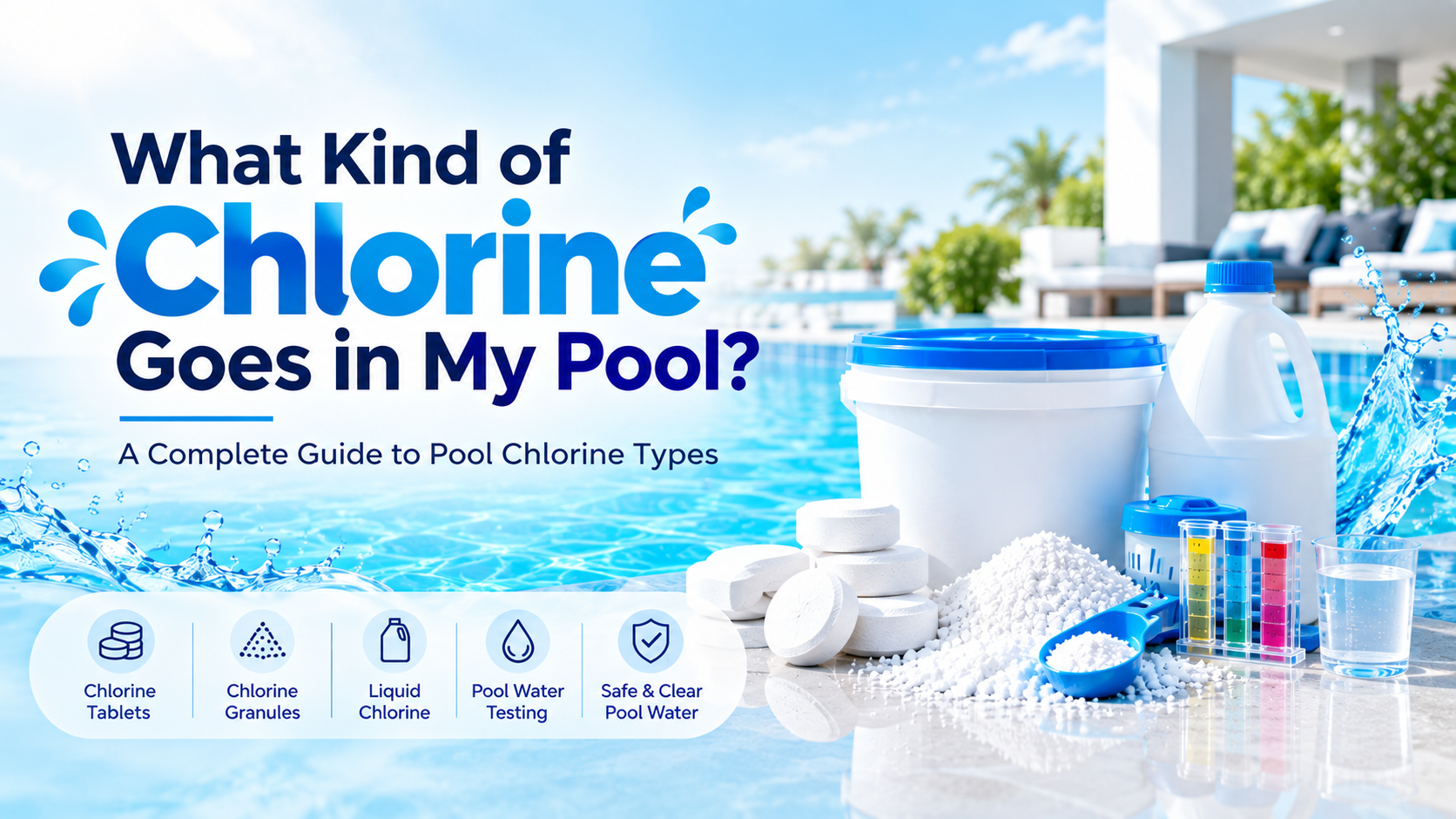
For most residential pools, stabilized trichlor (TCCA 90) — sold as tablets or granules — is the right chlorine: it resists sunlight breakdown, works in a simple floater or chlorinator, and covers the vast majority of pools. The exceptions: new pool fills and spas do better with dichlor (fast-dissolving, near-neutral), heavy shock treatments favor cal-hypo (fast, unstabilized), commercial pools with liquid feed systems often use liquid chlorine (sodium hypochlorite), and pools with a salt chlorine generator are still chlorine pools — the chlorine is just made on-site.
The 5 Types of Chlorine, Compared
Type |
Available Chlorine |
Stabilized? |
Dissolve Speed |
Best For |
|---|---|---|---|---|
Trichlor (TCCA) |
~90% |
Yes |
Slow (5–7 days as tablets) |
Everyday maintenance via floater/chlorinator |
Dichlor |
~56–62% |
Yes (less per dose) |
Fast |
New pool fills, spas, spot-dosing |
Cal-Hypo |
~65–75% |
No |
Fast |
Shock treatments, algae outbreaks |
Liquid (Sodium Hypochlorite) |
~10–12% |
No |
Instant |
Commercial pools with liquid feed systems |
Salt-Generated Chlorine |
Generated on-site |
No (add separately) |
Continuous |
Owners wanting to avoid manual dosing |
Trichlor (TCCA 90): The Everyday Standard
Trichlor — trichloroisocyanuric acid — is chlorine with a built-in UV stabilizer, which is why it holds up in direct sunlight far better than unstabilized alternatives. This is what makes it the default choice for most residential and commercial pools: dose it through a floater or automatic chlorinator and it releases steadily over days rather than needing constant attention. See What Is a TCCA 90 Chlorine Tablet? Complete Guide for the full chemistry, dosage guidelines, and safety handling, and Best Chlorine Tablets for Swimming Pools: Complete Buying Guide for choosing the right size and pack.
The one thing to watch with trichlor: every dose adds a small amount of stabilizer (cyanuric acid), which can build up too high over a season — see the "Ignoring Cyanuric Acid Levels" section of the TCCA 90 guide above for what that means in practice.
Dichlor: Fast and Gentle on New Water
Dichlor dissolves almost instantly and stays close to pH-neutral, which is why it's the standard choice for filling a brand-new pool or dosing a spa — situations where you want quick, precise correction without pre-dissolving or waiting days for a tablet to work. It carries some stabilizer too, but less per dose than trichlor.
Cal-Hypo: The Shock Treatment Chemical
Calcium hypochlorite dissolves fast and carries no stabilizer, which is exactly what you want for a rapid shock dose — algae outbreaks and heavy chlorine demand need a fast, high-concentration hit that a slow-dissolving tablet simply can't deliver. The tradeoff: cal-hypo raises calcium hardness over repeated use and needs cyanuric acid added separately if used outdoors. Never mix cal-hypo directly with trichlor — combining different dry chlorine chemistries can trigger a dangerous reaction; dose one, let it fully dissolve, then add the other if needed.
Liquid Chlorine: The Commercial Default
Sodium hypochlorite acts immediately and carries no stabilizer, making it common in commercial pools running automatic liquid-feed systems that can dose it continuously and precisely. For most residential owners it's less practical: it degrades within hours in direct sunlight, needs far more frequent redosing than tablets, and is corrosive with a short shelf life in storage.
Salt-Generated Chlorine: Still Chlorine, Just Made On-Site
A salt chlorine generator converts dissolved salt into chlorine through electrolysis — the pool is still sanitized by chlorine, it's simply produced automatically rather than added by hand. This trades a higher equipment cost for less manual dosing, but the water still needs the same pH, alkalinity, and stabilizer monitoring as any other chlorine pool.
Which One Should You Actually Buy?
-
Standard residential pool, in-ground or above-ground: Trichlor tablets — see Which Chlorine Tablets Should I Buy? A Quick Decision Guide
-
Filling a new pool or dosing a spa: Dichlor
-
Active algae bloom or heavy shock need: Cal-hypo, or trichlor granules if you're keeping one chemistry on hand — both work; see Pool pH vs Chlorine: Complete Water Chemistry Guide for why correcting pH before shocking matters more than which shock chemical you pick
-
Commercial pool with an automated feed system: Liquid chlorine
-
Want to minimize manual dosing long-term: Salt chlorine generator, understanding it's still a chlorine pool
-
Not sure where to actually buy any of this: See Where Can I Buy Chlorine Tablets? Complete Buying Guide
Frequently Asked Questions
Can I switch between chlorine types partway through the season?
Yes, but never mix different dry chlorine chemistries directly in the same dose or storage container — dose one, let it fully dissolve, then switch. Retest water chemistry after switching, since stabilizer and calcium levels differ between types.
Is one type of chlorine actually "stronger" than the others?
Not exactly — available chlorine percentage varies (cal-hypo is often higher than trichlor by percentage), but "strength" in practice depends more on dissolve speed and stabilization matching your actual need than on the raw percentage alone.
Why does my pool store sell so many different chlorine products if they all sanitize the same way?
Because dissolve speed, stabilization, and application method genuinely differ — a product built for shock treatment and one built for weeks of steady maintenance solve different problems even though both are "chlorine."
Is saltwater chlorine gentler on skin than traditional chlorine?
Many people report this, likely because salt systems tend to hold a steadier, lower chlorine level rather than the peaks and dips of manual dosing — but it's still chlorine sanitizing the water either way.
What kind of chlorine should I use if I have a vinyl-liner pool?
Any type works chemically, but always dose through a floater or chlorinator rather than direct contact — concentrated chlorine sitting against a vinyl liner can bleach or damage the surface regardless of which chemical type it is.
Final Takeaway
So, what kind of chlorine goes in your pool?
The answer depends on your pool's chemistry.
-
Trichlor tablets: convenient slow-release chlorine but increase CYA.
-
Dichlor granules: fast-dissolving stabilized chlorine that also increases CYA.
-
Calcium hypochlorite: useful for raising chlorine without adding CYA, but increases calcium.
-
Liquid chlorine: adds chlorine without adding CYA or calcium.
-
Salt chlorine generator: produces chlorine automatically from salt.
Comments (0)